Home / Fishes / Carp, barbs, minnows, loaches / Nemacheilidae / Ataran Zipper loach
No federal permit to keepAtaran Zipper loach
Acanthocobitis pictilis
Fishes › Carp, barbs, minnows, loaches (Cypriniformes) › Nemacheilidae (Stone loaches)
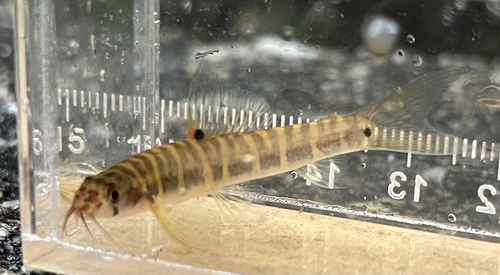
Paracanthocobitis pictilis, also known as the Ataran zipper loach, is a species of ray-finned fish in the genus Paracanthocobitis.
Care at a glance
Species-specific aquarium care
- Water: Freshwater.
- Layout: Lives on or near the bottom: floor space and hiding places matter more than height.
- Availability: Rarely or never seen in the aquarium trade; expect to source it from specialists or not at all.
Calculated from this species' own FishBase record: tank size from its typical adult length and swimming zone, water values from its recorded ranges. The group guide below fills in general care.
Care guide
Species care notes
- Tank: a base of at least 35 × 12 in (roughly 21 US gallons); space needed is rated “large tank”.
- Water: a fairly wide range, from slightly acidic to slightly alkaline, 70–79 °F, pH 6.5–7.5, 1–8 dGH.
- Behaviour: a shoaling fish best kept in a group of six or more; not a community fish.
- Difficulty: Moderate (Seriously Fish rating).
Short excerpts from the species profile:
- Setup: “Should not prove difficult to maintain under the correct conditions meaning we recommend designing the aquarium to resemble a flowing stream or river with a substrate of variably-sized rocks, sand, fine gravel and some large water-worn boulders.”
- Diet: “Probably a micropredator feeding on insect larvae and suchlike in nature.”
- Tankmates: “Apparently not as peaceful as other members of the genus and very bold so best kept with similarly-sized, active, schooling or shoaling cyprinids.”
From the Seriously Fish profile for this species, which has the full habitat, maintenance, diet, behaviour and breeding write-up 167
Stone loaches
Applies to most species in this group. Habitat: Eurasian stone loaches include oxygen-rich stream dwellers such as Schistura and small Vietnamese river species such as the hovering zebra loach. [fg157-sumo, fg157-hover]. Individual species can differ, so compare with the species numbers above and the linked sources.
Housing & setup
- For Schistura balteata groups use a floor at least 90 × 30 cm (36 × 12 in).
- Build a stream layout with sand, rounded rocks and driftwood forming numerous caves and broken sight lines.
- Use strong filtration, aeration and some flow for Schistura; change 30–50% of water weekly.
- For hovering zebra loaches use at least 60 × 30 cm (24 × 12 in), dense plants and well-oxygenated but non-turbulent water.
- Introduce hovering zebra loaches only to a biologically mature aquarium; pH 6.0–7.5 and hardness 2–12 dGH suit both profiled species.
Climate & lighting
| Water | 71.6–78.8°F |
Diet
- Small live or frozen Daphnia and Artemia.
- Bloodworms for Schistura.
- Moina, microworms and Artemia nauplii for hovering zebra loaches.
- Appropriately sized dried foods alongside invertebrates, not as the sole Schistura diet.
Social life
- Schistura defend individual caves and can harass placid bottom dwellers; groups require territories. Hovering zebra loaches are peaceful and need at least 8–10 companions.
Health watch
- Territorial fin injuries in poorly structured Schistura tanks.
- Freshwater ich, a general aquarium risk.
- Stress-associated bacterial infections.
Understanding the animal
About this animal
About this animal
It is native to Myanmar and Thailand. It was described to science in 2012.
Quoted from the Wikipedia article “Paracanthocobitis pictilis” (CC BY-SA 4.0) 174
In the wild
In the wild
From this species’ own FishBase record (habitat, bottom type, water and breeding data), not its family. Good care copies these conditions.1
| Where it lives | Lives in freshwater. Stays near the bottom. |
| Water it lives in | Freshwater. |
| Climate | Tropical climate. |
From the sources
From the sources
Quoted from the matching sections of reputable sources for this exact species. Specialist databases are used first; Wikipedia (community-edited, CC BY-SA 4.0) only fills gaps. Other sources are short credited quotes.
| Overview | Paracanthocobitis pictilis, also known as the Ataran zipper loach, is a species of ray-finned fish in the genus Paracanthocobitis. It is native to Myanmar and Thailand. It was described to science in 2012. This freshwater fish has dark brown triangular saddle-shaped markings along its side, slanted at the front end of the body and almost vertical toward the tail. — Wikipedia (community-edited) |
| Where it lives | Home ranges Population dynamics Growth parameters Max. ages / sizes Length-weight rel. Length-frequencies Mass conversion Recruitment Abundance Life cycle Reproduction Maturity Maturity/Gills rel. — FishBase |
Data and studies
The numbers
The numbers
Each bar is what one source reports. Where several sources weigh in, the dashed gold band marks their average.
Water temperature
Range the species tolerates; aim for the middle.
pH
Water hardness
Adult length
Minimum tank footprint
Seriously Fish recommends a tank base of at least 35 × 12 in (about 21 US gallons).
Sources for this sheet
- Seriously Fish species profiles Experienced keeper or breederLong-running aquarium reference written and peer-checked by experienced fishkeepers and ichthyologists; each profile covers habitat, tank size, water, diet, behaviour and breeding.
- Seriously Fish: Schistura balteata Experienced keeper or breederAdded in the 2026 source-checked care-guide review.
- Seriously Fish: Micronemacheilus cruciatus (formerly Yunnanilus cruciatus) Experienced keeper or breederAdded in the 2026 source-checked care-guide review.
- Merck Veterinary Manual: Disorders and Diseases of Fish Zoo, university or veterinaryAdded in the 2026 source-checked care-guide review.
- FishBase (Froese & Pauly, eds.), version 24.07 Peer-reviewed researchThe global scientific database on fishes, maintained by a consortium of research institutions; every value is referenced.
- Wikipedia (species article) Community referenceFree encyclopedia; useful overviews with their own citations. Intro text is quoted under CC BY-SA 4.0.
More stone loaches

Dwarf Zipper Loach
Paracanthocobitis zonalternans
Aquarium hobby
Grey-banded loach
Nemacheilus selangoricus
Aquarium hobby

Hovering Zebra Loach
Yunnanilus cruciatus
Aquarium hobby

Mesonoemacheilus herrei
Mesonoemacheilus herrei
Aquarium hobby

Mottled loach
Acanthocobitis botia
Aquarium hobby
Nemacheilus anguilla
Nemacheilus anguilla
Aquarium hobby