
Home / Fishes / Catfish / Loricariidae / Antenna Armored Catfish
No federal permit to keepAntenna Armored Catfish
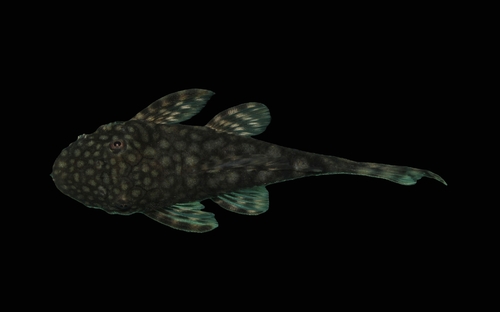
Ancistrus yanesha
Fishes › Catfish (Siluriformes) › Loricariidae (Plecos)
Care at a glance
Species-specific values
Values researched for this exact species. Air, surface and water temperatures are listed separately, and each source is kept as published rather than averaged.
| Minimum enclosure | At least a 25 US gal tank is appropriate for one individual or a pair. Source: aquaristatlas.com | |
| Water temperature | 72–79 °F Source: aquaristatlas.com | |
| Diet | Algae wafers and spirulina foods are staple foods, supplemented with vegetables and occasional small live or frozen invertebrates. Source: aquaristatlas.com | |
| Feeding frequency | Condition adults on a varied diet when breeding. Source: aquaristatlas.com | |
| Social housing | Peaceful with other species; males may not tolerate one another in confined quarters but can coexist in a large tank with plentiful caves. Source: aquaristatlas.com | |
| Substrate | Include caves, rough-surfaced rocks, smooth rocks, and substantial driftwood. Source: aquaristatlas.com |
Species-specific aquarium care
- Tank: At least 24 in long and 12 in front to back for one adult (adults commonly reach about 6.1 in / 15.6 cm).
- Water: Freshwater.
- Layout: Lives on or near the bottom: floor space and hiding places matter more than height.
- Availability: Rarely or never seen in the aquarium trade; expect to source it from specialists or not at all.
Calculated from this species' own FishBase record: tank size from its typical adult length and swimming zone, water values from its recorded ranges. The group guide below fills in general care.
Understanding the animal
In the wild
In the wild
From this species’ own FishBase record (habitat, bottom type, water and breeding data), not its family. Wild conditions are context, not enclosure settings.1
| Where it lives | Lives in freshwater. Stays near the bottom. |
| Climate | Tropical climate. |
Data and studies
Researched care notes
Researched care notes
Findings checked against veterinary, zoo, welfare, keeper and peer-reviewed sources. Air, basking-surface and water temperatures are kept separate, and where sources disagree both are shown. “Study” notes report what a paper measured, not a universal rule.
Bristlenose Pleco
Researched for this genus; applies to its species unless a species note says otherwise.
- The common aquarium bristlenose has uncertain ancestry; do not automatically identify every trade specimen as confirmed Ancistrus cirrhosus.1
- For the common trade bristlenose profile, Seriously Fish gives water temperature 21–26°C, pH 5.5–7.5 and hardness 1–15 dGH.1
- Provide well-oxygenated water and plentiful cover rather than treating the fish as a substitute for aquarium maintenance.1
- Bristlenoses can be territorial toward conspecifics and similarly shaped fish; a peaceful community reputation does not guarantee compatibility between males.1
- Offer dedicated sinking foods with vegetable components and other appropriate variety; the source does not present incidental algae alone as a complete ration.1
The numbers
The numbers
Each bar is what one source reports. Where several sources weigh in, the dashed gold band marks their average.
Adult length
Maximum recorded length. Measured as standard length (snout to the base of the tail, not counting the tail fin). Fish in home aquariums often stay smaller than wild records.
Sources for this sheet
- FishBase (Froese & Pauly, eds.), version 24.07 (CC BY-NC 4.0) Peer-reviewed researchThe global scientific database on fishes, maintained by a consortium of research institutions; every value is referenced.
More plecos
Ancistrus claro
Ancistrus claro
Aquarium hobby

Ancistrus multispinis
Ancistrus multispinis
Aquarium hobby

Aphanotorulus unicolor
Aphanotorulus unicolor
Aquarium hobby

Armbruster's Pleco
Panaque armbrusteri
Aquarium hobby

Baryancistrus chrysolomus
Baryancistrus chrysolomus
Aquarium hobby

Baryancistrus demantoides
Baryancistrus demantoides
Aquarium hobby