
Home / Birds / Ducks, geese and swans / Baer's pochard
Some federal rules applyBaer's pochard
Aythya baeri
Birds › Ducks, geese and swans (Anseriformes) › Anatidae (Ducks, geese and swans)
Baer's pochard (Aythya baeri) is a diving duck found in eastern Asia.
From Wikipedia: Baer's pochard, CC BY-SA 4.0 (excerpt)

Care at a glance
Species-specific values
Values researched for this exact species. Air, surface and water temperatures are listed separately, and each source is kept as published rather than averaged.
| Minimum enclosure | Provide deep water for diving, with shallow sloping banks, islands, marginal vegetation, and loafing areas. Source: sierwatervogels.nl | |
| Diet | Feed floating pellets in water to encourage natural diving behaviour. Source: sierwatervogels.nl | |
| Substrate | Nest in close ground cover or ground-level nest boxes. Source: sierwatervogels.nl | |
| Egg incubation humidity (ground nesters) | 55 % Source: sierwatervogels.nl | |
| Egg incubation humidity (cavity nesters) | 40 % Source: sierwatervogels.nl | |
| Egg incubation temperature | 99 °F (37.4 °C) Source: sierwatervogels.nl | |
| Hatching humidity (eggs) | 65 % Source: sierwatervogels.nl |
Understanding the animal
About this animal
About this animal
It is a resident bird in North and Central China, and formerly bred in southeast Russia and Northeast China, migrating in winter to southern China, Vietnam, Japan, and India. Baer's pochard is a monotypic species.
From Wikipedia: Baer's pochard, CC BY-SA 4.0 (excerpt)
In the wild
In the wild
| Overview | Baer's pochard (Aythya baeri) is a diving duck found in eastern Asia. It is a bird in North and Central China, and formerly bred in southeast Russia and Northeast China, migrating in winter to southern China, Vietnam, Japan, and India. Baer's pochard is a monotypic species. The holotype was collected in middle Amur. — From Wikipedia: Baer's pochard, CC BY-SA 4.0 (excerpt) |
| Where it lives | Baer's pochard traditionally bred in the Amur and Ussuri basins in Northeast China and the southeastern Russian Far East. In recent years, it has also colonised North China and Central China. — From Wikipedia: Baer's pochard, CC BY-SA 4.0 (excerpt) |
| Behavior | Baer's pochard is a shy species, that inhabit open, slow-flowing lakes, swamps and ponds. It breeds around lakes with rich aquatic vegetation, nesting in dense grass, flooded tussock meadows, or flooded shrubby meadows. In winter, it forms large flocks on large and open freshwater lakes and reservoirs with other pochards. — From Wikipedia: Baer's pochard, CC BY-SA 4.0 (excerpt) |
| Reproduction | Baer's pochard appears to have a monogamous mating system, at least within a breeding season. In traditional breeding grounds in northeastern China, Baer's pochard gathers in gaps in the ice before it completely thawed. After the ice season, it gathers on the large, open lakes. — From Wikipedia: Baer's pochard, CC BY-SA 4.0 (excerpt) |
| Appearance and size | The Baer's pochard is 41–47 cm long with a 70–79 cm wingspan. The male is slightly larger, weighing on average 500–730 g, wings lengthed 18.6–20.3 cm, tail at 53–60 mm, and culmen at 38–44 mm. Relatively, the female weighing on average 590–655 g, wings lengthed 19.1–20.5 cm, tail at 51–64 mm, and culmen at 40–44 mm. — From Wikipedia: Baer's pochard, CC BY-SA 4.0 (excerpt) |
| History and naming | Baer's pochard was first scientifically described in 1863 as Anas baeri by Gustav Radde in his book Reisen im Süden von Ost-Sibirien. The epithet and English common name commemorate the Baltic German naturalist Karl Ernst von Baer. It is also called eastern white-eye, Siberian white-eye, Baer's white-eye and green-headed pochard. — From Wikipedia: Baer's pochard, CC BY-SA 4.0 (excerpt) |
Native climate (measured)
Native climate (measured)
| Warm-season highs | about 87°F (up to 91°F in the hottest sampled areas) |
| Cool-season lows | about 31°F (down to -1°F in the coldest sampled areas) |
| Average temperature | 43–74°F across sampled records |
| Relative humidity | 62–76% on average (driest month about 62%) |
| Rainfall | about 1112 mm a year, with strong wet and dry seasons |
| Winters | Cool to cold winters (lows around 31°F) in much of its native range. Seasonal slowdown may be relevant, but species-specific biology determines whether brumation or hibernation occurs. |
Measured at 308 wild occurrence records sampled against WorldClim 2.1 climate data (1970–2000 averages). Air conditions in the range are ecological context, not enclosure settings: microhabitats such as burrows, leaf litter or basking rocks can be cooler, warmer or more humid.
Profile
Profile
Researched for this exact species. Sources are listed under In the wild above.
History
Baer's pochard was first scientifically described in 1863 as Anas baeri by Gustav Radde in his book Reisen im Süden von Ost-Sibirien. The epithet and English common name commemorate the Baltic German naturalist Karl Ernst von Baer. It is also called eastern white-eye, Siberian white-eye, Baer's white-eye and green-headed pochard.
From Wikipedia: Baer's pochard, CC BY-SA 4.0 (excerpt)
Data and studies
The numbers
The numbers
Each bar is what one source reports. Where several sources weigh in, the dashed gold band marks their average.
Typical adult weight
Average adult body mass in each database (FishBase gives the maximum recorded weight).
Incubation
Female maturity
Sources for this sheet
- Myhrvold et al. (2015). An amniote life-history database. Ecology 96: 3109 Peer-reviewed researchPeer-reviewed compilation of life-history data for over 21,000 birds, mammals and reptiles.
- 50 CFR 21.48: Permit exceptions for captive-bred migratory waterfowl Zoo, university or veterinaryCurrent federal rule letting people keep marked, captive-bred waterfowl without a permit.
- 50 CFR 10.13: List of migratory birds Zoo, university or veterinaryCurrent federal regulation listing birds protected by the Migratory Bird Treaty Act.
- GBIF Backbone Taxonomy (Global Biodiversity Information Facility) (CC BY 4.0) Peer-reviewed researchInternational scientific taxonomy used here for classification. GBIF Secretariat (2023). GBIF Backbone Taxonomy. Checklist dataset https://doi.org/10.15468/39omei, accessed via GBIF.org.
- Wikipedia (species article) (CC BY-SA 4.0) Community referenceFree encyclopedia; useful overviews with their own citations. Short excerpts are quoted under CC BY-SA 4.0, each credited with a link to its article.
- The eBird/Clements Checklist of Birds of the World (Cornell Lab of Ornithology) Peer-reviewed researchThe standard global bird checklist maintained by the Cornell Lab of Ornithology; used here for complete species lists of widely kept bird families.
- iNaturalist (captive observations) Community referenceCommunity observation platform run by the California Academy of Sciences and National Geographic; observations marked captive show animals living in homes, zoos and aquariums.
More ducks, geese and swans
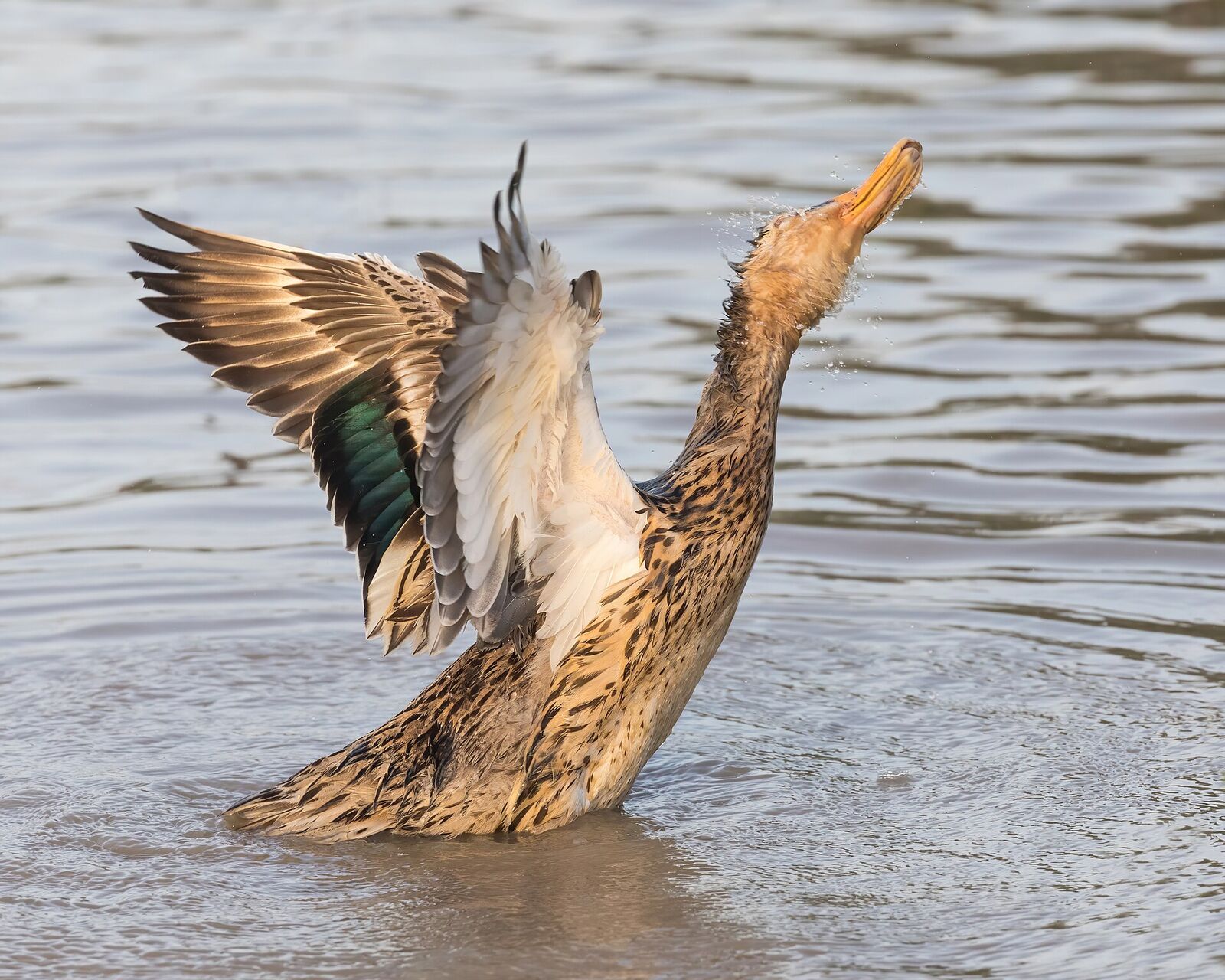
Domestic duck (mallard)
Anas platyrhynchos
Messy, hardy and happiest near water.
Farm & ranch

Bernier's teal
Anas bernieri
Aviary

Black scoter
Melanitta americana
Aviary

Brazilian teal
Amazonetta brasiliensis
Aviary

Comb duck
Sarkidiornis sylvicola
Aviary

Common shelduck
Tadorna tadorna
Farm & ranch