
Home / Fishes / Carp, barbs, minnows, loaches / Cyprinidae / Common barbel
No federal permit to keepCommon barbel
Barbus barbus
Fishes › Carp, barbs, minnows, loaches (Cypriniformes) › Cyprinidae (Carps and barbs)
The common barbel (Barbus barbus) is a species of freshwater fish belonging to the family Cyprinidae.

Care at a glance
Species-specific values
Values researched for this exact species. Air, surface and water temperatures are listed separately, and each source is kept as published rather than averaged.
| Minimum enclosure | Only very large cold-water tanks or purpose-built pond systems can provide suitable conditions. Source: aquaristatlas.com | |
| Water temperature | 50–68 °F Source: aquaristatlas.com | |
| Diet | The species is a benthic feeder, eating crustaceans, insect larvae, mollusks, worms, and carrion. Source: aquaristatlas.com | |
| Social housing | Young barbel may be kept in large river-species or coldwater set-ups alongside other native rheophiles. Source: aquaristatlas.com | |
| Substrate | Use clean gravel or coarse sand to allow natural rooting behaviour. Source: aquaristatlas.com |
Species-specific aquarium care
- Tank: At least 60 in long and 24 in front to back for one adult (adults commonly reach about 11.8 in / 30 cm; the largest recorded was 47.2 in).
- Water: Freshwater.
- Temperature: 50–75°F (range recorded for this species).
- Layout: Uses both the bottom and open water: give open swimming space plus cover near the substrate.
- Diet: Eats a varied diet: mix quality prepared foods with frozen and live foods. FishBase classes it as a carnivore.
Calculated from this species' own FishBase record: tank size from its typical adult length and swimming zone, water values from its recorded ranges. The group guide below fills in general care.
Understanding the animal
About this animal
About this animal
It shares the common name 'barbel' with its many relatives in the genus Barbus, of which it is the type species. In Great Britain it is usually referred to simply as the barbel; similar names are used elsewhere in Europe, such as barbeau in France and flodbarb in Sweden.
From Wikipedia: Common barbel, CC BY-SA 4.0 (excerpt)
In the wild
In the wild
From this species’ own FishBase record (habitat, bottom type, water and breeding data), not its family. Wild conditions are context, not enclosure settings.1
| Where it lives | Lives in freshwater, in rivers and streams. Uses both the bottom and open water. |
| Climate | Temperate climate. |
| Behavior to plan for | Breeding: open water/substratum egg scatterers. |
Data and studies
The numbers
The numbers
Each bar is what one source reports. Where several sources weigh in, the dashed gold band marks their average.
Maximum recorded lifespan
Longest recorded lifespan reported by each database; typical lifespans are usually shorter.
Typical adult weight
Average adult body mass in each database (FishBase gives the maximum recorded weight).
Adult length
Common length to maximum recorded length. Measured as total length. Fish in home aquariums often stay smaller than wild records.
Veterinary & husbandry research
Veterinary & husbandry research
- Allometric and ontogenetic larval development of common barbel during rearing under optimal conditions Nowosad J et al., Animal: an international journal of animal bioscience 2021
- Understanding Nutrition and Metabolism of Threatened, Data-Poor Rheophilic Fishes in Context of Riverine Stocking Success- Barbel as a Model for Major European Drainages? Roy K et al., Biology 2021
- Optimization of barbel (Barbus Barbus L.) fertilization and effects of ovarian fluid when there are controlled conditions for gamete activations Nowosad J et al., Animal reproduction science 2021
Peer-reviewed papers that mention this species alongside captivity, zoos, veterinary care or aquaculture. Some cover several species or mention it only in passing, so check the abstract. See all 6 on PubMed → PubMed
Sources for this sheet
- FishBase (Froese & Pauly, eds.), version 24.07 (CC BY-NC 4.0) Peer-reviewed researchThe global scientific database on fishes, maintained by a consortium of research institutions; every value is referenced.
- Wikipedia (species article) (CC BY-SA 4.0) Community referenceFree encyclopedia; useful overviews with their own citations. Short excerpts are quoted under CC BY-SA 4.0, each credited with a link to its article.
- PubMed (U.S. National Library of Medicine) Peer-reviewed researchIndex of peer-reviewed veterinary, zoo and husbandry research.
- iNaturalist (captive observations) Community referenceCommunity observation platform run by the California Academy of Sciences and National Geographic; observations marked captive show animals living in homes, zoos and aquariums.
More carps and barbs
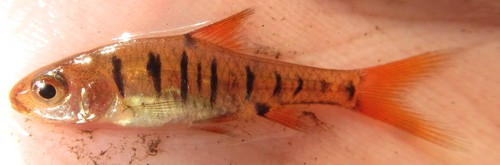
Acrossocheilus parallens
Acrossocheilus parallens
Aquarium hobby
African banded barb
Enteromius fasciolatus
Aquarium hobby
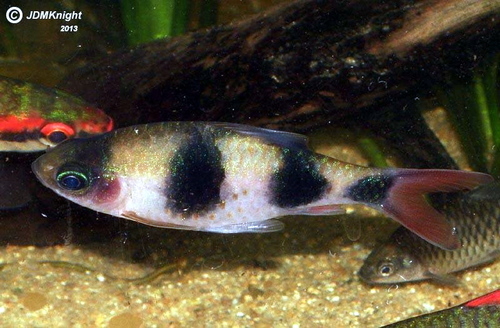
Arulius barb
Dawkinsia arulius
Aquarium hobby

Bala shark
Balantiocheilos melanopterus
Aquarium hobby

Beardless barb
Cyclocheilichthys apogon
Aquarium hobby

Bigspot barb
Barbodes dunckeri
Aquarium hobby