Home / Fishes / Carp, barbs, minnows, loaches / Botiidae / Bengal loach
No federal permit to keepBengal loach
Botia dario
Fishes › Carp, barbs, minnows, loaches (Cypriniformes) › Botiidae (Clown, yoyo and other loaches)
Botia dario (Bengal loach or queen loach) is a species of fish in the loach family Botiidae found in the Brahmaputra and Ganges basins in Bangladesh, Bhutan and northern India.

Care at a glance
Species-specific aquarium care
- Tank: At least 24 in long and 12 in front to back for one adult (adults commonly reach about 5.9 in / 15.1 cm).
- Water: Freshwater.
- Temperature: 73–79°F (range recorded for this species).
- pH: 6.5–7.5.
- Hardness: 0–10 dGH.
- Layout: Lives on or near the bottom: floor space and hiding places matter more than height.
Calculated from this species' own FishBase record: tank size from its typical adult length and swimming zone, water values from its recorded ranges. The group guide below fills in general care.
Care guide
Species care notes
- Tank: a base of at least 47 × 18 in (roughly 64 US gallons); space needed is rated “large tank”.
- Water: a fairly wide range, from slightly acidic to slightly alkaline, 73–79 °F, pH 6–7.5, 1–10 dGH.
- Behaviour: a shoaling fish best kept in a group of six or more; suited to a community tank.
- Difficulty: Moderate (Seriously Fish rating).
Short excerpts from the species profile:
- Setup: “All botiids need a well-structured set-up although the actual choice of décor is more-or-less down to personal taste.”
- Tankmates: “Not especially aggressive but don't keep it with much smaller fishes as they may be intimidated by its size and sometimes very active behaviour.”
- Breeding: “Not known to have been bred in the hobby as with the majority of botiid loaches though some, including B.”
From the Seriously Fish profile for this species, which has the full habitat, maintenance, diet, behaviour and breeding write-up 167
Clown, yoyo and other loaches
Applies to most species in this group. Habitat: Botiids inhabit Asian freshwater rivers and tributaries, including forested headwaters and seasonally flooded river margins. Individual species can differ, so compare with the species numbers above and the linked sources.
Housing & setup
- Provide at least an 80 × 30 cm (31 × 12 in) base for dwarf chain loaches; clown loaches require at least 180 × 60 cm (71 × 24 in).
- Use sand or fine gravel, smooth rocks, roots and numerous shelters; fill trapping holes and remove sharp edges.
- Fit a tight lid.
- Use a mature biological filter and maintain well-oxygenated water with some flow.
- Perform routine weekly water changes of 30–50% for the dwarf chain loach setup.
Climate & lighting
| Water | 75.2–86°F |
Diet
- Quality sinking dried foods
- Live or frozen bloodworms
- Daphnia or Artemia
- Blanched spinach or courgette
Social life
- For clown and dwarf chain loaches, keep at least 5–6 conspecifics, preferably 10 or more; pairs and trios can suffer severe dominance stress. Avoid slow, long-finned tankmates.
Handling
- Take care with the erectable subocular spines when moving loaches; they can become entangled in nets.
Health watch
- Stress and failure to feed in undersized social groups
- Entrapment injuries in narrow décor
- Water-quality illness from accumulated organic waste
Understanding the animal
About this animal
About this animal
The species is overall widespread. In Bangladesh, B. dario is threatened by pesticide used in the cultivation of rice.
Quoted from the Wikipedia article “Botia dario” (CC BY-SA 4.0) 174
In the wild
In the wild
From this species’ own FishBase record (habitat, bottom type, water and breeding data), not its family. Good care copies these conditions.1
| Where it lives | Lives in freshwater, in rivers and streams. Stays near the bottom. Occurs in clear mountain streams. |
| Water it lives in | Freshwater, 73–79 °F (23–26 °C), pH 6.5–7.5, hardness 10 dH. |
| Climate | Tropical climate. |
What this means for care
- Keep water within its wild range, 73–79 °F.
Native climate (measured)
Native climate (measured)
| Warm-season highs | about 90°F (up to 102°F in the hottest sampled areas) |
| Cool-season lows | about 51°F (down to 44°F in the coldest sampled areas) |
| Average temperature | 69–78°F across sampled records |
| Relative humidity | 71–78% on average (driest month about 63%) |
| Rainfall | about 2188 mm a year, with strong wet and dry seasons |
Measured at 36 wild occurrence records sampled against WorldClim 2.1 climate data (1970–2000 averages). Air conditions in the range are ecological context, not enclosure settings: microhabitats such as burrows, leaf litter or basking rocks can be cooler, warmer or more humid.
From the sources
From the sources
Quoted from the matching sections of reputable sources for this exact species. Specialist databases are used first; Wikipedia (community-edited, CC BY-SA 4.0) only fills gaps. Other sources are short credited quotes.
| Overview | Botia dario (Bengal loach or queen loach) is a species of fish in the loach family Botiidae found in the Brahmaputra and Ganges basins in Bangladesh, Bhutan and northern India. The species is overall widespread. In Bangladesh, B. dario is threatened by pesticide used in the cultivation of rice. Since 1997, the Bangladesh government has enforced strict penalties against polluters, with specific rules about the pollution of streams and waterways. — Wikipedia (community-edited) |
| Where it lives | Home ranges Population dynamics Growth parameters Max. ages / sizes Length-weight rel. Length-frequencies Mass conversion Recruitment Abundance Life cycle Reproduction Maturity Maturity/Gills rel. — FishBase |
| Appearance and size | Maximum length 15.1 cm tl male/unsexed. — FishBase |
| Biology | Occurs in clear mountain streams. — FishBase |
Data and studies
The numbers
The numbers
Each bar is what one source reports. Where several sources weigh in, the dashed gold band marks their average.
Adult length
Maximum recorded length. Measured as total length. Fish in home aquariums often stay smaller than wild records.
Water temperature
Range the species tolerates in nature; aim for the middle.
Water hardness
Minimum tank footprint
Seriously Fish recommends a tank base of at least 47 × 18 in (about 64 US gallons).
Veterinary & husbandry research
Veterinary & husbandry research
- Molecular Mechanisms of Natural Carotenoid-based Pigmentation of Queen Loach, Botia dario (Hamilton, 1822) Under Captive Condition Tripathy PS et al., Scientific reports 2019
- Genetics of colour variation in wild versus cultured queen loach, Botia dario (Hamilton, 1822) Mandal SC et al., Genomics 2020
- Immunity augmentation in Botia dario (Hamilton, 1822) through carotenoid: a dietary approach Tripathy PS et al., Molecular biology reports 2019
- Unveiling the molecular mechanisms of pigmentation control in Queen Loach, Botia dario (Hamilton, 1822): Insights from sesame seed and marigold-induced antityrosinase effects Tripathy PS et al., Journal of animal physiology and animal nutrition 2024
Peer-reviewed papers that mention this species alongside captivity, zoos, veterinary care or aquaculture. Some cover several species or mention it only in passing, so check the abstract. 170
Sources for this sheet
- FishBase (Froese & Pauly, eds.), version 24.07 Peer-reviewed researchThe global scientific database on fishes, maintained by a consortium of research institutions; every value is referenced.
- Seriously Fish species profiles Experienced keeper or breederLong-running aquarium reference written and peer-checked by experienced fishkeepers and ichthyologists; each profile covers habitat, tank size, water, diet, behaviour and breeding.
- Seriously Fish: Chromobotia macracanthus Experienced keeper or breederAdded in the 2026 source-checked care-guide review.
- Seriously Fish: Ambastaia sidthimunki Experienced keeper or breederAdded in the 2026 source-checked care-guide review.
- Wikipedia (species article) Community referenceFree encyclopedia; useful overviews with their own citations. Intro text is quoted under CC BY-SA 4.0.
- PubMed (U.S. National Library of Medicine) Peer-reviewed researchIndex of peer-reviewed veterinary, zoo and husbandry research.
More clown, yoyo and other loaches
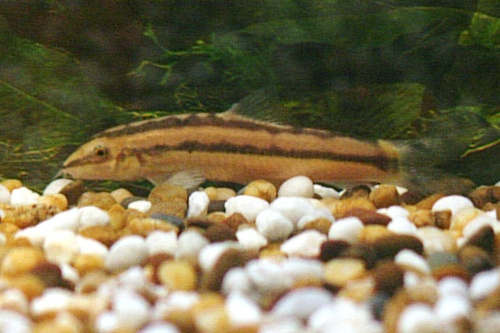
Black-lined loach
Ambastaia nigrolineata
Aquarium hobby

Blyth's loach
Syncrossus berdmorei
Aquarium hobby

Burmese border loach
Botia kubotai
Aquarium hobby

Chameleon loach
Syncrossus beauforti
Aquarium hobby

Clown loach
Chromobotia macracanthus
Aquarium hobby
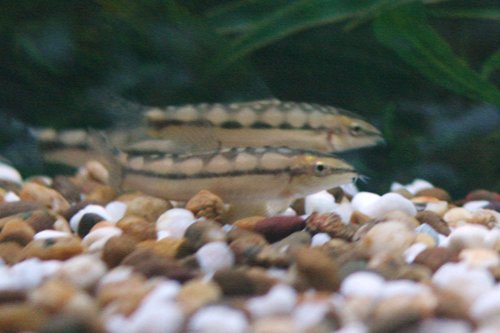
Dwarf loach
Ambastaia sidthimunki
Aquarium hobby