
Home / Fishes / Killifish and livebearers / Big Bend gambusia
Federal restrictions applyBig Bend gambusia
Gambusia gaigei
Fishes › Killifish and livebearers (Cyprinodontiformes) › Poeciliidae (Livebearers)
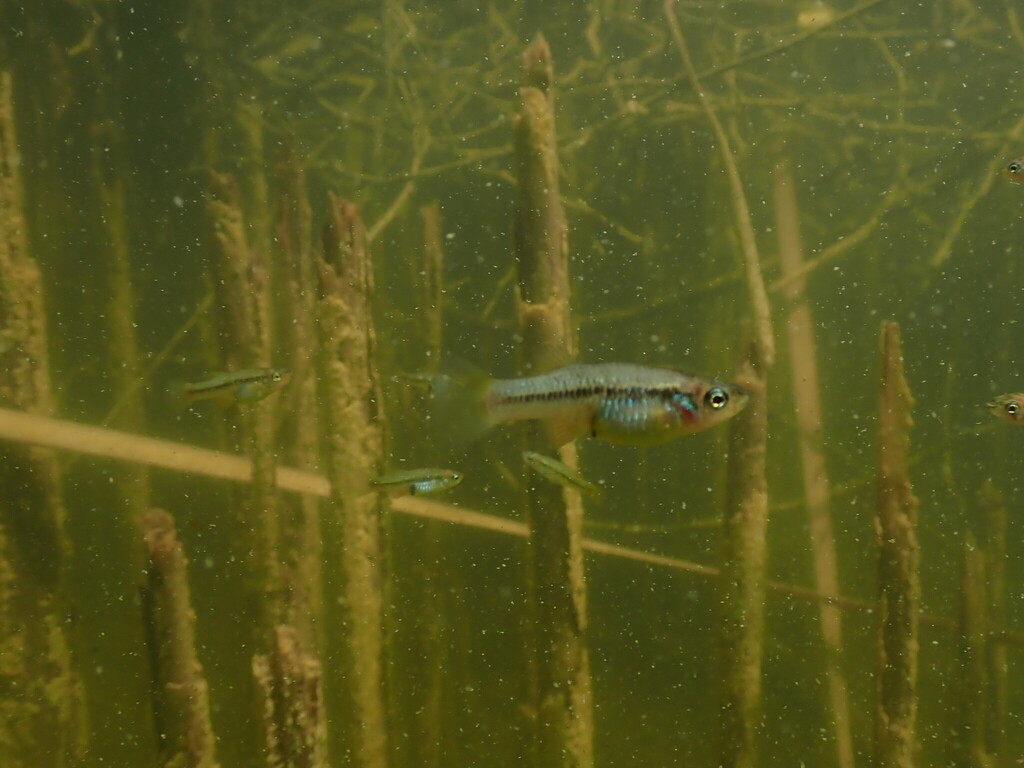
The Big Bend gambusia (Gambusia gaigei) is a rare species of fish in the family Poeciliidae.
Care at a glance
Species-specific values
Values researched for this exact species. Air, surface and water temperatures are listed separately, and each source is kept as published rather than averaged.
| Water temperature | 68–86 °F Source: cichlidatlas.com | |
| Diet | In captivity, it accepts standard small live, frozen and prepared foods suited to small mosquitofish. Source: cichlidatlas.com | |
| Feeding frequency | Frequent small feedings suit its near-constant grazing better than infrequent large meals. Source: cichlidatlas.com | |
| Social housing | Keep it strictly isolated from other Gambusia; successful holdings use single-species refuge ponds. Source: cichlidatlas.com |
Species-specific aquarium care
- Tank: At least 24 in long and 12 in front to back for one adult (adults commonly reach about 0.9 in / 2.25 cm; the largest recorded was 2.1 in).
- Water: Freshwater.
- Layout: Uses both the bottom and open water: give open swimming space plus cover near the substrate.
Calculated from this species' own FishBase record: tank size from its typical adult length and swimming zone, water values from its recorded ranges. The group guide below fills in general care.
Warnings
Understanding the animal
About this animal
About this animal
It is endemic to the Big Bend region of the Rio Grande of the United States and Mexico. The only known remaining population is in a protected pond in the Big Bend National Park.
From Wikipedia: Big Bend gambusia, CC BY-SA 4.0 (excerpt)
In the wild
In the wild
From this species’ own FishBase record (habitat, bottom type, water and breeding data), not its family. Wild conditions are context, not enclosure settings.1
| Where it lives | Lives in freshwater. Uses both the bottom and open water. |
| Climate | Subtropical climate. |
| Behavior to plan for | Breeding: internal live bearers. |
Data and studies
The numbers
The numbers
Each bar is what one source reports. Where several sources weigh in, the dashed gold band marks their average.
Adult length
Common length to maximum recorded length. Measured as total length. Fish in home aquariums often stay smaller than wild records.
Sources for this sheet
- FishBase (Froese & Pauly, eds.), version 24.07 (CC BY-NC 4.0) Peer-reviewed researchThe global scientific database on fishes, maintained by a consortium of research institutions; every value is referenced.
- 50 CFR 17.11: Endangered and threatened wildlife Zoo, university or veterinaryCurrent federal Endangered Species Act list.
- Wikipedia (species article) (CC BY-SA 4.0) Community referenceFree encyclopedia; useful overviews with their own citations. Short excerpts are quoted under CC BY-SA 4.0, each credited with a link to its article.
More livebearers
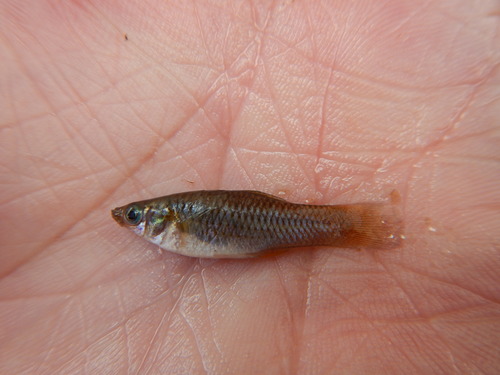
Amazon molly
Poecilia formosa
Aquarium hobby

Blackbelly limia
Limia melanogaster
Aquarium hobby

Cardinal toothcarp
Brachyrhaphis roseni
Aquarium hobby

Cuban limia
Limia vittata
Aquarium hobby

Dusky millions fish
Phalloceros caudimaculatus
Aquarium hobby

Eastern mosquitofish
Gambusia holbrooki
Aquarium hobby