Home / Invertebrates / Feather duster worms / Bispira volutacornis
No federal permit to keepBispira volutacornis
Bispira volutacornis
Invertebrates › Feather duster worms (Sabellida) › Sabellidae (Feather duster worms)
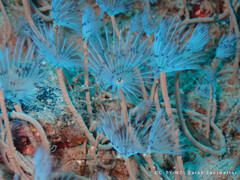
Bispira volutacornis, sometimes known as the twin fan worm or spiral fan worm, is a species of tube worm inhabiting the shallow sublittoral zone of the eastern Atlantic Ocean.
From Wikipedia: Bispira volutacornis, CC BY-SA 4.0 (excerpt)

Care at a glance
Species-specific values
Values researched for this exact species. Air, surface and water temperatures are listed separately, and each source is kept as published rather than averaged.
| Minimum enclosure | Recommended minimum volume is 75 liter (20 gallons). Source: reeflings.com | |
| Water temperature | 72–79 °F (22–26 °C) Source: reeflings.com | |
| Diet | A planktivore that feeds on suspended particulates; phytoplankton or fine particulate foods can supplement feeding. Source: reeflings.com |
Understanding the animal
About this animal
About this animal
It has a parchment-like tube with a mucoid outer layer, often coated with mud or silt. The tube is usually concealed in a crevice, and the worm can retract into it when disturbed.
From Wikipedia: Bispira volutacornis, CC BY-SA 4.0 (excerpt)
In the wild
In the wild
| Overview | Bispira volutacornis, sometimes known as the twin fan worm or spiral fan worm, is a species of tube worm inhabiting the shallow sublittoral zone of the eastern Atlantic Ocean. It has a parchment-like tube with a mucoid outer layer, often coated with mud or silt. The tube is usually concealed in a crevice, and the worm can retract into it when disturbed. — From Wikipedia: Bispira volutacornis, CC BY-SA 4.0 (excerpt) |
| Appearance and size | Bispira volutacornis often grows in colonies. Each individual worm has a double-headed crown formed from several whorls comprising up to 200 feathery plumes. One or more pairs of composite eyes are present on the outer side of the crown. — From Wikipedia: Bispira volutacornis, CC BY-SA 4.0 (excerpt) |
Read about this species in the wild at SeaLifeBase.
Sources for this sheet
- SeaLifeBase (Palomares & Pauly, eds.), version 24.07 (CC BY-NC 4.0) Peer-reviewed researchFishBase's sister database for non-fish marine and freshwater life; values are referenced.
- GBIF Backbone Taxonomy (Global Biodiversity Information Facility) (CC BY 4.0) Peer-reviewed researchInternational scientific taxonomy used here for classification. GBIF Secretariat (2023). GBIF Backbone Taxonomy. Checklist dataset https://doi.org/10.15468/39omei, accessed via GBIF.org.
- Wikipedia (species article) (CC BY-SA 4.0) Community referenceFree encyclopedia; useful overviews with their own citations. Short excerpts are quoted under CC BY-SA 4.0, each credited with a link to its article.
- iNaturalist (captive observations) Community referenceCommunity observation platform run by the California Academy of Sciences and National Geographic; observations marked captive show animals living in homes, zoos and aquariums.