Home / Birds / Songbirds and perching birds / Black-winged myna
No federal permit to keepBlack-winged myna
Acridotheres melanopterus
Birds › Songbirds and perching birds (Passeriformes) › Sturnidae (Starlings and mynas)
The black-winged myna (Acridotheres melanopterus) is a species of starling in the family Sturnidae.
Care at a glance
Species-specific values
Values researched for this exact species. Where they differ from the group guide below, follow these. Air, surface and water temperatures are listed separately, and each source is kept as published rather than averaged.
| Winter refuge air temperature | 68 °F (20 °C) Indoor aviary set point recommended by EAZA; provide ventilation. | 333 |
| Minimum main aviary dimensions | length: 4 m; width: 3.5 m; height: 2.5 m For a pair; recommendation is larger than some successfully used breeding enclosures. | 333 |
| Winter indoor aviary dimensions | length: 2 m; width: 2 m; height: 2 m For a pair during winter; group housing requires more space. | 333 |
| Maximum pellet iron | less than: 150 ppm Precautionary low-iron pellet criterion; source reports no detected iron-storage disease for this species. | 333 |
| Documented captive lifespan | 24 years Oldest individual in cited international studbook. | 333 |
Care guide
Starlings and mynas
Applies to most species in this group. Habitat: Tropical woodland. Individual species can differ, so compare with the species numbers above and the linked sources.
Housing & setup
- Large flights or aviaries; very active, messy birds.
Diet
- Low-iron softbill pellets, fruit and insects.
Health watch
- Mynahs are susceptible to iron storage disease. Use a suitably low-iron diet and avoid high-vitamin-C foods that increase iron uptake; susceptibility is not identical across all Sturnidae.
Understanding the animal
About this animal
About this animal
The species is also known as the black-winged starling or the white-breasted starling. It is endemic to Indonesia.
Quoted from the Wikipedia article “Black-winged myna” (CC BY-SA 4.0) 174
In the wild
In the wild
Quoted from the matching sections of reputable sources for this exact species. Specialist databases are used first; Wikipedia (community-edited, CC BY-SA 4.0) only fills gaps. Other sources are short credited quotes.
| Overview | The black-winged myna (Acridotheres melanopterus) is a species of starling in the family Sturnidae. The species is also known as the black-winged starling or the white-breasted starling. It is endemic to Indonesia. There are three recognised subspecies: the nominate race, which occurs across much of the island of Java; tricolor, which is restricted to south east Java; and tertius, which is found on Bali and possibly Lombok. — Wikipedia (community-edited) |
| Where it lives | Its natural habitats are tropical dry forests, tropical dry shrubland, tropical moist shrubland, and pastureland, from sea-level up to 2400 meters. Until recently it had adjusted to human-modified habitats well, moving into orchards, lawns, suburban areas and other cultivated land. — Wikipedia (community-edited) |
| Behavior | The black-winged myna feeds on a variety of items, including fruit, nectar and insects. It feeds in small groups and in pairs, both in trees and on the ground. It roosts communally at night in groups, sometimes with other starling species like the Bali myna. — Wikipedia (community-edited) |
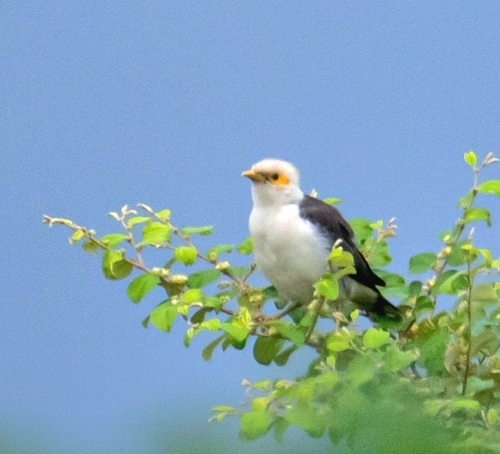
| Appearance and size | The black-winged myna is a small myna, 23 cm in length. The plumage of this species is striking, with the head, breast, back and rump being white, and the tail and parts of the wings glossy black. The tip of the tail and parts of the wings are also white. — Wikipedia (community-edited) |
| Conservation | The black-winged myna was once an abundant bird, so much so that it was considered a potential rival and threat to the threatened Bali myna. The species has declined, however, for much the same reasons as the Bali myna, principally collection for the caged-bird trade. — Wikipedia (community-edited) |
Native climate (measured)
Native climate (measured)
| Warm-season highs | about 85°F (up to 88°F in the hottest sampled areas) |
| Cool-season lows | about 68°F (down to 61°F in the coldest sampled areas) |
| Average temperature | 71–80°F across sampled records |
| Relative humidity | 80–83% on average (driest month about 77%) |
| Rainfall | about 2282 mm a year |
Measured at 27 wild occurrence records sampled against WorldClim 2.1 climate data (1970–2000 averages). Air conditions in the range are ecological context, not enclosure settings: microhabitats such as burrows, leaf litter or basking rocks can be cooler, warmer or more humid.
Data and studies
The numbers
The numbers
Each bar is what one source reports. Where several sources weigh in, the dashed gold band marks their average.
Sources for this sheet
- Myhrvold et al. (2015). An amniote life-history database. Ecology 96: 3109 Peer-reviewed researchPeer-reviewed compilation of life-history data for over 21,000 birds, mammals and reptiles.
- 9 CFR 2.1: Animal Welfare Act licensing (USDA) Zoo, university or veterinaryWho needs a USDA license to breed, sell or exhibit animals.
- Merck Veterinary Manual: Management of pet birds Zoo, university or veterinaryThe Merck Veterinary Manual: a standard veterinary reference written and reviewed by veterinary specialists.
- Merck Veterinary Manual: Nutritional diseases of pet birds Zoo, university or veterinaryThe Merck Veterinary Manual: a standard veterinary reference written and reviewed by veterinary specialists.
- MSD Veterinary Manual — Nutritional Diseases of Pet Birds Zoo, university or veterinaryAdded in the 2026 source-checked care-guide review.
- EAZA Best Practice Guidelines — Black-winged myna complex (2024) Zoo, university or veterinaryAdded in the 2026 source-checked care-guide review.
- GBIF Backbone Taxonomy (Global Biodiversity Information Facility) Peer-reviewed researchInternational scientific taxonomy used here for classification.
- Wikipedia (species article) Community referenceFree encyclopedia; useful overviews with their own citations. Intro text is quoted under CC BY-SA 4.0.
- The eBird/Clements Checklist of Birds of the World (Cornell Lab of Ornithology) Peer-reviewed researchThe standard global bird checklist maintained by the Cornell Lab of Ornithology; used here for complete species lists of widely kept bird families.
- iNaturalist (captive observations) Community referenceCommunity observation platform run by the California Academy of Sciences and National Geographic; observations marked captive show animals living in homes, zoos and aquariums.