
Home / Fishes / Cichlids and convict blennies / Cichlidae / Blackfin tilapia
No federal permit to keepBlackfin tilapia
Sarotherodon linnellii
Fishes › Cichlids and convict blennies (Cichliformes) › Cichlidae (Cichlids)
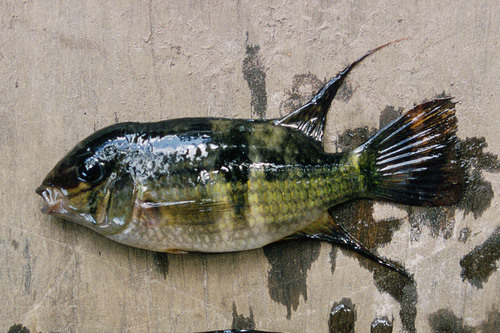
Sarotherodon linnellii, sometimes known as the unga, blackfin tilapia or blackbelly tilapia, is a cichlid endemic to Lake Barombi Mbo in western Cameroon.

Care at a glance
Species-specific values
Values researched for this exact species. Air, surface and water temperatures are listed separately, and each source is kept as published rather than averaged.
| Minimum enclosure | About 100 US gallons or more for a group, with a wide footprint. Source: cichlidatlas.com | |
| Water temperature | 75–82 °F Source: cichlidatlas.com | |
| Diet | Vegetable-forward prepared foods such as spirulina and algae-based foods, supplemented with smaller live and frozen items; juveniles are more insectivorous. Source: cichlidatlas.com | |
| Social housing | Best kept in a group; male aggression can flare around spawning. Source: cichlidatlas.com | |
| Substrate | A sand bottom lets males excavate spawning craters. Source: cichlidatlas.com |
Species-specific aquarium care
- Tank: At least 30 in long and 15 in front to back for one adult (adults commonly reach about 7.3 in / 18.5 cm).
- Water: Freshwater.
- Temperature: 75–79°F (range recorded for this species).
- Layout: Lives on or near the bottom: floor space and hiding places matter more than height.
- Diet: A grazer on plants and algae: base the diet on vegetable foods (algae wafers, blanched vegetables, spirulina). FishBase classes it as a omnivore.
- Availability: Rarely or never seen in the aquarium trade; expect to source it from specialists or not at all.
Calculated from this species' own FishBase record: tank size from its typical adult length and swimming zone, water values from its recorded ranges. The group guide below fills in general care.
Understanding the animal
About this animal
About this animal
This species reaches a length of 18.5 centimetres (7.3 in) SL. It is critically endangered because of pollution and sedimentation due to human activities. It is potentially also threatened by large emissions of carbon dioxide (CO2) from the lake's bottom (compare Lake Nyos), although studies indicate that Barombo Mbo lacks excess amounts of this gas.
From Wikipedia: Sarotherodon linnellii, CC BY-SA 4.0 (excerpt)
In the wild
In the wild
From this species’ own FishBase record (habitat, bottom type, water and breeding data), not its family. Wild conditions are context, not enclosure settings.1
| Where it lives | Lives in freshwater, in lakes. Stays near the bottom. |
| Climate | Tropical climate. |
| Wild diet | Grazing on aquatic plants. |
| Behavior to plan for | Breeding: external brooders. |
Data and studies
The numbers
The numbers
Each bar is what one source reports. Where several sources weigh in, the dashed gold band marks their average.
Adult length
Maximum recorded length. Measured as standard length (snout to the base of the tail, not counting the tail fin). Fish in home aquariums often stay smaller than wild records.
Sources for this sheet
- FishBase (Froese & Pauly, eds.), version 24.07 (CC BY-NC 4.0) Peer-reviewed researchThe global scientific database on fishes, maintained by a consortium of research institutions; every value is referenced.
- Wikipedia (species article) (CC BY-SA 4.0) Community referenceFree encyclopedia; useful overviews with their own citations. Short excerpts are quoted under CC BY-SA 4.0, each credited with a link to its article.
More cichlids
Aequidens potaroensis
Aequidens potaroensis
Aquarium hobby

Agassiz's dwarf cichlid
Apistogramma agassizii
Aquarium hobby

Altolamprologus calvus
Altolamprologus calvus
Aquarium hobby

Altum Angel
Pterophyllum altum
Aquarium hobby

Amatitlania myrnae
Amatitlania myrnae
Aquarium hobby
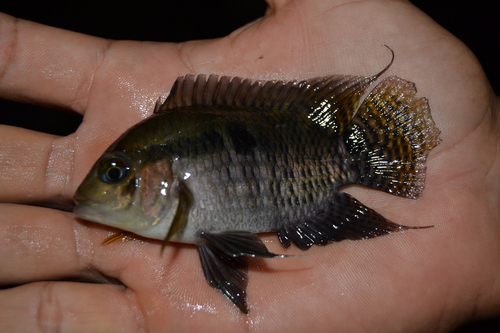
Amazon Cichlid
Cichlasoma amazonarum
Aquarium hobby