
Home / Fishes / Perches, groupers, scorpionfish / Blacktip grouper
No federal permit to keepBlacktip grouper
Epinephelus fasciatus
+ 4 more names
Scarlet rock-cod, Weathered rock-cod, Banded Reed Cod, Redbarred RoccodFishes › Perches, groupers, scorpionfish (Perciformes) › Epinephelidae (Groupers)
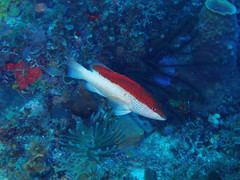
The blacktip grouper (Epinephelus fasciatus), also known as the redbanded grouper, blacktipped cod, black-tipped rockcod, footballer cod, red-barred cod, red-barred rockcod, scarlet rock-cod or weathered rock-cod, is a species of marine ray-finned…

Care at a glance
Species-specific values
Values researched for this exact species. Air, surface and water temperatures are listed separately, and each source is kept as published rather than averaged.
| Minimum enclosure | Minimum aquarium size: 125 gallons or larger. Source: qualitymarine.com | |
| Water temperature | 72–78 °F Source: qualitymarine.com | |
| Diet | Provide a diet of meaty enriched foods; offer live foods to entice feeding if needed. Source: qualitymarine.com | |
| Feeding frequency | Feed every other day. Source: qualitymarine.com | |
| Social housing | House with larger peaceful tank mates; keep one grouper per aquarium. Source: qualitymarine.com |
Species-specific aquarium care
- Tank: At least 36 in long and 18 in front to back for one adult (adults commonly reach about 8.7 in / 22 cm; the largest recorded was 20.5 in).
- Water: Marine.
- Layout: Lives around reefs and rockwork: give caves, overhangs and swimming room along the rock.
- Habitat: Associated with coral reefs: needs stable marine water quality; check reef safety before mixing with corals and invertebrates.
- Diet: A predator: feed meaty foods sized to its mouth (frozen fish, shrimp, worms); it will eat tankmates that fit in its mouth. FishBase classes it as a carnivore.
Calculated from this species' own FishBase record: tank size from its typical adult length and swimming zone, water values from its recorded ranges. The group guide below fills in general care.
Understanding the animal
About this animal
About this animal
It is found in the tropical Indo-Pacific region.
From Wikipedia: Blacktip grouper, CC BY-SA 4.0 (excerpt)
In the wild
In the wild
From this species’ own FishBase record (habitat, bottom type, water and breeding data), not its family. Wild conditions are context, not enclosure settings.1
| Where it lives | Lives in brackish water and the sea, in estuaries, coral reefs, open ocean. Lives around reefs. |
| Ground it lives on | Over rock. |
| Climate | Tropical climate. |
| Wild diet | Hunting macrofauna (predator). |
| Behavior to plan for | Breeding: open water/substratum egg scatterers. |
Data and studies
The numbers
The numbers
Each bar is what one source reports. Where several sources weigh in, the dashed gold band marks their average.
Typical adult weight
Average adult body mass in each database (FishBase gives the maximum recorded weight).
Adult length
Common length to maximum recorded length. Measured as total length. Fish in home aquariums often stay smaller than wild records.
Veterinary & husbandry research
Veterinary & husbandry research
- Comparative Analysis of Embryonic Development and Mitochondrial Genome of a New Intergeneric Hybrid Grouper (Epinephelus fasciatus ♀ × Plectropomus leopardus ♂) Jiao X et al., Animals: an open access journal from MDPI 2025
Peer-reviewed papers that mention this species alongside captivity, zoos, veterinary care or aquaculture. Some cover several species or mention it only in passing, so check the abstract. See all 2 on PubMed → PubMed
Sources for this sheet
- FishBase (Froese & Pauly, eds.), version 24.07 (CC BY-NC 4.0) Peer-reviewed researchThe global scientific database on fishes, maintained by a consortium of research institutions; every value is referenced.
- Wikipedia (species article) (CC BY-SA 4.0) Community referenceFree encyclopedia; useful overviews with their own citations. Short excerpts are quoted under CC BY-SA 4.0, each credited with a link to its article.
- PubMed (U.S. National Library of Medicine) Peer-reviewed researchIndex of peer-reviewed veterinary, zoo and husbandry research.
- iNaturalist (captive observations) Community referenceCommunity observation platform run by the California Academy of Sciences and National Geographic; observations marked captive show animals living in homes, zoos and aquariums.
More groupers

Blue-and-yellow grouper
Epinephelus flavocaeruleus
Aquarium hobby

Brown-marbled grouper
Epinephelus fuscoguttatus
Aquarium hobby

Chocolate hind
Cephalopholis boenak
Aquarium hobby
Coney
Cephalopholis fulva
Aquarium hobby

Coral grouper
Cephalopholis miniata
Aquarium hobby

Creole-fish
Paranthias furcifer
Aquarium hobby