Home / Fishes / Sunfish, bass and hawkfish / Bluegill
No federal permit to keepBluegill
Lepomis macrochirus
Fishes › Sunfish, bass and hawkfish (Centrarchiformes) › Centrarchidae (Sunfish and black bass)
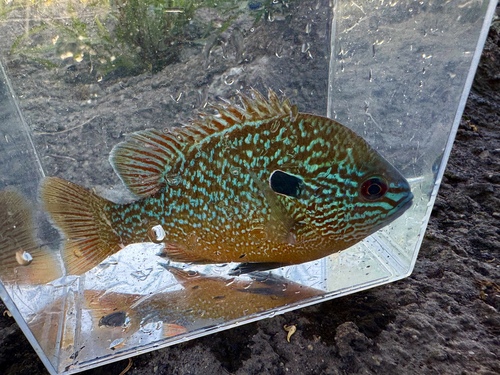
The bluegill (Lepomis macrochirus), sometimes referred to as "bream", "brim", "sunny", or, in Texas, "copper nose", is a species of North American freshwater fish, native to and commonly found in streams, rivers, lakes, ponds and wetlands east of…

Care at a glance
Species-specific values
Values researched for this exact species. Air, surface and water temperatures are listed separately, and each source is kept as published rather than averaged.
| Minimum enclosure | At least 400 litres for a single adult. Source: studioscaped.com | |
| Water temperature | 50–79 °F (10–26 °C) Source: studioscaped.com | |
| Diet | Carnivore pellets and frozen foods such as bloodworm, mysis, krill, and chopped prawn. Source: studioscaped.com | |
| Social housing | House individually, in large-tank groups, or alongside robust, similarly sized tank mates. Source: studioscaped.com | |
| Seasonal cooling | A cooler winter followed by warmer spring water supports breeding behavior. Source: studioscaped.com | |
| Minimum enclosure | Minimum pond volume is 1000 gallons. Source: fastaquatics.com | |
| Water temperature | 50–78 °F Source: fastaquatics.com | |
| Diet | Carnivore; eats frozen or live meaty foods and quality carnivore pellets. Source: fastaquatics.com | |
| Feeding frequency | Adults: 2-3 times weekly; growing juveniles: daily. Source: fastaquatics.com | |
| Substrate | Provide rocks, plants, or brushes as spawning substrate. Source: fastaquatics.com |
Species-specific aquarium care
- Tank: At least 36 in long and 15 in front to back for one adult (adults commonly reach about 7.5 in / 19.05 cm; the largest recorded was 16.1 in).
- Water: Freshwater.
- Temperature: 34–97°F (range recorded for this species).
- pH: 7–7.5.
- Hardness: 10–15 dGH.
- Layout: Uses both the bottom and open water: give open swimming space plus cover near the substrate.
- Diet: A predator: feed meaty foods sized to its mouth (frozen fish, shrimp, worms); it will eat tankmates that fit in its mouth. FishBase classes it as a carnivore.
Calculated from this species' own FishBase record: tank size from its typical adult length and swimming zone, water values from its recorded ranges. The group guide below fills in general care.
Understanding the animal
About this animal
About this animal
It is from the family Centrarchidae (sunfishes, crappies and black basses) in the order Centrarchiformes. Bluegills can grow up to 16 in (41 cm) long and about 4+1⁄2 lb (2.0 kg).
From Wikipedia: Bluegill, CC BY-SA 4.0 (excerpt)
In the wild
In the wild
From this species’ own FishBase record (habitat, bottom type, water and breeding data), not its family. Wild conditions are context, not enclosure settings.1
| Where it lives | Lives in freshwater, in rivers and streams, lakes, estuaries. Uses both the bottom and open water. |
| Ground it lives on | Over vegetation. |
| Climate | Subtropical climate. |
| Wild diet | Hunting macrofauna (predator). |
| Behavior to plan for | Breeding: nesters, paternal parental care. |
Data and studies
The numbers
The numbers
Each bar is what one source reports. Where several sources weigh in, the dashed gold band marks their average.
Maximum recorded lifespan
Longest recorded lifespan reported by each database; typical lifespans are usually shorter.
Typical adult weight
Average adult body mass in each database (FishBase gives the maximum recorded weight).
Adult length
Common length to maximum recorded length. Measured as total length. Fish in home aquariums often stay smaller than wild records.
Veterinary & husbandry research
Veterinary & husbandry research
- Nestling recognition via direct cues by parental male bluegill sunfish ( Lepomis macrochirus) Neff BD et al., Animal cognition 2003
- Mortality and carrier status of bluegills exposed to viral hemorrhagic septicemia virus genotype IVb at different temperatures Goodwin AE et al., Journal of aquatic animal health 2011
Peer-reviewed papers that mention this species alongside captivity, zoos, veterinary care or aquaculture. Some cover several species or mention it only in passing, so check the abstract. See all 11 on PubMed → PubMed
Sources for this sheet
- AnAge: The Animal Ageing and Longevity Database (Human Ageing Genomic Resources) (CC BY 3.0) Peer-reviewed researchCurated, referenced longevity and life-history records for thousands of species; maximum lifespans are often from zoo animals.
- FishBase (Froese & Pauly, eds.), version 24.07 (CC BY-NC 4.0) Peer-reviewed researchThe global scientific database on fishes, maintained by a consortium of research institutions; every value is referenced.
- Wikipedia (species article) (CC BY-SA 4.0) Community referenceFree encyclopedia; useful overviews with their own citations. Short excerpts are quoted under CC BY-SA 4.0, each credited with a link to its article.
- PubMed (U.S. National Library of Medicine) Peer-reviewed researchIndex of peer-reviewed veterinary, zoo and husbandry research.
- iNaturalist (captive observations) Community referenceCommunity observation platform run by the California Academy of Sciences and National Geographic; observations marked captive show animals living in homes, zoos and aquariums.