
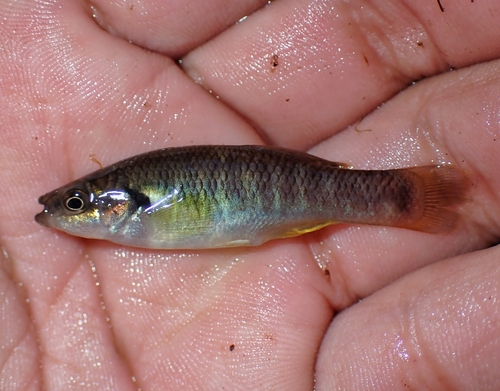
Home / Fishes / Killifish and livebearers / Catarina allotoca
No federal permit to keepCatarina allotoca
Allotoca catarinae
Fishes › Killifish and livebearers (Cyprinodontiformes) › Goodeidae (Goodeid livebearers and killifish)
Care at a glance
Species-specific values
Values researched for this exact species. Air, surface and water temperatures are listed separately, and each source is kept as published rather than averaged.
| Minimum enclosure | House in a tank with a 100 liter capacity minimum. Source: goodeidworkinggroup.com | |
| Social housing | Fry may be added to the group at 1.5 or 2 cm to support a flock-breeding colony. Source: goodeidworkinggroup.com | |
| Diet | Animal foods such as bloodworms, insect larvae, water fleas, Mysids, flake food, granulate, tablets, and Brine Shrimp Nauplia are eaten. Source: goodeidworkinggroup.com | |
| Feeding frequency | Fry may be eaten depending on food quantity and quality and available hiding places. Source: goodeidworkinggroup.com | |
| Substrate | Use a structured habitat with gravel, rocks, roots, branches, fallen leaves, and riverbank vegetation. Source: goodeidworkinggroup.com | |
| Seasonal cooling | Provide a 2–3 month winter rest below 20°C; spawning begins around 20–21°C and stops when colder or above 25°C. Source: goodeidworkinggroup.com | |
| Seasonal cooling | Bring the fish in before daytime water drops below 15°C; keep them cool initially and slowly raise temperature while aiming below 20°C in winter. Source: goodeidworkinggroup.com |
Species-specific aquarium care
- Tank: At least 24 in long and 12 in front to back for one adult (adults commonly reach about 2.0 in / 5 cm).
- Water: Freshwater.
- Temperature: 75–81°F (range recorded for this species).
- Layout: Lives on or near the bottom: floor space and hiding places matter more than height.
- Availability: Rarely or never seen in the aquarium trade; expect to source it from specialists or not at all.
Calculated from this species' own FishBase record: tank size from its typical adult length and swimming zone, water values from its recorded ranges. The group guide below fills in general care.
Understanding the animal
In the wild
In the wild
From this species’ own FishBase record (habitat, bottom type, water and breeding data), not its family. Wild conditions are context, not enclosure settings.1
| Where it lives | Lives in freshwater. Stays near the bottom. |
| Water it lives in | Freshwater, 75–81 °F (24–27 °C). |
| Climate | Tropical climate. |
| Behavior to plan for | Breeding: internal live bearers. |
Data and studies
The numbers
The numbers
Each bar is what one source reports. Where several sources weigh in, the dashed gold band marks their average.
Adult length
Maximum recorded length. Measured as total length. Fish in home aquariums often stay smaller than wild records.
Water temperature
Range the species tolerates in nature; aim for the middle.
Sources for this sheet
- FishBase (Froese & Pauly, eds.), version 24.07 (CC BY-NC 4.0) Peer-reviewed researchThe global scientific database on fishes, maintained by a consortium of research institutions; every value is referenced.
More goodeid livebearers and killifish

Banded allotoca
Allotoca goslinei
Aquarium hobby
Bandfin splitfin
Allodontichthys zonistius
Aquarium hobby
Barred splitfin
Chapalichthys encaustus
Aquarium hobby

Butterfly splitfin
Ameca splendens
Aquarium hobby

Chapultepec splitfin
Girardinichthys viviparus
Aquarium hobby

Doadrios Redtail Splitfin
Xenotoca doadrioi
Aquarium hobby