Home / Invertebrates / Praying mantises / Chinese mantis
No federal permit to keepChinese mantis
Tenodera sinensis
Invertebrates › Praying mantises (Mantodea) › Mantidae (Mantises)
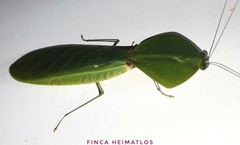
The Chinese mantis (Tenodera sinensis), is a species of mantis native to temperate Asia and the nearby islands.
From Wikipedia: Chinese mantis, CC BY-SA 4.0 (excerpt)

Care at a glance
Species-specific values
Values researched for this exact species. Air, surface and water temperatures are listed separately, and each source is kept as published rather than averaged.
| Minimum enclosure | At least 3 times the mantis’s length in height and 2 times its length in width. Source: panterrapets.com | |
| Social housing | Do not house together after L2. Source: panterrapets.com | |
| Warm side air temperature | 70–85 °F Source: panterrapets.com | |
| Humidity | 50–60 % Source: panterrapets.com | |
| Diet | L1–L3: D. hydei fruit flies; L4–L5: house or blue bottle flies; L6 to adult: blue bottle flies as a staple, with cockroaches also suitable. Source: panterrapets.com | |
| Feeding frequency | Mist the enclosure at least once daily so the mantis can drink; mesh cages are misted twice daily. Source: panterrapets.com |
Understanding the animal
About this animal
About this animal
In 1896, this species was accidentally introduced by a nursery tender at Mt. Airy, a neighborhood of Philadelphia, United States.
From Wikipedia: Chinese mantis, CC BY-SA 4.0 (excerpt)
In the wild
In the wild
| Overview | The Chinese mantis (Tenodera sinensis), is a species of mantis native to temperate Asia and the nearby islands. In 1896, this species was accidentally introduced by a nursery tender at Mt. Airy, a neighborhood of Philadelphia, United States. T. sinensis often is erroneously referred to as Tenodera aridifolia sinensis because it was at first described as a subspecies of Tenodera aridifolia, but T. sinensis is now established as a full species. T. sinensis feeds primarily on other large insects, though adult females sometimes catch small vertebrates. — From Wikipedia: Chinese mantis, CC BY-SA 4.0 (excerpt) |
| Appearance and size | The Chinese mantis is a long, slender, brown and green praying mantis. It is typically longer than other praying mantis species, reaching just over 11 cm, and is the largest mantis species in North America (spread throughout the Northeast United States). Its color can vary from overall green to brown with a green lateral stripe on the borders of the front wings in the brown color form. — From Wikipedia: Chinese mantis, CC BY-SA 4.0 (excerpt) |
Native climate (measured)
Native climate (measured)
| Warm-season highs | about 85°F (up to 88°F in the hottest sampled areas) |
| Cool-season lows | about 20°F (down to 13°F in the coldest sampled areas) |
| Average temperature | 48–56°F across sampled records |
| Relative humidity | 67–72% on average (driest month about 62%) |
| Rainfall | about 1081 mm a year, spread fairly evenly |
| Winters | Cool to cold winters (lows around 20°F) in much of its native range. Seasonal slowdown may be relevant, but species-specific biology determines whether brumation or hibernation occurs. |
Measured at 107 wild occurrence records sampled against WorldClim 2.1 climate data (1970–2000 averages). Air conditions in the range are ecological context, not enclosure settings: microhabitats such as burrows, leaf litter or basking rocks can be cooler, warmer or more humid.
Sources for this sheet
- GBIF Backbone Taxonomy (Global Biodiversity Information Facility) (CC BY 4.0) Peer-reviewed researchInternational scientific taxonomy used here for classification. GBIF Secretariat (2023). GBIF Backbone Taxonomy. Checklist dataset https://doi.org/10.15468/39omei, accessed via GBIF.org.
- Wikipedia (species article) (CC BY-SA 4.0) Community referenceFree encyclopedia; useful overviews with their own citations. Short excerpts are quoted under CC BY-SA 4.0, each credited with a link to its article.
- iNaturalist (captive observations) Community referenceCommunity observation platform run by the California Academy of Sciences and National Geographic; observations marked captive show animals living in homes, zoos and aquariums.