
Home / Fishes / Wrasses, breams and drums / Choat's wrasse
No federal permit to keepChoat's wrasse
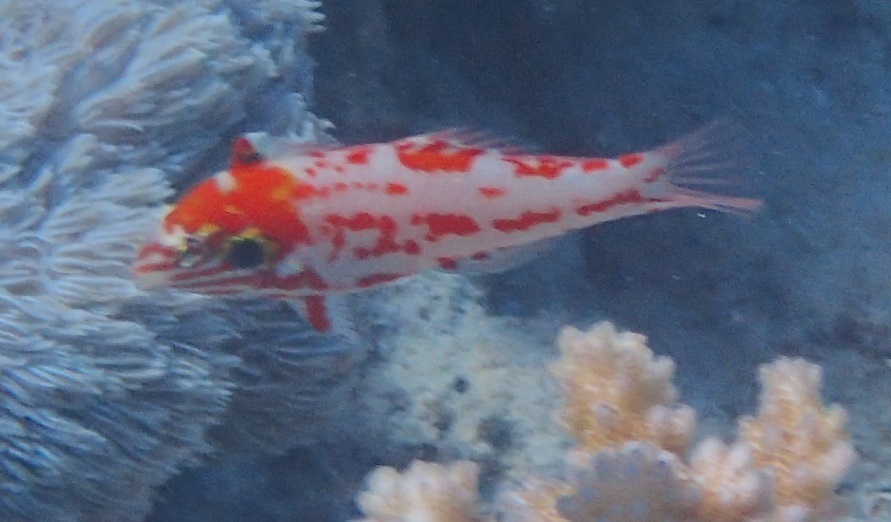
Macropharyngodon choati
Fishes › Wrasses, breams and drums (Eupercaria) › Labridae (Wrasses)
Care at a glance
Species-specific values
Values researched for this exact species. Air, surface and water temperatures are listed separately, and each source is kept as published rather than averaged.
| Minimum enclosure | Minimum volume is 200 liters (53 gallons). Source: reeflings.com | |
| Water temperature | 75–81 °F (24–27 °C) Source: reeflings.com | |
| Diet | Carnivore; prefers live foods such as copepods, plus small meaty foods. Source: reeflings.com | |
| Substrate | Provide a sandy substrate for sleeping and hiding. Source: reeflings.com | |
| Minimum enclosure | Adults need a marine aquarium of at least 75 gallons. Source: topshelfaquatics.com | |
| Diet | Accepts enriched mysis and brine shrimp, chopped clam, mussel, fish or shrimp flesh, and suitable marine frozen, flake, or pellet foods. Source: topshelfaquatics.com | |
| Feeding frequency | Feed twice daily. Source: topshelfaquatics.com | |
| Social housing | Some keepers house one per aquarium; others use groups introduced together or a harem. Never house two males together. Source: topshelfaquatics.com | |
| Substrate | Provide fine, non-abrasive sand about 2 to 4 inches deep. Source: topshelfaquatics.com |
Species-specific aquarium care
- Tank: At least 24 in long and 12 in front to back for one adult (adults commonly reach about 3.0 in / 7.6 cm).
- Water: Marine.
- Temperature: 73–79°F (range recorded for this species).
- Layout: Lives around reefs and rockwork: give caves, overhangs and swimming room along the rock.
Calculated from this species' own FishBase record: tank size from its typical adult length and swimming zone, water values from its recorded ranges. The group guide below fills in general care.
Understanding the animal
In the wild
In the wild
From this species’ own FishBase record (habitat, bottom type, water and breeding data), not its family. Wild conditions are context, not enclosure settings.1
| Where it lives | Lives in the sea. Lives around reefs. |
| Climate | Subtropical climate. |
Data and studies
The numbers
The numbers
Each bar is what one source reports. Where several sources weigh in, the dashed gold band marks their average.
Adult length
Maximum recorded length. Measured as standard length (snout to the base of the tail, not counting the tail fin). Fish in home aquariums often stay smaller than wild records.
Veterinary & husbandry research
Veterinary & husbandry research
- A new lineage of Ranavirus micropterus1 infects ornamental wrasses (Macropharyngodon choati) from the Great Barrier Reef and causes severe disease in captivity Costa VA et al., Frontiers in veterinary science 2026
Peer-reviewed papers that mention this species alongside captivity, zoos, veterinary care or aquaculture. Some cover several species or mention it only in passing, so check the abstract. PubMed
Sources for this sheet
- FishBase (Froese & Pauly, eds.), version 24.07 (CC BY-NC 4.0) Peer-reviewed researchThe global scientific database on fishes, maintained by a consortium of research institutions; every value is referenced.
- PubMed (U.S. National Library of Medicine) Peer-reviewed researchIndex of peer-reviewed veterinary, zoo and husbandry research.
More wrasses

African coris
Coris gaimard
Aquarium hobby

Argus wrasse
Halichoeres argus
Aquarium hobby

Axil spot wrasse
Halichoeres podostigma
Aquarium hobby

Axilspot hogfish
Bodianus axillaris
Aquarium hobby

Barred thicklip
Hemigymnus fasciatus
Aquarium hobby

Batu coris
Coris batuensis
Aquarium hobby