Home / Amphibians / Frogs and toads / Couch's spadefoot
No federal permit to keepCouch's spadefoot
Scaphiopus couchii
Amphibians › Frogs and toads (Anura) › Scaphiopodidae (Spadefoot toads)
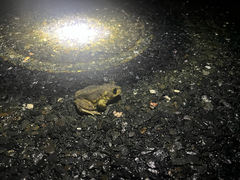
Couch's spadefoot toad or Couch's spadefoot (Scaphiopus couchii) is a species of North American spadefoot toad (family Scaphiopodidae).
From Wikipedia: Wikipedia, CC BY-SA 4.0 (excerpt)

Care at a glance
Species-specific values
Values researched for this exact species. Air, surface and water temperatures are listed separately, and each source is kept as published rather than averaged.
| Minimum enclosure | Minimum enclosure volume is at least 45 L. Source: atlarium.bio | |
| Humidity | 40–70 % Source: atlarium.bio | |
| Night temperature | 68–72 °F (20–22 °C) Source: atlarium.bio | |
| Uvb lighting | Provide low-level UVB lighting during the day. Source: atlarium.bio | |
| Diet | Offer crickets, dubia roaches, and worms. Source: atlarium.bio | |
| Social housing | Housed successfully in small groups of similar size. Source: atlarium.bio | |
| Substrate | Use 10–15 cm of a coconut fiber and sand mixture for burrowing. Source: atlarium.bio |
Understanding the animal
About this animal
About this animal
The specific epithet couchii is in honor of American naturalist Darius Nash Couch, who collected the first specimen while on a personal expedition to northern Mexico to collect plant, mineral, and animal specimens for the Smithsonian Institution.
From Wikipedia: Couch's spadefoot toad, CC BY-SA 4.0 (excerpt)
In the wild
In the wild
| Overview | Couch's spadefoot toad or Couch's spadefoot (Scaphiopus couchii) is a species of North American spadefoot toad (family Scaphiopodidae). The specific epithet couchii is in honor of American naturalist Darius Nash Couch, who collected the first specimen while on a personal expedition to northern Mexico to collect plant, mineral, and animal specimens for the Smithsonian Institution. — From Wikipedia: Wikipedia, CC BY-SA 4.0 (excerpt) |
Read about this species in the wild at Animal Diversity Web.
Native climate (measured)
Native climate (measured)
| Warm-season highs | about 95°F (up to 99°F in the hottest sampled areas) |
| Cool-season lows | about 38°F (down to 27°F in the coldest sampled areas) |
| Average temperature | 60–73°F across sampled records |
| Relative humidity | 45–65% on average (driest month about 46%) |
| Rainfall | about 506 mm a year |
| Winters | Cool to cold winters (lows around 38°F) in much of its native range. Seasonal slowdown may be relevant, but species-specific biology determines whether brumation or hibernation occurs. |
Measured at 104 wild occurrence records sampled against WorldClim 2.1 climate data (1970–2000 averages). Air conditions in the range are ecological context, not enclosure settings: microhabitats such as burrows, leaf litter or basking rocks can be cooler, warmer or more humid.
Data and studies
The numbers
The numbers
Each bar is what one source reports. Where several sources weigh in, the dashed gold band marks their average.
Maximum recorded lifespan
Longest recorded lifespan reported by each database; typical lifespans are usually shorter. The AnAge record comes from an animal in human care.
Veterinary & husbandry research
Veterinary & husbandry research
- Pathological effects of Pseudodiplorchis americanus (Monogenea: Polystomatidae) on the lung epithelium of its host, Scaphiopus couchii Tinsley RC et al., Parasitology 2002
Peer-reviewed papers that mention this species alongside captivity, zoos, veterinary care or aquaculture. Some cover several species or mention it only in passing, so check the abstract. PubMed
Sources for this sheet
- AnAge: The Animal Ageing and Longevity Database (Human Ageing Genomic Resources) (CC BY 3.0) Peer-reviewed researchCurated, referenced longevity and life-history records for thousands of species; maximum lifespans are often from zoo animals.
- AmphibiaWeb (University of California, Berkeley) (CC BY-NC) Peer-reviewed researchUniversity-hosted database of amphibian biology and conservation.
- GBIF Backbone Taxonomy (Global Biodiversity Information Facility) (CC BY 4.0) Peer-reviewed researchInternational scientific taxonomy used here for classification. GBIF Secretariat (2023). GBIF Backbone Taxonomy. Checklist dataset https://doi.org/10.15468/39omei, accessed via GBIF.org.
- Wikipedia (species article) (CC BY-SA 4.0) Community referenceFree encyclopedia; useful overviews with their own citations. Short excerpts are quoted under CC BY-SA 4.0, each credited with a link to its article.
- PubMed (U.S. National Library of Medicine) Peer-reviewed researchIndex of peer-reviewed veterinary, zoo and husbandry research.
- iNaturalist (captive observations) Community referenceCommunity observation platform run by the California Academy of Sciences and National Geographic; observations marked captive show animals living in homes, zoos and aquariums.