
Home / Reptiles / Snakes / Viperidae / Southwestern Speckled Rattlesnake
No federal permit to keepSouthwestern Speckled Rattlesnake
Crotalus pyrrhus
Reptiles › Snakes (Serpentes) › Viperidae (Vipers and pit vipers)
Common names: southwestern speckled rattlesnake, Mitchell's rattlesnake, more. Crotalus pyrrhus is a venomous pitviper species found in the southwestern United States and northwestern Mexico.
From Wikipedia: Crotalus pyrrhus, CC BY-SA 4.0 (excerpt)
Care at a glance
Species-specific values
Values researched for this exact species. Air, surface and water temperatures are listed separately, and each source is kept as published rather than averaged.
| Minimum enclosure | Adult enclosure at least 120 x 60 x 75 cm. Source: academy.herpeton.net | |
| Basking surface temperature | 90–95 °F (32–35 °C) | academy.herpeton.net |
| Warm side air temperature | 75–84 °F (24–29 °C) | academy.herpeton.net |
| Cool side air temperature | 68–75 °F (20–24 °C) | academy.herpeton.net |
| Night temperature | 61–70 °F (16–21 °C) | academy.herpeton.net |
| Humidity | 25–45 % Source: academy.herpeton.net | |
| Uvb lighting | Low-output UVB may be offered as a measured Ferguson Zone 1 opportunity. Source: academy.herpeton.net | |
| Diet | Offer appropriately sized frozen-thawed whole prey. Source: academy.herpeton.net | |
| Social housing | House singly except for controlled, professionally planned breeding introductions. Source: academy.herpeton.net | |
| Substrate | Use 8 cm of low-dust mineral soil with coarse sand and locality-appropriate leaf litter. Source: academy.herpeton.net | |
| Seasonal cooling | Seasonal cooling is appropriate only to healthy, established, locality-documented adults where the native climate supports it. Source: academy.herpeton.net | |
| Note: more detail at academy.herpeton.net. | ||
Understanding the animal
About this animal
About this animal
A medium-sized snake, it is found mostly in rocky country, active at night and feeding on small mammals.
From Wikipedia: Crotalus pyrrhus, CC BY-SA 4.0 (excerpt)
In the wild
In the wild
| Overview | Common names: southwestern speckled rattlesnake, Mitchell's rattlesnake, more. Crotalus pyrrhus is a venomous pitviper species found in the southwestern United States and northwestern Mexico. A medium-sized snake, it is found mostly in rocky country, active at night and feeding on small mammals. The coloration is variable and depends on the color of the rocks and soil of the habitat. — From Wikipedia: Crotalus pyrrhus, CC BY-SA 4.0 (excerpt) |
| Where it lives | Rocky country, including rocky hillsides and canyons, talus slopes and rock ledges. In southern California, these snakes have sometimes been found in chaparral or cactus country, but usually never stray far from the rocks that provide its usual shelter. Not exclusively a rock dweller, they have also been observed emerging from mammal burrows at dusk. — From Wikipedia: Crotalus pyrrhus, CC BY-SA 4.0 (excerpt) |
| Wild diet | The diet consists mostly of small mammals, although birds and lizards are also taken, the latter especially by juveniles. There is one report of a large specimen that contained a nearly grown cottontail rabbit (Sylvilagus auduboni sanctidiegi). Another report describes a specimen that had eaten eight birds, most likely goldfinches, that had been attracted to a small fountain installed as a bird bath at a desert camp. — From Wikipedia: Crotalus pyrrhus, CC BY-SA 4.0 (excerpt) |
| Behavior | Primarily nocturnal, these snakes shelter in rock crevices and mammal burrows during the heat of the day. They become more diurnal during the cooler months of the year. — From Wikipedia: Crotalus pyrrhus, CC BY-SA 4.0 (excerpt) |
| Reproduction | Ovoviviparous, with females giving birth to as many as 12 live young. Neonates are 12 in long and prey mostly on lizards. — From Wikipedia: Crotalus pyrrhus, CC BY-SA 4.0 (excerpt) |
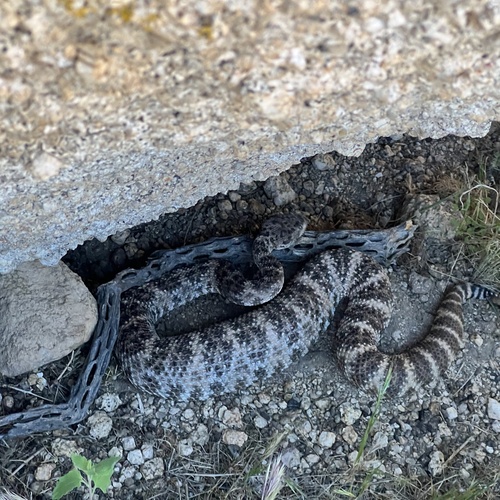
| Appearance and size | Adults grow to an average length of 3 ft, but may sometimes exceed 4 ft. The color pattern is variable, depending on the color of the rocks and soil of the habitat. The snake's ground color may be pink, brown, gray, yellow or nearly white, and speckled with black and white. — From Wikipedia: Crotalus pyrrhus, CC BY-SA 4.0 (excerpt) |
Read about this species in the wild at The Reptile Database.
Native climate (measured)
Native climate (measured)
| Warm-season highs | about 100°F (up to 107°F in the hottest sampled areas) |
| Cool-season lows | about 38°F (down to 29°F in the coldest sampled areas) |
| Average temperature | 57–73°F across sampled records |
| Relative humidity | 31–47% on average (driest month about 23%) |
| Rainfall | about 194 mm a year |
| Winters | Cool to cold winters (lows around 38°F) in much of its native range. Seasonal slowdown may be relevant, but species-specific biology determines whether brumation or hibernation occurs. |
Measured at 175 wild occurrence records sampled against WorldClim 2.1 climate data (1970–2000 averages). Air conditions in the range are ecological context, not enclosure settings: microhabitats such as burrows, leaf litter or basking rocks can be cooler, warmer or more humid.
Profile
Profile
Researched for this exact species. Sources are listed under In the wild above.
History
Named after Greek pyrrhos = flame colored, reddish.
Sources for this sheet
- The Reptile Database Peer-reviewed researchScientist-curated catalog of every reptile species, with taxonomy and literature.
- GBIF Backbone Taxonomy (Global Biodiversity Information Facility) (CC BY 4.0) Peer-reviewed researchInternational scientific taxonomy used here for classification. GBIF Secretariat (2023). GBIF Backbone Taxonomy. Checklist dataset https://doi.org/10.15468/39omei, accessed via GBIF.org.
- Species+ (UNEP-WCMC and the CITES Secretariat) Zoo, university or veterinaryThe official database of species listed under CITES. UNEP (2026). The Species+ Website. Nairobi, Kenya. Compiled by UNEP-WCMC, Cambridge, UK. Available at: www.speciesplus.net. [Accessed 04/10/2026].
- Wikipedia (species article) (CC BY-SA 4.0) Community referenceFree encyclopedia; useful overviews with their own citations. Short excerpts are quoted under CC BY-SA 4.0, each credited with a link to its article.
- iNaturalist (captive observations) Community referenceCommunity observation platform run by the California Academy of Sciences and National Geographic; observations marked captive show animals living in homes, zoos and aquariums.
More vipers and pit vipers

African Saw-scaled Viper
Echis ocellatus
Pet trade

Arizona Black Rattlesnake
Crotalus cerberus
Pet trade

Armenian Steppe Viper
Vipera eriwanensis
Pet trade

Asp Viper
Vipera aspis
Pet trade

Berg adder
Bitis atropos
Pet trade

Black-speckled Palm Pit Viper
Bothriechis nigroviridis
Pet trade