Home / Mammals / Rodents / Degu
No federal permit to keep In-depth sheetDegu
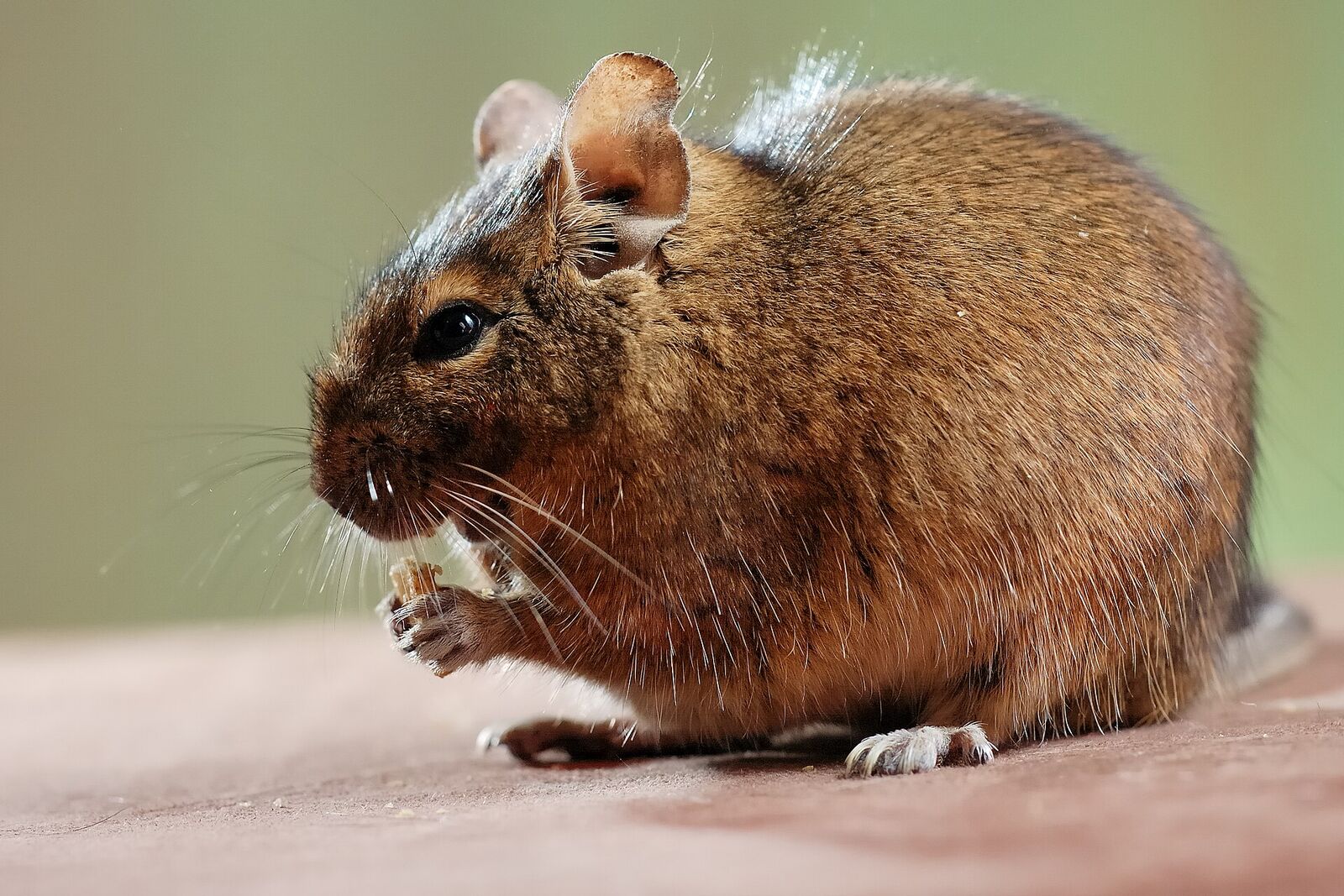
Octodon degus
Mammals › Rodents (Rodentia) › Octodontidae (Degus and coruros)
Degus are daytime, highly social rodents best kept in pairs or small groups. Their teeth grow constantly, so regular dental checks matter.
Care at a glance
Species-specific values
Values researched for this exact species. Where they differ from the group guide below, follow these. Air, surface and water temperatures are listed separately, and each source is kept as published rather than averaged.
| Lifespan typical captive | 5–8 years Pet-rodent table; not maximum longevity | 291 |
| Adult body mass male | 170–300 g | 291 |
| Adult body mass female | 170–350 g | 291 |
| Diet | High-fibre herbivorous maintenance diet with moderate-to-low nonstructural carbohydrate. | 297 |
Care guide
Care
- Keep in pairs or small groups.
- Dental checkups every 3–6 months are recommended.
Sources 38
Show the group care guide for degus
Degus
Applies to most species in this group. Habitat: Chilean scrub. Individual species can differ, so compare with the species numbers above and the linked sources.
Housing & setup
- Tall wire cages with solid levels, a large wheel, dust baths and lots to chew.
Diet
- For Octodon degus, provide a fibrous herbivorous diet with moderate-to-low nonstructural carbohydrates; avoid high-sugar treats.
Social life
- Pairs or groups.
Health watch
- Diabetes and cataracts on sugary diets; dental problems.
Understanding the animal
In the wild
In the wild
Researched for this exact species, not its family. Good care copies these conditions.123
| Where it lives | Semiarid Mediterranean matorral on the lower western Andean slopes of central Chile, generally below 1,200 m. Forages among shrubs and grasses near communal burrows. |
| Ground it lives on | Dry soil with extensive burrows; above-ground grass and shrub cover. |
| Climate | Cool rainy austral winters and hot dry summers; seeks shade or burrows during heat. Species-specific relative-humidity and complete ambient temperature ranges were not established. |
| Active | Diurnal; summer surface activity shifts toward dawn and late afternoon, while winter activity concentrates during daylight. |
| Social life | Social territorial groups, commonly related females with one or two males; communal burrowing and care of young. |
| Wild diet | Young grass and forb leaves, shrub leaves and bark, and seeds, including thistle seeds; consumes cecal feces. |
| Behavior to plan for | Digs communal tunnels and climbs low shrub branches to forage. Dust wallows and scent marks contribute to group communication. |
What this means for care
- Provide compatible social companions, multiple shelters and digging space.
- Offer fibrous forage and browse rather than a fruit-heavy rodent diet.
- Provide a dust bath and shaded cool retreats.
Native climate (measured)
Native climate (measured)
| Warm-season highs | about 78°F (up to 85°F in the hottest sampled areas) |
| Cool-season lows | about 40°F (down to 36°F in the coldest sampled areas) |
| Average temperature | 53–60°F across sampled records |
| Relative humidity | 61–70% on average (driest month about 58%) |
| Rainfall | about 344 mm a year, with strong wet and dry seasons |
| Winters | Cool to cold winters (lows around 40°F) in much of its native range. Seasonal slowdown may be relevant, but species-specific biology determines whether brumation or hibernation occurs. |
Measured at 107 wild occurrence records sampled against WorldClim 2.1 climate data (1970–2000 averages). Air conditions in the range are ecological context, not enclosure settings: microhabitats such as burrows, leaf litter or basking rocks can be cooler, warmer or more humid.
Profile
Profile
Researched for this exact species. Sources are listed under In the wild above.
History
Octodon degus is native to west-central Chile and is generally regarded as endemic there, although an extension of its range into Peru has been proposed without strong support. Outside its native range it has become common in the international pet trade and in laboratory research.
Keeper tips
- Base environmental design on a terrestrial, semi-arid shrubland habitat.
- Avoid conditions associated with very low oxygen availability because the species is limited by intolerance of low oxygen partial pressure.
- Plan secure housing for pups because they begin exploring within hours after birth.
- Allow space appropriate for an animal measuring roughly 325-440 mm in total length.
Behaviors reported
- Newborn pups begin exploring within hours of birth.
- The species readily occupies landscapes modified by cattle grazing.
- It can become an agricultural pest.
Unique adaptations
- Pups are born furred and able to see.
- The cheek teeth are hypsodont.
- The biting surfaces of the cheek teeth resemble a figure eight.
- The fifth digit is reduced, and the forefoot fifth digit bears a nail rather than a claw.
Remarkable facts
- Octodon degus is generally considered endemic to west-central Chile.
- It is usually found below 1200 m elevation.
- Its native ecosystem is the Mediterranean-type semi-arid shrubland called matorral.
- Adults typically weigh 170-300 g and measure 325-440 mm including the tail.
- Males tend to be about 10% larger than females.
- The species is common in the international pet trade and is also used in laboratory studies.
From the sources
From the sources
Quoted from the matching sections of reputable sources for this exact species. Specialist databases are used first; Wikipedia (community-edited, CC BY-SA 4.0) only fills gaps. Other sources are short credited quotes.
| Overview | The common degu (Octodon degus; ), or, historically, the degu, is a small hystricomorpha rodent endemic to the Chilean matorral ecoregion of central Chile. The name degu on its own indicates either the entire genus Octodon or, more commonly, just the common degu. Common degus belong to the parvorder Caviomorpha of the infraorder Hystricognathi, along with the chinchilla and guinea pig. The word degu comes from the Mapuche word dewü, meaning 'mouse' or 'rat'. — Wikipedia (community-edited) |
| Where it lives | Octodon degus inhabits a mediterranean-type semi-arid shrubland ecosystem called "matorral", which is found on the western slopes of the Andes between 28 and 35 degrees south latitude. — Animal Diversity Web |
| Social life and communication | Degus have well-developed sight, smell, and hearing. — Animal Diversity Web |
| Wild diet | Degus are generalist herbivores. — Animal Diversity Web |
| Behavior | Degus are social and tend to live in groups of one to two males and two to five related females. — Animal Diversity Web |
| Reproduction | During the annual breeding season, male-male aggression temporarily increases. — Animal Diversity Web |
| Lifespan | In laboratory conditions, degus typically live five to eight years. — Animal Diversity Web |
| Appearance and size | Octodon degus superficially resembles a gerbil, but is much larger. — Animal Diversity Web |
Data and studies
Researched care notes
Researched care notes
Findings checked against veterinary, zoo, welfare, keeper and peer-reviewed sources. Air, basking-surface and water temperatures are kept separate, and where sources disagree both are shown. “Study” notes report what a paper measured, not a universal rule.
Degu
- Provide climbing branches and platforms as well as deep digging bedding and hay-filled nest boxes; floor area alone does not describe the usable enclosure.1
- Provide a suitable sand bath for grooming; RSPCA suggests supervised access two or three times weekly for about 20 minutes.1
- Keep hay continuously available as the bulk of the diet, with a measured portion of suitable nuggets and leafy vegetables.2
- Avoid sugary foods, fruit-containing mixes and molasses-containing feeds; degus' susceptibility to diabetes makes high-sugar treats inappropriate.2
- Keep compatible degus in pairs or groups; same-sex groups avoid unwanted breeding, and mixed-sex groups require careful management of males.3
The numbers
The numbers
Each bar is what one source reports. Where several sources weigh in, the dashed gold band marks their average.
Lifespan
Maximum recorded lifespan
Longest recorded lifespan reported by each database; typical lifespans are usually shorter. The AnAge record comes from an animal in human care.
Typical adult weight
Average adult body mass in each database (FishBase gives the maximum recorded weight).
Veterinary & husbandry research
Veterinary & husbandry research
- Octodon degus (Molina 1782): a model in comparative biology and biomedicine Ardiles AO et al., Cold Spring Harbor protocols 2013
- Revisiting rodent models: Octodon degus as Alzheimer's disease model? Steffen J et al., Acta neuropathologica communications 2016
- Diseases in pet degus: a retrospective study in 300 animals Jekl V et al., The Journal of small animal practice 2011
- Nutrition and behavior of degus (Octodon degus) Edwards MS et al., The veterinary clinics of North America. Exotic animal practice 2009
Peer-reviewed papers that mention this species alongside captivity, zoos, veterinary care or aquaculture. Some cover several species or mention it only in passing, so check the abstract. See all 28 on PubMed → 170
Sources for this sheet
- Royal Veterinary College Exotics Service: Degu care Zoo, university or veterinaryVet-school exotics hospital factsheet, reviewed 2021–2024.
- AnAge: The Animal Ageing and Longevity Database (Human Ageing Genomic Resources) Peer-reviewed researchCurated, referenced longevity and life-history records for thousands of species; maximum lifespans are often from zoo animals.
- Myhrvold et al. (2015). An amniote life-history database. Ecology 96: 3109 Peer-reviewed researchPeer-reviewed compilation of life-history data for over 21,000 birds, mammals and reptiles.
- 9 CFR 2.1: Animal Welfare Act licensing (USDA) Zoo, university or veterinaryWho needs a USDA license to breed, sell or exhibit animals.
- Edwards (2009): Nutrition and behavior of degus (Octodon degus), Veterinary Clinics: Exotic Animal Practice Peer-reviewed researchAdded in the 2026 source-checked care-guide review.
- GBIF Backbone Taxonomy (Global Biodiversity Information Facility) Peer-reviewed researchInternational scientific taxonomy used here for classification.
- Wikipedia (species article) Community referenceFree encyclopedia; useful overviews with their own citations. Intro text is quoted under CC BY-SA 4.0.
- PubMed (U.S. National Library of Medicine) Peer-reviewed researchIndex of peer-reviewed veterinary, zoo and husbandry research.
- iNaturalist (captive observations) Community referenceCommunity observation platform run by the California Academy of Sciences and National Geographic; observations marked captive show animals living in homes, zoos and aquariums.