
Home / Fishes / Killifish and livebearers / Desert pupfish
Federal restrictions applyDesert pupfish
Cyprinodon macularius
Fishes › Killifish and livebearers (Cyprinodontiformes) › Cyprinodontidae (Pupfish)
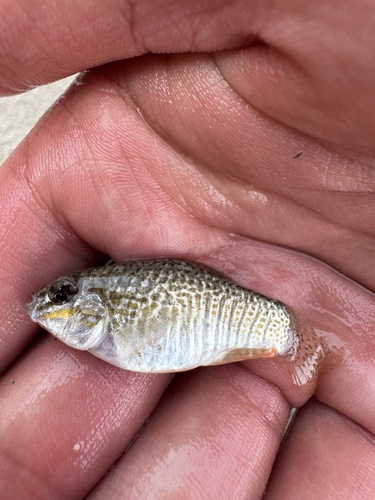
The desert pupfish (Cyprinodon macularius) is a rare species of bony fish in the family Cyprinodontidae.

Care at a glance
Species-specific values
Values researched for this exact species. Air, surface and water temperatures are listed separately, and each source is kept as published rather than averaged.
| Diet | Mainly spirulina flakes mixed with basic flake food; occasional live brine shrimp, tubifex and daphnia, plus freeze-dried bloodworms and krill. Source: aka.org | |
| Feeding frequency | Multiple light feedings throughout the day are best. Source: aka.org | |
| Social housing | The author preferred keeping about fifteen fish in the breeding tank; at least five females and three males. Source: aka.org |
Species-specific aquarium care
- Tank: At least 24 in long and 12 in front to back for one adult (adults commonly reach about 2.0 in / 5 cm).
- Water: Freshwater.
- Temperature: 77–95°F (range recorded for this species).
- pH: 7.5–8.
- Hardness: 13–19 dGH.
- Layout: Uses both the bottom and open water: give open swimming space plus cover near the substrate.
Calculated from this species' own FishBase record: tank size from its typical adult length and swimming zone, water values from its recorded ranges. The group guide below fills in general care.
Warnings
Understanding the animal
About this animal
About this animal
It is a small fish, typically less than 7.62 cm (3 in) in length. Males are generally larger than females, and have bright-blue coloration, while females and juveniles are silvery or tan.
From Wikipedia: Desert pupfish, CC BY-SA 4.0 (excerpt)
In the wild
In the wild
From this species’ own FishBase record (habitat, bottom type, water and breeding data), not its family. Wild conditions are context, not enclosure settings.1
| Where it lives | Lives in freshwater. Uses both the bottom and open water. |
| Water it lives in | Freshwater, 77–95 °F (25–35 °C), pH 7.5–8, hardness 13–19 dH. |
| Climate | Subtropical climate. |
| Behavior to plan for | Breeding: open water/substratum egg scatterers. |
Data and studies
The numbers
The numbers
Each bar is what one source reports. Where several sources weigh in, the dashed gold band marks their average.
Maximum recorded lifespan
Longest recorded lifespan reported by each database; typical lifespans are usually shorter.
Adult length
Maximum recorded length. Measured as total length. Fish in home aquariums often stay smaller than wild records.
Water temperature
Range the species tolerates in nature; aim for the middle.
pH
Water hardness
Veterinary & husbandry research
Veterinary & husbandry research
- Genotoxic Assessment of Some Inorganic Compounds in Desert Pupfish (Cyprinodon macularius) in the Evaporation Pond from a Geothermal Plant Flores-Galván M et al., Bulletin of environmental contamination and toxicology 2017
Peer-reviewed papers that mention this species alongside captivity, zoos, veterinary care or aquaculture. Some cover several species or mention it only in passing, so check the abstract. See all 2 on PubMed → PubMed
Sources for this sheet
- AnAge: The Animal Ageing and Longevity Database (Human Ageing Genomic Resources) (CC BY 3.0) Peer-reviewed researchCurated, referenced longevity and life-history records for thousands of species; maximum lifespans are often from zoo animals.
- FishBase (Froese & Pauly, eds.), version 24.07 (CC BY-NC 4.0) Peer-reviewed researchThe global scientific database on fishes, maintained by a consortium of research institutions; every value is referenced.
- 50 CFR 17.11: Endangered and threatened wildlife Zoo, university or veterinaryCurrent federal Endangered Species Act list.
- Wikipedia (species article) (CC BY-SA 4.0) Community referenceFree encyclopedia; useful overviews with their own citations. Short excerpts are quoted under CC BY-SA 4.0, each credited with a link to its article.
- PubMed (U.S. National Library of Medicine) Peer-reviewed researchIndex of peer-reviewed veterinary, zoo and husbandry research.
- iNaturalist (captive observations) Community referenceCommunity observation platform run by the California Academy of Sciences and National Geographic; observations marked captive show animals living in homes, zoos and aquariums.
More pupfish

Cyprinodon brontotheroides
Cyprinodon brontotheroides
Aquarium hobby

Cyprinodon julimes
Cyprinodon julimes
Aquarium hobby

Flagfish
Jordanella floridae
Aquarium hobby
Goldspotted killifish
Floridichthys carpio
Aquarium hobby

Scale-eating pupfish
Cyprinodon desquamator
Aquarium hobby
Sheepshead minnow
Cyprinodon variegatus
Aquarium hobby