
Home / Reptiles / Lizards / Agamidae / Splendid Japalure
No federal permit to keepSplendid Japalure
Diploderma splendidum
Reptiles › Lizards (Lacertilia) › Agamidae (Agamas and dragons)
Diploderma splendidum, the green striped tree dragon, also called splendid japalure, is an agamid lizard found in the Yangtze River Basin of southwestern China.
From Wikipedia: Diploderma splendidum, CC BY-SA 4.0 (excerpt)

Care at a glance
Species-specific values
Values researched for this exact species. Air, surface and water temperatures are listed separately, and each source is kept as published rather than averaged.
| Minimum enclosure | Vertical terrarium, minimum 80x50x100 cm for one lizard. Source: terranpolska.pl | |
| Basking surface temperature | 86–90 °F (30–32 °C) Source: terranpolska.pl | |
| Night temperature | 64–72 °F (18–22 °C) Source: terranpolska.pl | |
| Humidity | 60–70 % Source: terranpolska.pl | |
| Uvb lighting | UVB lighting at 10–12%, with a 12-hour light/12-hour dark cycle. Source: terranpolska.pl | |
| Diet | Feed insects (crickets, cockroaches, larvae), with calcium and vitamin supplementation. Source: terranpolska.pl | |
| Warm side air temperature | 77–82 °F (25–28 °C) Source: terranpolska.pl | |
| Minimum enclosure | For a pair, provide a tank at least 80x40x65 cm. Source: terrarium.com.pl | |
| Substrate | Use peat substrate for amphibians or a mix of sterilized coconut peat and peat soil; moss may be added. Source: terrarium.com.pl | |
| Uvb lighting | Use UVB lighting at 5%. Source: terrarium.com.pl | |
| Warm side air temperature | 72–79 °F (22–26 °C) Source: terrarium.com.pl | |
| Basking surface temperature | 86 °F (up to 30 °C) Source: terrarium.com.pl | |
| Night temperature | 55 °F (up to 13 °C) Source: terrarium.com.pl | |
| Humidity | 70–90 % Source: terrarium.com.pl | |
| Diet | Offer varied feeder insects; earthworms and medium-sized rose chafer larvae are also readily eaten. Supplement with vitamin-mineral preparations. Source: terrarium.com.pl | |
| Feeding frequency | Systematically supplement food with vitamin-mineral preparations. Source: terrarium.com.pl | |
| Social housing | For a pair, prepare an enclosure at least 80x40x65 cm. Source: terrarium.com.pl | |
| Seasonal cooling | The article says wintering may be needed to trigger courtship behavior. Source: terrarium.com.pl |
Understanding the animal
About this animal
About this animal
They are sold as pets internationally.
From Wikipedia: Diploderma splendidum, CC BY-SA 4.0 (excerpt)
In the wild
In the wild
| Overview | Diploderma splendidum, the green striped tree dragon, also called splendid japalure, is an agamid lizard found in the Yangtze River Basin of southwestern China. They are sold as pets internationally. — From Wikipedia: Diploderma splendidum, CC BY-SA 4.0 (excerpt) |
| Where it lives | D. splendidum is native to the temperate yet humid lowland jungles surrounding the Yangtze River in southwestern China. — From Wikipedia: Diploderma splendidum, CC BY-SA 4.0 (excerpt) |
| Wild diet | While primarily insectivorous, recent research on the gut flora of D. splendidum suggest that - due to the presence of bacteria responsible for anaerobic fermentation and the digestion of fiber - this species may occasionally be herbivorous. — From Wikipedia: Diploderma splendidum, CC BY-SA 4.0 (excerpt) |
| Appearance and size | The top of the head is covered with medium-sized, subequal, rugose, juxtaposed scales. On the snout a median series of three or four slightly enlarged subconical scales forms a faintly indicated ridge, which is flanked on each side by a considerably enlarged anterior canthal scale. No other head scales are conspicuously enlarged, except one or two on each side of the post-occipital areas. — From Wikipedia: Diploderma splendidum, CC BY-SA 4.0 (excerpt) |
Read about this species in the wild at The Reptile Database.
Native climate (measured)
Native climate (measured)
| Warm-season highs | about 83°F (up to 88°F in the hottest sampled areas) |
| Cool-season lows | about 30°F (down to 25°F in the coldest sampled areas) |
| Average temperature | 52–62°F across sampled records |
| Relative humidity | 73–77% on average (driest month about 70%) |
| Rainfall | about 1239 mm a year |
| Winters | Cool to cold winters (lows around 30°F) in much of its native range. Seasonal slowdown may be relevant, but species-specific biology determines whether brumation or hibernation occurs. |
Measured at 23 wild occurrence records sampled against WorldClim 2.1 climate data (1970–2000 averages). Air conditions in the range are ecological context, not enclosure settings: microhabitats such as burrows, leaf litter or basking rocks can be cooler, warmer or more humid.
Profile
Profile
Researched for this exact species. Sources are listed under In the wild above.
Sources for this sheet
- The Reptile Database Peer-reviewed researchScientist-curated catalog of every reptile species, with taxonomy and literature.
- GBIF Backbone Taxonomy (Global Biodiversity Information Facility) (CC BY 4.0) Peer-reviewed researchInternational scientific taxonomy used here for classification. GBIF Secretariat (2023). GBIF Backbone Taxonomy. Checklist dataset https://doi.org/10.15468/39omei, accessed via GBIF.org.
- Wikipedia (species article) (CC BY-SA 4.0) Community referenceFree encyclopedia; useful overviews with their own citations. Short excerpts are quoted under CC BY-SA 4.0, each credited with a link to its article.
- iNaturalist (captive observations) Community referenceCommunity observation platform run by the California Academy of Sciences and National Geographic; observations marked captive show animals living in homes, zoos and aquariums.
More agamas and dragons
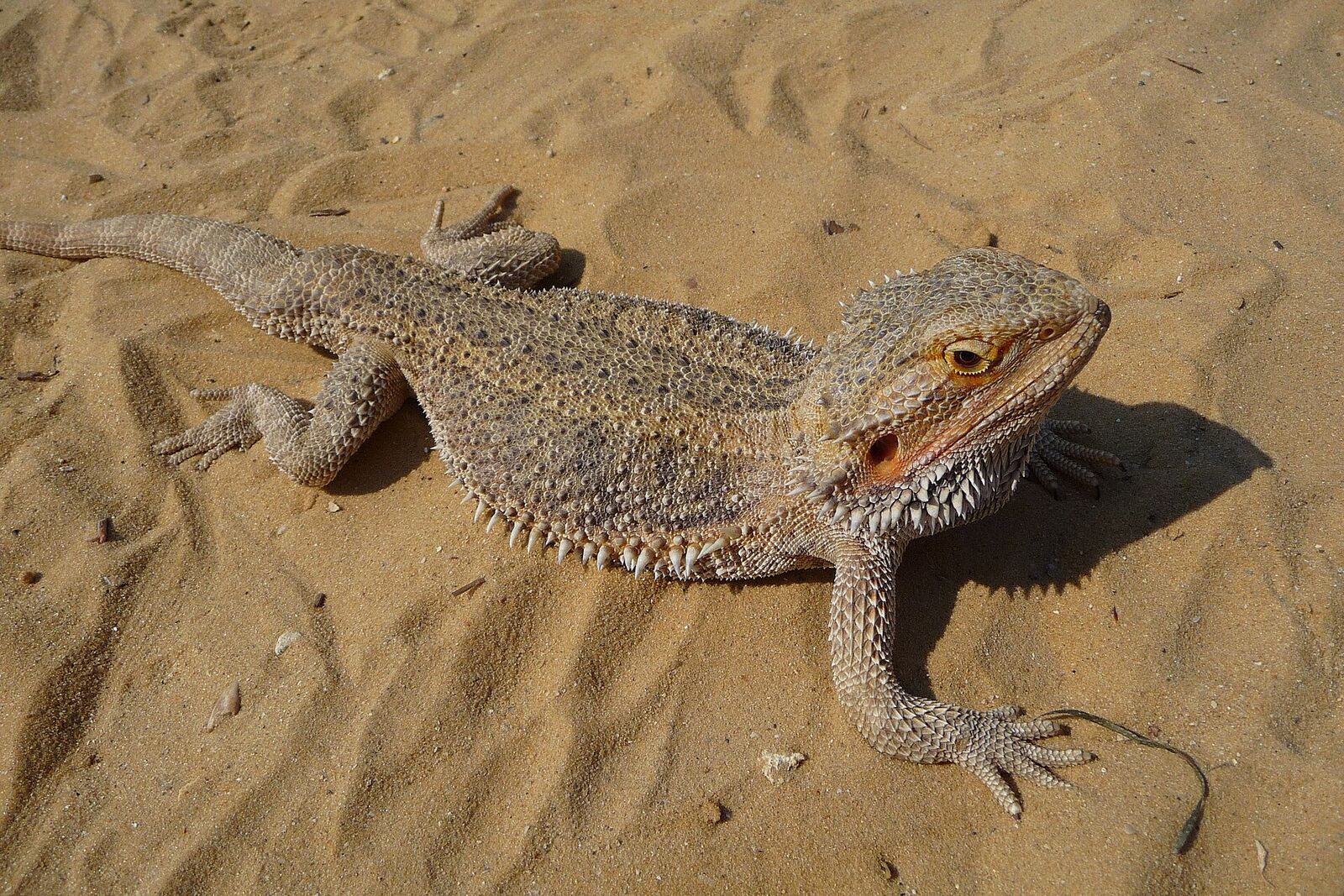
Bearded dragon
Pogona vitticeps
Sun-loving, friendly and endlessly popular.
Pet trade

(Sulawesi) Sailfin Lizard
Hydrosaurus celebensis
Pet trade

(Sulawesi) Sailfin Lizard (Hydrosaurus microlophus)
Hydrosaurus microlophus
Pet trade

Australian water dragon
Intellagama lesueurii
Pet trade

Bent's Mastigure
Uromastyx benti
Pet trade

Black-necked agama
Acanthocercus atricollis
Zoos & aquariums