
Home / Fishes / Tetras, piranhas and pacus / Distichodontidae / Distichodus noboli
No federal permit to keepDistichodus noboli
Distichodus noboli
Fishes › Tetras, piranhas and pacus (Characiformes) › Distichodontidae (Distichodus and African characins)
Care at a glance
Species-specific values
Values researched for this exact species. Air, surface and water temperatures are listed separately, and each source is kept as published rather than averaged.
| Minimum enclosure | A small group requires a tank measuring at least 300 litres. Source: tankora.co.uk | |
| Water temperature | 72–79 °F (22–26 °C) Source: tankora.co.uk | |
| Diet | Use spirulina-based flake or pellets as a staple, with vegetables and algae wafers; offer protein foods occasionally. Source: tankora.co.uk | |
| Feeding frequency | Feed two to three times daily, removing uneaten vegetables after several hours. Source: tankora.co.uk | |
| Social housing | Keep them in groups of four to six or more; solitary fish may become stressed. Source: tankora.co.uk | |
| Substrate | Avoid sharp substrates; use smooth gravel or sand with a fine to medium grade. Source: tankora.co.uk |
Species-specific aquarium care
- Tank: At least 48 in long and 15 in front to back for one adult (adults commonly reach about 7.5 in / 19 cm).
- Water: Freshwater.
- Layout: An open-water swimmer: needs long, open swimming space with few obstacles.
Calculated from this species' own FishBase record: tank size from its typical adult length and swimming zone, water values from its recorded ranges. The group guide below fills in general care.
Understanding the animal
In the wild
In the wild
From this species’ own FishBase record (habitat, bottom type, water and breeding data), not its family. Wild conditions are context, not enclosure settings.1
| Where it lives | Lives in freshwater. |
| Climate | Tropical climate. |
Data and studies
The numbers
The numbers
Each bar is what one source reports. Where several sources weigh in, the dashed gold band marks their average.
Adult length
Maximum recorded length. Measured as total length. Fish in home aquariums often stay smaller than wild records.
Sources for this sheet
- FishBase (Froese & Pauly, eds.), version 24.07 (CC BY-NC 4.0) Peer-reviewed researchThe global scientific database on fishes, maintained by a consortium of research institutions; every value is referenced.
More distichodus and african characins
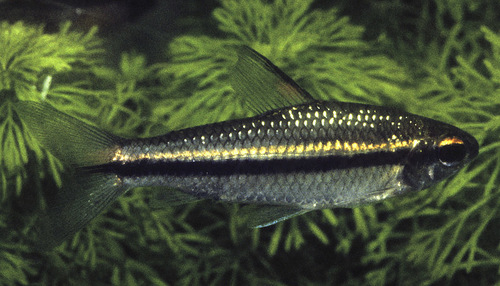
Oneline tetra
Nannaethiops unitaeniatus
Aquarium hobby

Six-banded distichodus
Distichodus sexfasciatus
Aquarium hobby
African pike-characin
Phago loricatus
Aquarium hobby
Ansorge's characin
Neolebias ansorgii
Aquarium hobby
Longsnout distichodus
Distichodus lusosso
Aquarium hobby
Multibar citharine
Nannocharax multifasciatus
Aquarium hobby