
Home / Mammals / Cats, dogs and other carnivores / Domestic cat
No federal permit to keepDomestic cat
Felis catus
Mammals › Cats, dogs and other carnivores (Carnivora) › Felidae (Cats)
The cat (Felis catus), also called domestic cat and house cat, is a small domesticated carnivorous mammal.

Care at a glance
Species-specific values
Values researched for this exact species. Air, surface and water temperatures are listed separately, and each source is kept as published rather than averaged.
| Minimum diet crude protein | 26 % dry matter AAFCO adult-maintenance minimum reported by MSD; not a complete ration specification. | merckvetmanual.com |
| Minimum diet crude protein | 30 % dry matter AAFCO growth minimum reported by MSD; not a complete ration specification. | merckvetmanual.com |
| Diet | Feed high-quality, brand-name food balanced for the cat’s life stage; ask a veterinarian to determine the best diet. Source: aspca.org | |
| Substrate | Provide a clean, dry sleeping place lined with a soft, warm blanket or towel; wash bedding often. Source: aspca.org |
Understanding the animal
About this animal
About this animal
It is a member of Felidae, the family of mammals in the order Carnivora also colloquially referred to as cats. An obligate carnivore requiring a predominantly meat-based diet, it has retractable claws adapted to killing small prey species such as mice and rats.
From Wikipedia: Cat, CC BY-SA 4.0 (excerpt)
In the wild
In the wild
Researched for this exact species, not its family. Wild conditions are context, not enclosure settings.1234
| Where it lives | A domesticated species with feral populations, usually near current or former settlements, farms and urban areas worldwide. Feral habitat should not be confused with the native habitat of wildcat species. |
| Ground it lives on | Variable soil or built surfaces; also climbs trees and structures. |
| Climate | Temperate habitat is listed, but the provided sources give no temperature, humidity, or seasonal values. |
| Active | Cathemeral in some urban-edge populations, with dawn and dusk peaks; other populations are predominantly nocturnal. |
| Social life | Solitary hunters; may live in related-female colonies where concentrated food supports them. Territories and resource competition remain important. |
| Wild diet | Small rodents, birds and arthropods; human-provided food where available. |
| Behavior to plan for | Climbs and stalks prey; marks space by scratching, rubbing and urine spraying. |
Native climate (measured)
Native climate (measured)
| Warm-season highs | about 87°F (up to 95°F in the hottest sampled areas) |
| Cool-season lows | about 34°F (down to 21°F in the coldest sampled areas) |
| Average temperature | 48–80°F across sampled records |
| Relative humidity | 67–76% on average (driest month about 65%) |
| Rainfall | about 957 mm a year |
| Winters | Cool to cold winters (lows around 34°F) in much of its native range. Seasonal slowdown may be relevant, but species-specific biology determines whether brumation or hibernation occurs. |
Measured at 119 wild occurrence records sampled against WorldClim 2.1 climate data (1970–2000 averages). Air conditions in the range are ecological context, not enclosure settings: microhabitats such as burrows, leaf litter or basking rocks can be cooler, warmer or more humid.
Profile
Profile
Researched for this exact species. Sources are listed under In the wild above.
History
Archaeological and genetic evidence places the beginning of cat domestication in the Near East around 7500 BCE. Domestic cats subsequently spread worldwide with humans and are now kept for companionship, vermin control, work, and showing.
Data and studies
The numbers
The numbers
Each bar is what one source reports. Where several sources weigh in, the dashed gold band marks their average.
Maximum recorded lifespan
Longest recorded lifespan reported by each database; typical lifespans are usually shorter. The AnAge record comes from an animal in human care.
Typical adult weight
Average adult body mass in each database (FishBase gives the maximum recorded weight).
Litter size
Average per litter or clutch.
Gestation
Female maturity
Veterinary & husbandry research
Veterinary & husbandry research
- Patent ductus arteriosus in cats (Felis catus): 50 cases (2000-2015) Bascuñán A et al., Journal of veterinary cardiology: the official journal of the European Society of Veterinary Cardiology 2017
Peer-reviewed papers that mention this species alongside captivity, zoos, veterinary care or aquaculture. Some cover several species or mention it only in passing, so check the abstract. See all 215 on PubMed → PubMed
Sources for this sheet
- AnAge: The Animal Ageing and Longevity Database (Human Ageing Genomic Resources) (CC BY 3.0) Peer-reviewed researchCurated, referenced longevity and life-history records for thousands of species; maximum lifespans are often from zoo animals.
- Myhrvold et al. (2015). An amniote life-history database. Ecology 96: 3109 Peer-reviewed researchPeer-reviewed compilation of life-history data for over 21,000 birds, mammals and reptiles.
- 9 CFR 2.1: Animal Welfare Act licensing (USDA) Zoo, university or veterinaryWho needs a USDA license to breed, sell or exhibit animals.
- Clint's Reptiles (YouTube): Cat, The Best Pet Mammal? Expert educator & keeperClint Laidlaw, PhD in Biology Education and MS in Evolutionary Ecology; owner of Clint's Reptile Room and a longtime keeper. His "Best Pet?" series reviews each species' care in depth.
- GBIF Backbone Taxonomy (Global Biodiversity Information Facility) (CC BY 4.0) Peer-reviewed researchInternational scientific taxonomy used here for classification. GBIF Secretariat (2023). GBIF Backbone Taxonomy. Checklist dataset https://doi.org/10.15468/39omei, accessed via GBIF.org.
- Species+ (UNEP-WCMC and the CITES Secretariat) Zoo, university or veterinaryThe official database of species listed under CITES. UNEP (2026). The Species+ Website. Nairobi, Kenya. Compiled by UNEP-WCMC, Cambridge, UK. Available at: www.speciesplus.net. [Accessed 04/10/2026].
- Wikipedia (species article) (CC BY-SA 4.0) Community referenceFree encyclopedia; useful overviews with their own citations. Short excerpts are quoted under CC BY-SA 4.0, each credited with a link to its article.
- PubMed (U.S. National Library of Medicine) Peer-reviewed researchIndex of peer-reviewed veterinary, zoo and husbandry research.
- iNaturalist (captive observations) Community referenceCommunity observation platform run by the California Academy of Sciences and National Geographic; observations marked captive show animals living in homes, zoos and aquariums.
More cats
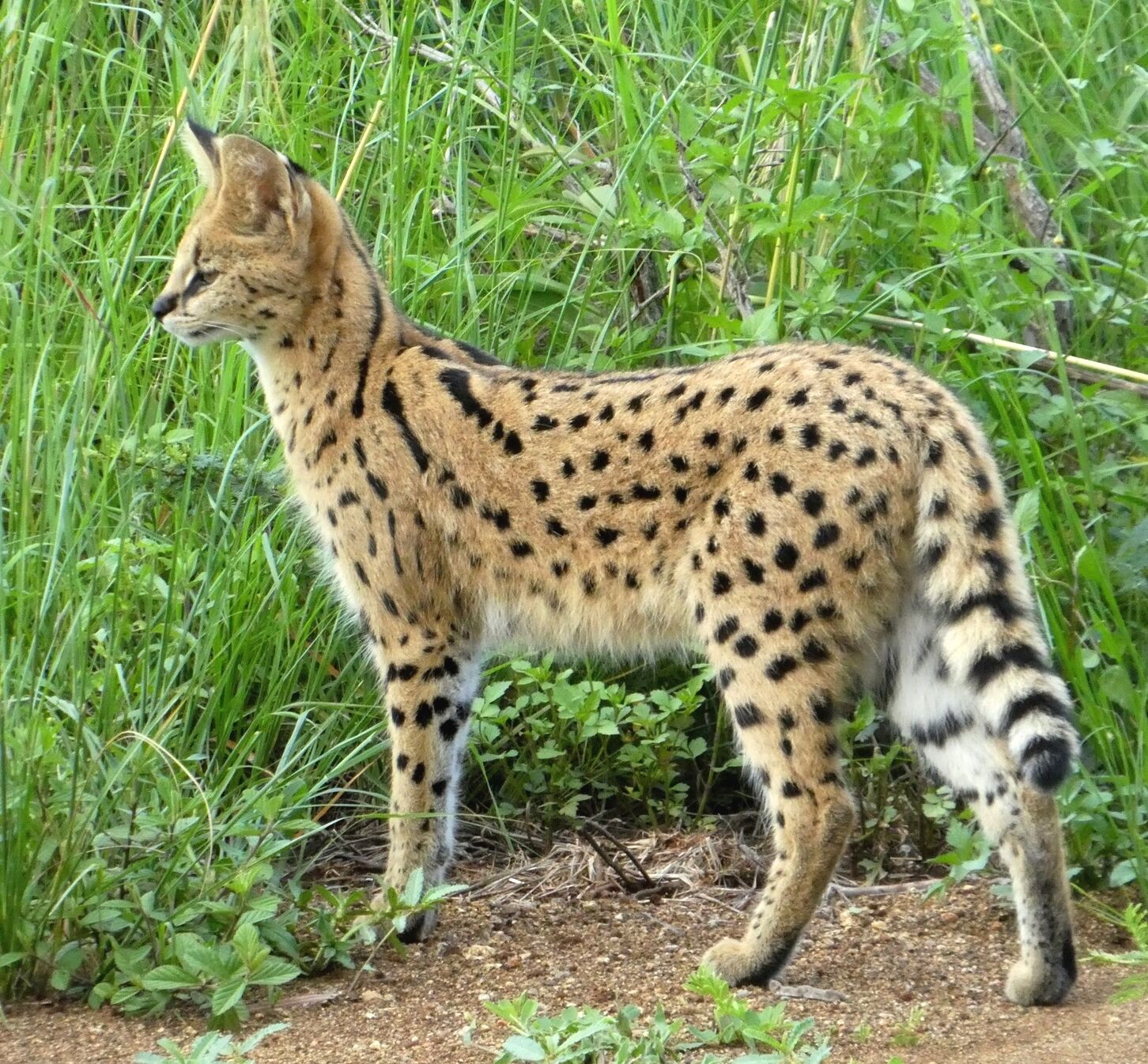
Serval
Leptailurus serval
A long-legged African cat that can leap 5 feet.
Pet trade

Asian golden cat
Catopuma temminckii
Pet trade

Black-footed cat
Felis nigripes
Pet trade

Bobcat
Lynx rufus
Zoos & aquariums

Canada lynx
Lynx canadensis
Zoos & aquariums

Caracal
Caracal caracal
Pet trade