Home / Fishes / Killifish and livebearers / Dwarf panchax
No federal permit to keepDwarf panchax
Aplocheilus parvus
Fishes › Killifish and livebearers (Cyprinodontiformes) › Aplocheilidae (Panchax killifish)
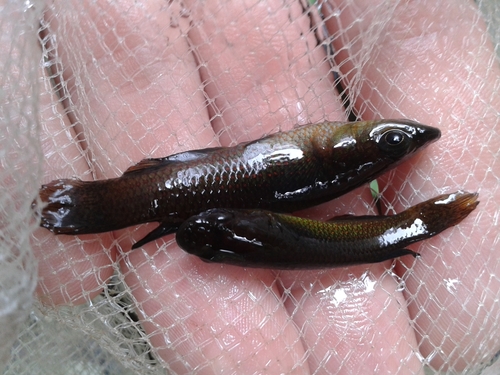
Aplocheilus parvus, the dwarf panchax, is a species of killifish native to India and Sri Lanka, and was first identified in 1916 by Sundara Raj.

Care at a glance
Species-specific aquarium care
- Tank: At least 24 in long and 12 in front to back for one adult (adults commonly reach about 1.6 in / 4 cm; the largest recorded was 2.5 in).
- Water: Freshwater (tolerates brackish).
- Temperature: 72–77°F (range recorded for this species).
- pH: 6.5–7.2.
- Layout: Uses both the bottom and open water: give open swimming space plus cover near the substrate.
- Diet: A predator: feed meaty foods sized to its mouth (frozen fish, shrimp, worms); it will eat tankmates that fit in its mouth. FishBase classes it as a carnivore.
Calculated from this species' own FishBase record: tank size from its typical adult length and swimming zone, water values from its recorded ranges. The group guide below fills in general care.
Care guide
Species care notes
- Tank: a base of at least 18 × 12 in (roughly 11 US gallons); space needed is rated “modest tank”.
- Water: a fairly wide range, from slightly acidic to slightly alkaline, 68–82 °F, pH 6–8.5, 2–20 dGH.
- Behaviour: a shoaling fish best kept in a group of six or more; suited to a community tank.
- Difficulty: Easy (Seriously Fish rating).
From the Seriously Fish profile for this species, which has the full habitat, maintenance, diet, behaviour and breeding write-up 167
Panchax killifish
Applies to most species in this group. Habitat: Aplocheilus inhabit vegetated Asian streams, swamps and rice paddies, while Pachypanchax occur in Madagascar and Seychelles freshwater habitats (lineatus, playfairii). Individual species can differ, so compare with the species numbers above and the linked sources.
Housing & setup
- For A. lineatus use at least 75 × 30 × 30 cm, approximately 68 L (lineatus).
- Fit a close-fitting lid to prevent Aplocheilus jumping (lineatus).
- Provide dim lighting, floating plants and dense planted refuges (lineatus).
- Arrange wood and rocks into hiding places, especially for subordinate fish (lineatus).
Diet
- Quality dried food sized to the fish (lineatus, playfairii).
- Live or frozen Daphnia and bloodworms (playfairii).
- Gut-loaded wingless fruit flies or tiny crickets for Pachypanchax (playfairii).
Social life
- Keep only tankmates too large to swallow; male aggression requires space and refuges, and species tanks are preferable for conservation breeding (lineatus, playfairii).
Health watch
- Ammonia toxicity from inadequate biofiltration (fish_health).
- Parasitic skin and gill infections (fish_health).
- Nutritional deficiencies from unsuitable diets (fish_health).
Understanding the animal
About this animal
About this animal
This species grows to a length of 6.3 cm (2.5 in). Its natural habitats are sheltered fresh and brackish water tanks, small streams and rivulets overgrown with vegetation As aquarium fish, they are difficult to maintain but continue to be popular due to their small size and bright coloration.
Quoted from the Wikipedia article “Aplocheilus parvus” (CC BY-SA 4.0) 174
In the wild
In the wild
From this species’ own FishBase record (habitat, bottom type, water and breeding data), not its family. Good care copies these conditions.1
| Where it lives | Lives in freshwater and brackish water, in rivers and streams. Uses both the bottom and open water. Inhabits sheltered fresh and brackish water tanks, small streams and rivulets overgrown with vegetation. |
| Water it lives in | Freshwater / brackish water, 72–77 °F (22–25 °C), pH 6.5–7.2. |
| Climate | Tropical climate. |
| Wild diet | Hunting macrofauna (predator). |
| Behavior to plan for | Breeding: open water/substratum egg scatterers. |
What this means for care
- Keep water within its wild range, 72–77 °F.
- It tolerates or needs brackish water; check salinity needs before setup.
Native climate (measured)
Native climate (measured)
| Warm-season highs | about 92°F (up to 100°F in the hottest sampled areas) |
| Cool-season lows | about 71°F (down to 68°F in the coldest sampled areas) |
| Average temperature | 81–83°F across sampled records |
| Relative humidity | 72–77% on average (driest month about 69%) |
| Rainfall | about 1348 mm a year |
Measured at 41 wild occurrence records sampled against WorldClim 2.1 climate data (1970–2000 averages). Air conditions in the range are ecological context, not enclosure settings: microhabitats such as burrows, leaf litter or basking rocks can be cooler, warmer or more humid.
From the sources
From the sources
Quoted from the matching sections of reputable sources for this exact species. Specialist databases are used first; Wikipedia (community-edited, CC BY-SA 4.0) only fills gaps. Other sources are short credited quotes.
| Overview | Aplocheilus parvus, the dwarf panchax, is a species of killifish native to India and Sri Lanka, and was first identified in 1916 by Sundara Raj. This species grows to a length of 6.3 cm (2.5 in). Its natural habitats are sheltered fresh and brackish water tanks, small streams and rivulets overgrown with vegetation As aquarium fish, they are difficult to maintain but continue to be popular due to their small size and bright coloration. It is often misidentified as other species under the same genus, Aplocheilus. — Wikipedia (community-edited) |
| Where it lives | Home ranges Population dynamics Growth parameters Max. ages / sizes Length-weight rel. Length-frequencies Mass conversion Recruitment Abundance Life cycle Reproduction Maturity Maturity/Gills rel. — FishBase |
| Wild diet | A. parvus are diurnal feeders that prey on adult and larval stages of Insecta (coleoptera, Hymenoptera), Maxillopoda (Copepod), and Malacostraca. These fish are also selective eaters, so regardless of prey scarcity and habitat type, A. parvus will continue to prefer insects and insect larvae. — Wikipedia (community-edited) |
| Reproduction | A. parvus prefers dark areas to breed and during the breeding season, males become aggressive to one another in order to fight for females. They lay eggs and attach them to mosses, fine-leaved plants, and algae. Aside from being surface dwellers, this is another reason why they prefer habitats with lots of vegetation. — Wikipedia (community-edited) |
| Appearance and size | The body size of Aplocheilus parvus can range from 2 cm to 6.3 cm. They have a terminal mouth and their head is flat at the top. Their bodies are slender and elongated, possessing round scales, round fins, and lack barbels. — Wikipedia (community-edited) |
| Biology | Inhabits sheltered fresh and brackish water tanks, small streams and rivulets overgrown with vegetation. Valuable for mosquito control. Not a seasonal killifish. — FishBase |
| Conservation | After a 2019 assessment by the IUCN, they concluded that A. parvus is of least concern. Although these fish are common in their native habitat, they are still faced with threats of habitat fragmentation, pollution from farming and mining, and increased competition from introduced exotic species used to combat invasive pests. — Wikipedia (community-edited) |
Data and studies
The numbers
The numbers
Each bar is what one source reports. Where several sources weigh in, the dashed gold band marks their average.
Adult length
Common length to maximum recorded length. Measured as total length. Fish in home aquariums often stay smaller than wild records.
Water temperature
Range the species tolerates in nature; aim for the middle.
Water hardness
Minimum tank footprint
Seriously Fish recommends a tank base of at least 18 × 12 in (about 11 US gallons).
Sources for this sheet
- FishBase (Froese & Pauly, eds.), version 24.07 Peer-reviewed researchThe global scientific database on fishes, maintained by a consortium of research institutions; every value is referenced.
- Seriously Fish species profiles Experienced keeper or breederLong-running aquarium reference written and peer-checked by experienced fishkeepers and ichthyologists; each profile covers habitat, tank size, water, diet, behaviour and breeding.
- Seriously Fish: Aplocheilus lineatus Experienced keeper or breederAdded in the 2026 source-checked care-guide review.
- Seriously Fish: Pachypanchax playfairii Experienced keeper or breederAdded in the 2026 source-checked care-guide review.
- Merck Veterinary Manual: Disorders and Diseases of Fish Zoo, university or veterinaryAdded in the 2026 source-checked care-guide review.
- Merck Veterinary Manual: Management of Aquarium Fish Zoo, university or veterinaryAdded in the 2026 source-checked care-guide review.
- Wikipedia (species article) Community referenceFree encyclopedia; useful overviews with their own citations. Intro text is quoted under CC BY-SA 4.0.
More panchax killifish
Golden panchax
Pachypanchax playfairii
Aquarium hobby
Green panchax
Aplocheilus blockii
Aquarium hobby

Powder-blue panchax
Pachypanchax omalonotus
Aquarium hobby

Sakaramy Killifish
Pachypanchax sakaramyi
Aquarium hobby

Striped panchax
Aplocheilus lineatus
Aquarium hobby
Pachypanchax arnoulti
Pachypanchax arnoulti
Aquarium hobby