
Home / Invertebrates / Isopods / Dwarf white isopod
No federal permit to keepDwarf white isopod
Trichorhina tomentosa
Invertebrates › Isopods (Isopoda) › Platyarthridae (Dwarf white isopods)
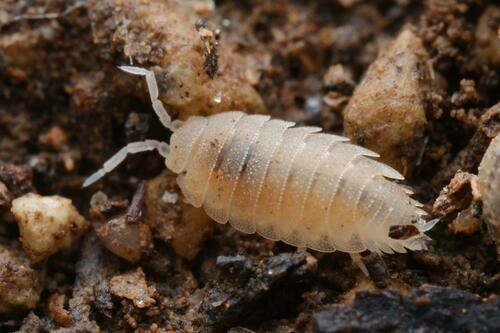
Trichorhina tomentosa, known informally as the dwarf white isopod, is a species of woodlouse in the family Platyarthridae.
From Wikipedia: Trichorhina tomentosa, CC BY-SA 4.0 (excerpt)
Care at a glance
Species-specific values
Values researched for this exact species. Air, surface and water temperatures are listed separately, and each source is kept as published rather than averaged.
| Substrate moisture gradient | moist: 100 % of substrate area; drier: 0 % of substrate area Keeper exception to dry/moist halves; moist does not mean flooded. | springtails.us |
| Warm side air temperature | 72–82 °F Source: thebiodude.com | |
| Humidity | 75–95 % Source: thebiodude.com | |
| Diet | Feeds on decaying hardwood, leaf litter, decomposing wood, supplemental vegetables and protein sources. Source: thebiodude.com | |
| Substrate | Layer Terra Isopoda Substrate on top of Terra Flora or Terra Fauna, based on the enclosure setup. Source: thebiodude.com | |
| Minimum enclosure | A small, well-ventilated tub is plenty. Source: postpods.co.uk | |
| Humidity | Maintain high humidity levels while keeping the substrate uniformly moist. Source: postpods.co.uk | |
| Diet | Mainly decaying wood and leaf litter, with occasional protein and vegetable scraps. Source: postpods.co.uk | |
| Substrate | Use moist, nutritious organic substrate with leaf litter; about 5 cm deep is ample. Source: postpods.co.uk |
Understanding the animal
About this animal
About this animal
It is a parthenogenetic species, and only female individuals are known. Native to tropical regions throughout the Americas, dwarf white isopods have been introduced to other tropical regions worldwide.
From Wikipedia: Trichorhina tomentosa, CC BY-SA 4.0 (excerpt)
In the wild
In the wild
| Overview | Trichorhina tomentosa, known informally as the dwarf white isopod, is a species of woodlouse in the family Platyarthridae. It is a parthenogenetic species, and only female individuals are known. Native to tropical regions throughout the Americas, dwarf white isopods have been introduced to other tropical regions worldwide. — From Wikipedia: Trichorhina tomentosa, CC BY-SA 4.0 (excerpt) |
| Appearance and size | Dwarf white isopods can grow to around 2–3 mm in length. They are uniformly white in color, and like other members in its family, cannot roll into a ball. Like many other woodlice, dwarf white isopods prefer moist soil, feeding on detritus. — From Wikipedia: Trichorhina tomentosa, CC BY-SA 4.0 (excerpt) |
Native climate (measured)
Native climate (measured)
| Warm-season highs | about 77°F (up to 90°F in the hottest sampled areas) |
| Cool-season lows | about 44°F (down to 21°F in the coldest sampled areas) |
| Average temperature | 45–78°F across sampled records |
| Relative humidity | 75–80% on average (driest month about 70%) |
| Rainfall | about 990 mm a year, spread fairly evenly |
Measured at 66 wild occurrence records sampled against WorldClim 2.1 climate data (1970–2000 averages). Air conditions in the range are ecological context, not enclosure settings: microhabitats such as burrows, leaf litter or basking rocks can be cooler, warmer or more humid.
Sources for this sheet
- SeaLifeBase (Palomares & Pauly, eds.), version 24.07 (CC BY-NC 4.0) Peer-reviewed researchFishBase's sister database for non-fish marine and freshwater life; values are referenced.
- GBIF Backbone Taxonomy (Global Biodiversity Information Facility) (CC BY 4.0) Peer-reviewed researchInternational scientific taxonomy used here for classification. GBIF Secretariat (2023). GBIF Backbone Taxonomy. Checklist dataset https://doi.org/10.15468/39omei, accessed via GBIF.org.
- Wikipedia (species article) (CC BY-SA 4.0) Community referenceFree encyclopedia; useful overviews with their own citations. Short excerpts are quoted under CC BY-SA 4.0, each credited with a link to its article.
- iNaturalist (captive observations) Community referenceCommunity observation platform run by the California Academy of Sciences and National Geographic; observations marked captive show animals living in homes, zoos and aquariums.