
Home / Invertebrates / Scorpions / Dwarf wood scorpion
No federal permit to keepDwarf wood scorpion
Liocheles australasiae
Invertebrates › Scorpions (Scorpiones) › Hormuridae (Rock and wood scorpions)
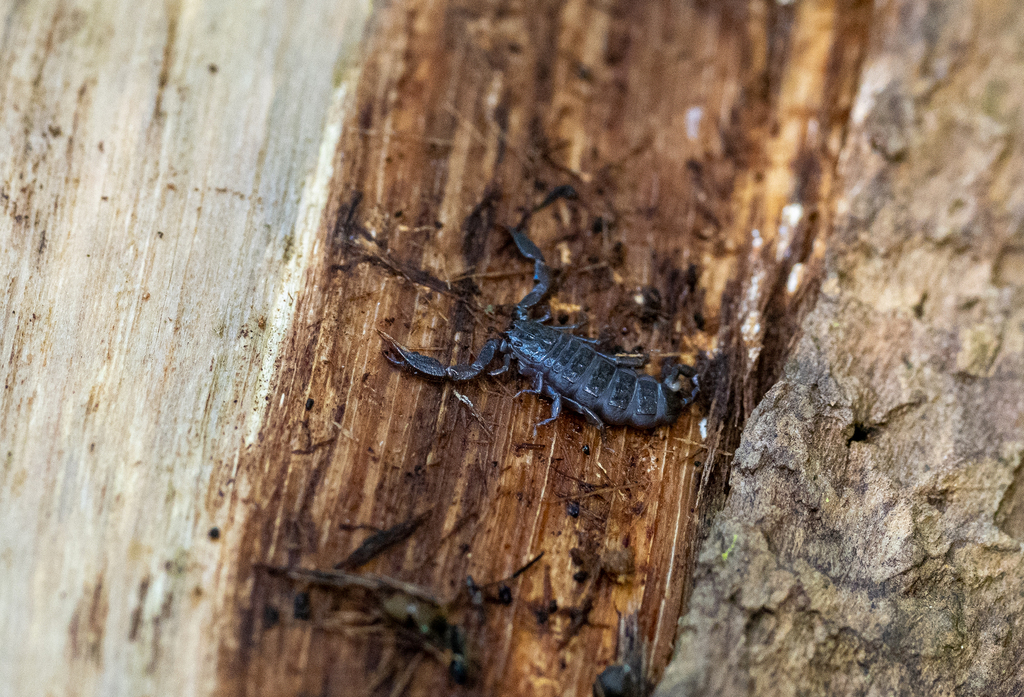
Liocheles australasiae, the dwarf wood scorpion, is a species of scorpion belonging to the family Hormuridae.
From Wikipedia: Liocheles australasiae, CC BY-SA 4.0 (excerpt)
Care at a glance
Species-specific values
Values researched for this exact species. Air, surface and water temperatures are listed separately, and each source is kept as published rather than averaged.
| Minimum enclosure | House adults in a space at least 20 × 15 × 15 cm. Source: academy.herpeton.net | |
| Night temperature | 68–75 °F (20–24 °C) Source: academy.herpeton.net | |
| Humidity | 65–80 % Source: academy.herpeton.net | |
| Uvb lighting | UVB is not required. Source: academy.herpeton.net | |
| Diet | Offer various tiny prey, smaller than the scorpion’s body. Source: academy.herpeton.net | |
| Feeding frequency | Feed adults every 5–10 days; juveniles more frequently in smaller portions. Source: academy.herpeton.net | |
| Social housing | House individuals separately unless conducting a controlled breeding project. Source: academy.herpeton.net | |
| Substrate | Use 4–6 cm of rotten hardwood, coconut fibre, and soil. Source: academy.herpeton.net | |
| Minimum enclosure | Tiny scorplings need a small secure enclosure; larger animals need scaled bark crevices, floor space, and prey. Source: bigzs.shop | |
| Humidity | 70–80 % Source: bigzs.shop | |
| Diet | Offer manageable small crickets or roaches; tiny young can take crushed prey, freshly killed portions, or slower prey. Source: bigzs.shop | |
| Feeding frequency | Base meal sizes on feeding response and body condition rather than a strict schedule; avoid feeding during molts. Source: bigzs.shop | |
| Social housing | House one scorpion per enclosure. Source: bigzs.shop | |
| Substrate | Use firm damp soil or coir beneath partly buried cork. Source: bigzs.shop | |
| Enclosure temperature | Keep temperature steady, starting near 77°F. Source: bigzs.shop |
Understanding the animal
In the wild
In the wild
| Overview | Liocheles australasiae, the dwarf wood scorpion, is a species of scorpion belonging to the family Hormuridae. — From Wikipedia: Liocheles australasiae, CC BY-SA 4.0 (excerpt) |
| Where it lives | This species is present in India, Sri Lanka, Bangladesh, Yaeyama Islands (Japan), China, Thailand, Vietnam, Malaysia, Philippines, Taiwan, Mariana Islands, Indonesia, Australia, Papua New Guinea, Solomon Islands, New Caledonia, Fiji, Tonga, Samoa and French Polynesia. — From Wikipedia: Liocheles australasiae, CC BY-SA 4.0 (excerpt) |
| Appearance and size | This small scorpion has the total length of 22 to 36 mm. Most of the populations are parthenogenetic, meaning they can produce young without males. — From Wikipedia: Liocheles australasiae, CC BY-SA 4.0 (excerpt) |
Native climate (measured)
Native climate (measured)
| Warm-season highs | about 87°F (up to 90°F in the hottest sampled areas) |
| Cool-season lows | about 69°F (down to 57°F in the coldest sampled areas) |
| Average temperature | 72–81°F across sampled records |
| Relative humidity | 79–84% on average (driest month about 78%) |
| Rainfall | about 2362 mm a year |
Measured at 94 wild occurrence records sampled against WorldClim 2.1 climate data (1970–2000 averages). Air conditions in the range are ecological context, not enclosure settings: microhabitats such as burrows, leaf litter or basking rocks can be cooler, warmer or more humid.
Sources for this sheet
- GBIF Backbone Taxonomy (Global Biodiversity Information Facility) (CC BY 4.0) Peer-reviewed researchInternational scientific taxonomy used here for classification. GBIF Secretariat (2023). GBIF Backbone Taxonomy. Checklist dataset https://doi.org/10.15468/39omei, accessed via GBIF.org.
- Wikipedia (species article) (CC BY-SA 4.0) Community referenceFree encyclopedia; useful overviews with their own citations. Short excerpts are quoted under CC BY-SA 4.0, each credited with a link to its article.
- iNaturalist (captive observations) Community referenceCommunity observation platform run by the California Academy of Sciences and National Geographic; observations marked captive show animals living in homes, zoos and aquariums.
