
Home / Amphibians / Frogs and toads / Eastern spadefoot
No federal permit to keepEastern spadefoot
Scaphiopus holbrookii
Amphibians › Frogs and toads (Anura) › Scaphiopodidae (Spadefoot toads)
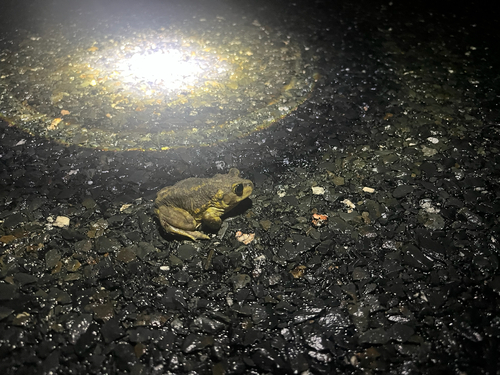
Scaphiopus holbrookii, commonly known as the eastern spadefoot, is a species of American spadefoot toad (family Scaphiopodidae) endemic to the eastern United States.
From Wikipedia: Scaphiopus holbrookii, CC BY-SA 4.0 (excerpt)
Care at a glance
Species-specific values
Values researched for this exact species. Air, surface and water temperatures are listed separately, and each source is kept as published rather than averaged.
| Minimum enclosure | At least 60x40x40 cm for one toad or a pair. Source: atlarium.bio | |
| Warm side air temperature | 68–75 °F (20–24 °C) Source: atlarium.bio | |
| Humidity | 60–70 % Source: atlarium.bio | |
| Uvb lighting | Intense UVB is unnecessary; low-output 2.0 or 5.0 can help maintain a natural day-night cycle. Source: atlarium.bio | |
| Diet | Provide prey like mealworms, crickets, small earthworms, roaches, and fruit flies. Source: atlarium.bio | |
| Feeding frequency | Feed at night; dust juveniles' prey with calcium every feeding and adults' prey twice weekly; add D3 and multivitamins weekly. Source: atlarium.bio | |
| Social housing | Small same-species groups are suitable when there is enough space and substrate. Source: atlarium.bio | |
| Substrate | Use at least 15-20 cm of damp, not soggy substrate; unfertilized peat, coconut fiber, and fine sand are suggested. Source: atlarium.bio | |
| Seasonal cooling | Trigger breeding and mimic brumation through a regulated cooling phase featuring lowered humidity. Source: atlarium.bio |
Understanding the animal
About this animal
About this animal
It is not considered a true toad, with Bufonidae being the family of "true toads".
From Wikipedia: Scaphiopus holbrookii, CC BY-SA 4.0 (excerpt)
In the wild
In the wild
| Overview | Scaphiopus holbrookii, commonly known as the eastern spadefoot, is a species of American spadefoot toad (family Scaphiopodidae) endemic to the eastern United States. It is not considered a true toad, with Bufonidae being the family of "true toads". — From Wikipedia: Scaphiopus holbrookii, CC BY-SA 4.0 (excerpt) |
| Wild diet | Although Scaphiopus holbrookii is both diurnal and nocturnal, most foraging for food sources, consisting of small invertebrates such as termites, insects, arachnids, worms, ants, beetles, and grasshoppers is completed during the day. — From Wikipedia: Scaphiopus holbrookii, CC BY-SA 4.0 (excerpt) |
| Behavior | Scaphiopus holbrookii spends almost all of its life deep underground; emerging only to breed or feed. It remains in a type of hibernation almost all its life. Burrow depth changes in the summer and winter. — From Wikipedia: Scaphiopus holbrookii, CC BY-SA 4.0 (excerpt) |
| History and naming | The epithet, holbrookii, is in honor of John Edwards Holbrook, American herpetologist. A similar species is Hurter's spadefoot toad, which was once considered a subspecies of S. holbrookii. — From Wikipedia: Scaphiopus holbrookii, CC BY-SA 4.0 (excerpt) |
| Conservation | While not listed as an endangered species by the U.S. federal government, S. holbrookii is considered "threatened" in Massachusetts and is listed endangered in Connecticut. In those states and in 13 others, it is listed as a "Species of Greatest Conservation Need". — From Wikipedia: Scaphiopus holbrookii, CC BY-SA 4.0 (excerpt) |
Read about this species in the wild at Animal Diversity Web.
Native climate (measured)
Native climate (measured)
| Warm-season highs | about 90°F (up to 92°F in the hottest sampled areas) |
| Cool-season lows | about 40°F (down to 26°F in the coldest sampled areas) |
| Average temperature | 56–71°F across sampled records |
| Relative humidity | 69–73% on average (driest month about 66%) |
| Rainfall | about 1289 mm a year, spread fairly evenly |
| Winters | Cool to cold winters (lows around 40°F) in much of its native range. Seasonal slowdown may be relevant, but species-specific biology determines whether brumation or hibernation occurs. |
Measured at 91 wild occurrence records sampled against WorldClim 2.1 climate data (1970–2000 averages). Air conditions in the range are ecological context, not enclosure settings: microhabitats such as burrows, leaf litter or basking rocks can be cooler, warmer or more humid.
Profile
Profile
Researched for this exact species. Sources are listed under In the wild above.
History
The epithet, holbrookii, is in honor of John Edwards Holbrook, American herpetologist. A similar species is Hurter's spadefoot toad, which was once considered a subspecies of S. holbrookii.
From Wikipedia: Scaphiopus holbrookii, CC BY-SA 4.0 (excerpt)
Data and studies
The numbers
The numbers
Each bar is what one source reports. Where several sources weigh in, the dashed gold band marks their average.
Maximum recorded lifespan
Longest recorded lifespan reported by each database; typical lifespans are usually shorter. The AnAge record comes from an animal in human care.
Incubation
Female maturity
Sources for this sheet
- AnAge: The Animal Ageing and Longevity Database (Human Ageing Genomic Resources) (CC BY 3.0) Peer-reviewed researchCurated, referenced longevity and life-history records for thousands of species; maximum lifespans are often from zoo animals.
- AmphibiaWeb (University of California, Berkeley) (CC BY-NC) Peer-reviewed researchUniversity-hosted database of amphibian biology and conservation.
- GBIF Backbone Taxonomy (Global Biodiversity Information Facility) (CC BY 4.0) Peer-reviewed researchInternational scientific taxonomy used here for classification. GBIF Secretariat (2023). GBIF Backbone Taxonomy. Checklist dataset https://doi.org/10.15468/39omei, accessed via GBIF.org.
- Wikipedia (species article) (CC BY-SA 4.0) Community referenceFree encyclopedia; useful overviews with their own citations. Short excerpts are quoted under CC BY-SA 4.0, each credited with a link to its article.
- iNaturalist (captive observations) Community referenceCommunity observation platform run by the California Academy of Sciences and National Geographic; observations marked captive show animals living in homes, zoos and aquariums.
