
Home / Reptiles / Lizards / Agamidae / Egyptian uromastyx
Some federal rules applyEgyptian uromastyx
Uromastyx aegyptia
Reptiles › Lizards (Lacertilia) › Agamidae (Agamas and dragons)
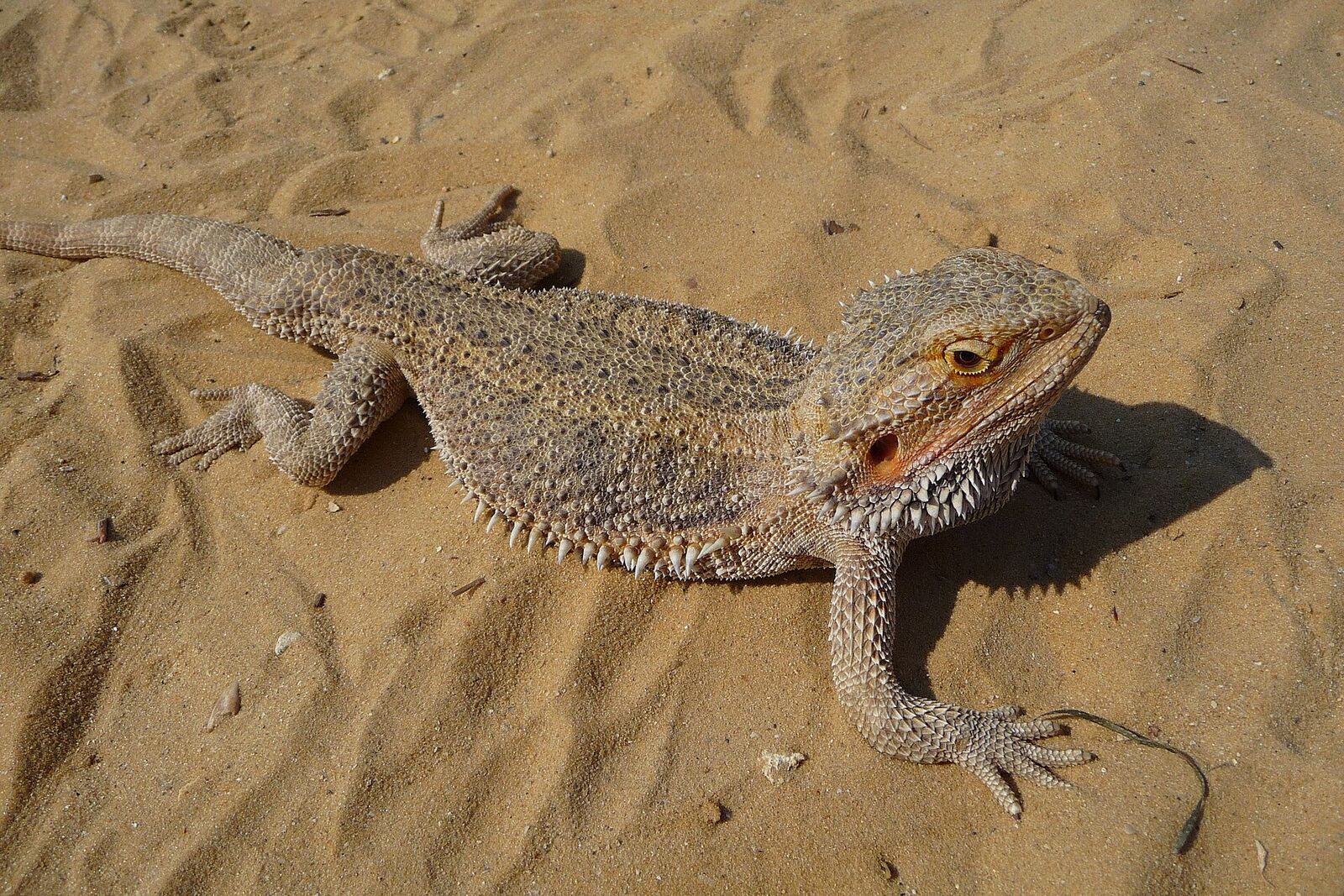
Uromastyx aegyptia is a species of lizard in the family Agamidae.

Care at a glance
Species-specific values
Values researched for this exact species. Air, surface and water temperatures are listed separately, and each source is kept as published rather than averaged.
| Social housing | Keep alone except during brief breeding periods. Source: shadowsreptiles.com | |
| Minimum enclosure | Minimum adult enclosure is 6 ft x 3 ft x 2 ft. Source: shadowsreptiles.com | |
| Substrate | Use a dry desert soil/sand mix or packed clay/sand mix. Source: shadowsreptiles.com | |
| Basking surface temperature | 120–130 °F Source: shadowsreptiles.com | |
| Basking surface temperature | up to 140 °F Source: shadowsreptiles.com | |
| Cool side air temperature | 85–95 °F Source: shadowsreptiles.com | |
| Humidity | up to 30 % Source: shadowsreptiles.com | |
| Uvb lighting | Provide strong UVB, such as Arcadia 12% or Zoo Med T5 HO. Source: shadowsreptiles.com | |
| Diet | Strict herbivore; feed daily salads with rotation. Source: shadowsreptiles.com | |
| Feeding frequency | Adults can be fed 5–6 days per week. Source: shadowsreptiles.com | |
| Seasonal cooling | They may dig, hide, and eat less during cooler seasons as brumation-type behavior. Source: shadowsreptiles.com |
Understanding the animal
About this animal
About this animal
The species is native to North Africa and the Middle East.
From Wikipedia: Uromastyx aegyptia, CC BY-SA 4.0 (excerpt)
In the wild
In the wild
Researched for this exact species, not its family. Wild conditions are context, not enclosure settings.12345
| Where it lives | Occupies desert and semi-desert east of the Nile and across parts of the Middle East and Arabian Peninsula. Arabian populations use open vegetated desert plains with deep soil burrows. |
| Ground it lives on | firm desert soil with gravel or sand, sparse plants and deep excavated burrows |
| Climate | Saudi field operative temperatures ranged from 34.2°F (1.2°C) in winter to 146.1°F (63.4°C) in summer; these are modeled environmental heat loads, not safe enclosure air temperatures. Burrows buffer extremes; wild relative humidity ranges were not established. |
| Active | Diurnal; most above-ground activity occurs in spring. Northern Saudi animals have strongly reduced winter activity, with apparent complete brumation in January at the studied site. |
| Wild diet | Predominantly desert plants; Kuwait records include Cyperus conglomeratus, Moltkiopsis ciliata, Rhanterium epapposum and Convolvulus oxyphyllus. |
| Behavior to plan for | Spends much of the day underground, emerging to bask and forage. Burrow use increases during extreme summer heat. |
- Daily and Seasonal Activity Patterns of Uromastyx aegyptia in Northern Saudi Arabia (2025)
- Wilms et al. (2011): Living on the edge? Thermobiology of Uromastyx aegyptia microlepis
- Impact of anthropogenic disturbance and vegetation composition on Uromastyx aegyptia (2020)
- Wikipedia: Uromastyx aegyptia (CC BY-SA 4.0)
- The Reptile Database: Uromastyx aegyptia
Native climate (measured)
Native climate (measured)
| Warm-season highs | about 96°F (up to 101°F in the hottest sampled areas) |
| Cool-season lows | about 41°F (down to 40°F in the coldest sampled areas) |
| Average temperature | 66–74°F across sampled records |
| Relative humidity | 45–46% on average (driest month about 34%) |
| Rainfall | about 60 mm a year, with strong wet and dry seasons |
Measured at 71 wild occurrence records sampled against WorldClim 2.1 climate data (1970–2000 averages). Air conditions in the range are ecological context, not enclosure settings: microhabitats such as burrows, leaf litter or basking rocks can be cooler, warmer or more humid.
Profile
Profile
Researched for this exact species. Sources are listed under In the wild above.
History
The nominotypical subspecies Uromastyx aegyptia was named by Forskål in 1775. The supplied sources also list U. a. leptieni and U. a. microlepis.
Data and studies
The numbers
The numbers
Each bar is what one source reports. Where several sources weigh in, the dashed gold band marks their average.
Maximum recorded lifespan
Longest recorded lifespan reported by each database; typical lifespans are usually shorter. The AnAge record comes from an animal in human care.
Typical adult weight
Average adult body mass in each database (FishBase gives the maximum recorded weight).
Adult snout-to-vent length
Body length without the tail.
Incubation
Sources for this sheet
- AnAge: The Animal Ageing and Longevity Database (Human Ageing Genomic Resources) (CC BY 3.0) Peer-reviewed researchCurated, referenced longevity and life-history records for thousands of species; maximum lifespans are often from zoo animals.
- Myhrvold et al. (2015). An amniote life-history database. Ecology 96: 3109 Peer-reviewed researchPeer-reviewed compilation of life-history data for over 21,000 birds, mammals and reptiles.
- Species+ (UNEP-WCMC and the CITES Secretariat) Zoo, university or veterinaryThe official database of species listed under CITES. UNEP (2026). The Species+ Website. Nairobi, Kenya. Compiled by UNEP-WCMC, Cambridge, UK. Available at: www.speciesplus.net. [Accessed 04/10/2026].
- USFWS International Affairs: CITES Zoo, university or veterinaryFederal agency that issues CITES permits.
- Clint's Reptiles (YouTube): Uromastyx, The Best Pet Lizard? Expert educator & keeperClint Laidlaw, PhD in Biology Education and MS in Evolutionary Ecology; owner of Clint's Reptile Room and a longtime keeper. His "Best Pet?" series reviews each species' care in depth.
- The Reptile Database Peer-reviewed researchScientist-curated catalog of every reptile species, with taxonomy and literature.
- GBIF Backbone Taxonomy (Global Biodiversity Information Facility) (CC BY 4.0) Peer-reviewed researchInternational scientific taxonomy used here for classification. GBIF Secretariat (2023). GBIF Backbone Taxonomy. Checklist dataset https://doi.org/10.15468/39omei, accessed via GBIF.org.
- Wikipedia (species article) (CC BY-SA 4.0) Community referenceFree encyclopedia; useful overviews with their own citations. Short excerpts are quoted under CC BY-SA 4.0, each credited with a link to its article.
- iNaturalist (captive observations) Community referenceCommunity observation platform run by the California Academy of Sciences and National Geographic; observations marked captive show animals living in homes, zoos and aquariums.
More agamas and dragons
Bearded dragon
Pogona vitticeps
Sun-loving, friendly and endlessly popular.
Pet trade

(Sulawesi) Sailfin Lizard
Hydrosaurus celebensis
Pet trade

(Sulawesi) Sailfin Lizard (Hydrosaurus microlophus)
Hydrosaurus microlophus
Pet trade

Australian water dragon
Intellagama lesueurii
Pet trade

Bent's Mastigure
Uromastyx benti
Pet trade

Black-necked agama
Acanthocercus atricollis
Zoos & aquariums