
Home / Fishes / Arowanas and elephantfish / Elephant fish
No federal permit to keepElephant fish
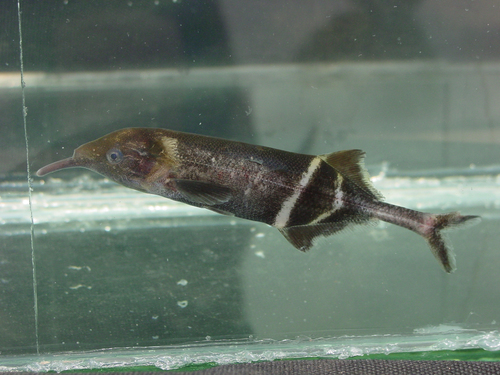
Pollimyrus isidori
Fishes › Arowanas and elephantfish (Osteoglossiformes) › Mormyridae (Elephantfish)
Pollimyrus isidori is a species of electric fish in the family Mormyridae, found in the rivers of Gambia, Bénoué, Senegal, Niger, Volta, Chad, Nile and the coastal banks of several rivers in the Ivory Coast; it can reach a size of approximately 90 mm.
From Wikipedia: Pollimyrus isidori, CC BY-SA 4.0 (excerpt)
Care at a glance
Species-specific values
Values researched for this exact species. Air, surface and water temperatures are listed separately, and each source is kept as published rather than averaged.
| Diet | Supply tubifex, small worms, or brine shrimp (live or frozen); flake is only eaten occasionally. Source: cichlidatlas.com | |
| Feeding frequency | Offer live or frozen foods after dark. Source: cichlidatlas.com | |
| Substrate | Keep it in a tank with soft substrate. Source: cichlidatlas.com |
Species-specific aquarium care
- Tank: At least 24 in long and 12 in front to back for one adult (adults commonly reach about 4.1 in / 10.3 cm).
- Water: Freshwater.
- Temperature: 72–75°F (range recorded for this species).
- pH: 6–8.
- Hardness: 5–19 dGH.
- Layout: Lives on or near the bottom: floor space and hiding places matter more than height.
- Diet: Eats a varied diet: mix quality prepared foods with frozen and live foods. FishBase classes it as a omnivore.
Calculated from this species' own FishBase record: tank size from its typical adult length and swimming zone, water values from its recorded ranges. The group guide below fills in general care.
Understanding the animal
In the wild
In the wild
From this species’ own FishBase record (habitat, bottom type, water and breeding data), not its family. Wild conditions are context, not enclosure settings.1
| Where it lives | Lives in freshwater, in lakes. Stays near the bottom. |
| Water it lives in | Freshwater, 72–75 °F (22–24 °C), pH 6–8, hardness 5–19 dH. |
| Climate | Tropical climate. |
| Behavior to plan for | Breeding: nesters. |
Data and studies
The numbers
The numbers
Each bar is what one source reports. Where several sources weigh in, the dashed gold band marks their average.
Maximum recorded lifespan
Longest recorded lifespan reported by each database; typical lifespans are usually shorter.
Typical adult weight
Average adult body mass in each database (FishBase gives the maximum recorded weight).
Adult length
Maximum recorded length. Measured as total length. Fish in home aquariums often stay smaller than wild records.
Water temperature
Range the species tolerates in nature; aim for the middle.
pH
Water hardness
Veterinary & husbandry research
Veterinary & husbandry research
- Reproductive strategies and developmental aspects in mormyrid and gymnotiform fishes Kirschbaum F et al., Journal of physiology, Paris 2002
- Larval electroreceptors in the epidermis of mormyrid fish: I. Tuberous organs of type A and B Bensouilah M et al., The Journal of comparative neurology 2002
Peer-reviewed papers that mention this species alongside captivity, zoos, veterinary care or aquaculture. Some cover several species or mention it only in passing, so check the abstract. PubMed
Sources for this sheet
- AnAge: The Animal Ageing and Longevity Database (Human Ageing Genomic Resources) (CC BY 3.0) Peer-reviewed researchCurated, referenced longevity and life-history records for thousands of species; maximum lifespans are often from zoo animals.
- FishBase (Froese & Pauly, eds.), version 24.07 (CC BY-NC 4.0) Peer-reviewed researchThe global scientific database on fishes, maintained by a consortium of research institutions; every value is referenced.
- Wikipedia (species article) (CC BY-SA 4.0) Community referenceFree encyclopedia; useful overviews with their own citations. Short excerpts are quoted under CC BY-SA 4.0, each credited with a link to its article.
- PubMed (U.S. National Library of Medicine) Peer-reviewed researchIndex of peer-reviewed veterinary, zoo and husbandry research.
More elephantfish

Baby Whale
Brienomyrus brachyistius
Aquarium hobby

Blunt-jawed elephantnose
Campylomormyrus tamandua
Aquarium hobby

Campylomormyrus rhynchophorus
Campylomormyrus rhynchophorus
Aquarium hobby
Peters's elephantnose fish
Gnathonemus petersii
Aquarium hobby