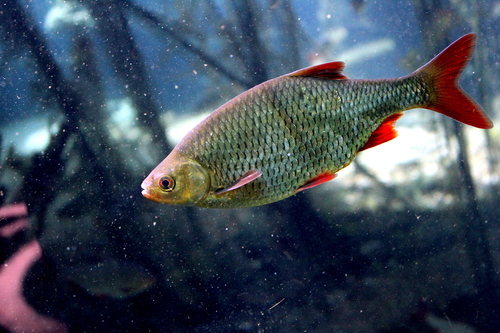
Home / Fishes / Carp, barbs, minnows, loaches / Leuciscidae / Eurasian minnow
Federal restrictions applyEurasian minnow
Phoxinus phoxinus
Fishes › Carp, barbs, minnows, loaches (Cypriniformes) › Leuciscidae (Minnows and shiners)
Phoxinus phoxinus (known colloquially as the Eurasian minnow, minnow, Channel minnow, or common minnow) is a species of freshwater ray-finned fish belonging to the family Leuciscidae, which includes the daces, minnows and related fishes.

Care at a glance
Species-specific values
Values researched for this exact species. Air, surface and water temperatures are listed separately, and each source is kept as published rather than averaged.
| Minimum enclosure | A group needs a tank about 110 litres that is at least 90 cm long. Source: studioscaped.com | |
| Water temperature | 39–64 °F (4–18 °C) Source: studioscaped.com | |
| Diet | In captivity they take flake and small pellets readily, and do best with frozen and live foods such as daphnia, bloodworm and brine shrimp. Source: studioscaped.com | |
| Feeding frequency | Frozen and live foods are recommended several times a week. Source: studioscaped.com | |
| Social housing | Keep a group of at least eight to ten; larger shoals are calmer and more natural. Source: studioscaped.com | |
| Substrate | Use a gravel or pebble substrate. Source: studioscaped.com | |
| Seasonal cooling | 43–50 °F (6–10 °C) Source: studioscaped.com |
Species-specific aquarium care
- Tank: At least 24 in long and 12 in front to back for one adult (adults commonly reach about 2.8 in / 7 cm; the largest recorded was 5.5 in).
- Water: Freshwater (tolerates brackish).
- Temperature: 36–68°F (range recorded for this species).
- pH: 7–7.5.
- Hardness: 10–20 dGH.
- Layout: Lives on or near the bottom: floor space and hiding places matter more than height.
- Diet: Eats a varied diet: mix quality prepared foods with frozen and live foods. FishBase classes it as a carnivore.
Calculated from this species' own FishBase record: tank size from its typical adult length and swimming zone, water values from its recorded ranges. The group guide below fills in general care.
Warnings
Understanding the animal
About this animal
About this animal
It is the type species of genus Phoxinus. This taxon was formerly considered to be the only species in the genus Phoxinus found in Europe and to have a wide geographic range in Eurasia, however, it is now regarded as part of a species complex with new species being described across its former range and this species being restricted to Western Europe.
From Wikipedia: Phoxinus phoxinus, CC BY-SA 4.0 (excerpt)
In the wild
In the wild
From this species’ own FishBase record (habitat, bottom type, water and breeding data), not its family. Wild conditions are context, not enclosure settings.1
| Where it lives | Lives in freshwater and brackish water, in rivers and streams, estuaries. Stays near the bottom. |
| Climate | Temperate climate. |
| Behavior to plan for | Breeding: open water/substratum egg scatterers. |
Data and studies
The numbers
The numbers
Each bar is what one source reports. Where several sources weigh in, the dashed gold band marks their average.
Maximum recorded lifespan
Longest recorded lifespan reported by each database; typical lifespans are usually shorter.
Adult length
Common length to maximum recorded length. Measured as total length. Fish in home aquariums often stay smaller than wild records.
Female maturity
Veterinary & husbandry research
Veterinary & husbandry research
- Fatal Diplostomum phoxini infection in captive Atlantic puffin Fratercula arctica chicks following ingestion of infected European minnows Phoxinus phoxinus Hoby S et al., Diseases of aquatic organisms 2022
Peer-reviewed papers that mention this species alongside captivity, zoos, veterinary care or aquaculture. Some cover several species or mention it only in passing, so check the abstract. See all 2 on PubMed → PubMed
Sources for this sheet
- AnAge: The Animal Ageing and Longevity Database (Human Ageing Genomic Resources) (CC BY 3.0) Peer-reviewed researchCurated, referenced longevity and life-history records for thousands of species; maximum lifespans are often from zoo animals.
- FishBase (Froese & Pauly, eds.), version 24.07 (CC BY-NC 4.0) Peer-reviewed researchThe global scientific database on fishes, maintained by a consortium of research institutions; every value is referenced.
- 50 CFR Part 16: Injurious wildlife (Lacey Act) Zoo, university or veterinaryCurrent federal regulation, read from eCFR.
- U.S. Association of Reptile Keepers v. Zinke (D.C. Cir. 2017) Zoo, university or veterinaryAppeals ruling that the Lacey Act's shipping ban does not cover moves between the continental states.
- Wikipedia (species article) (CC BY-SA 4.0) Community referenceFree encyclopedia; useful overviews with their own citations. Short excerpts are quoted under CC BY-SA 4.0, each credited with a link to its article.
- PubMed (U.S. National Library of Medicine) Peer-reviewed researchIndex of peer-reviewed veterinary, zoo and husbandry research.
- iNaturalist (captive observations) Community referenceCommunity observation platform run by the California Academy of Sciences and National Geographic; observations marked captive show animals living in homes, zoos and aquariums.