Home / Mammals / Hedgehogs / European hedgehog
No federal permit to keepEuropean hedgehog
Erinaceus europaeus
Mammals › Hedgehogs (Erinaceomorpha) › Erinaceidae (Hedgehogs)
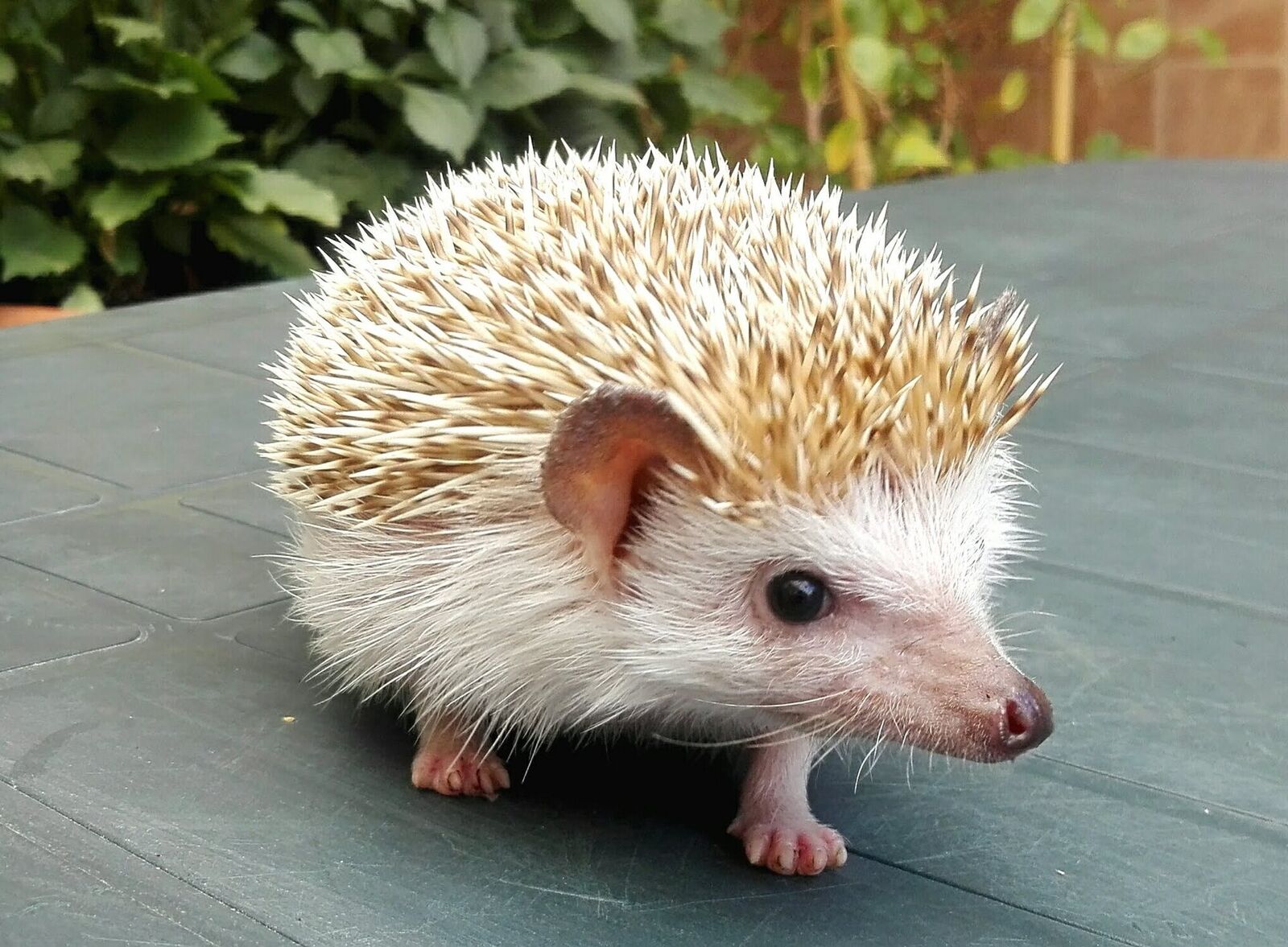
The European hedgehog (Erinaceus europaeus), also known as the West European hedgehog or common hedgehog, is a hedgehog species native to Europe from Iberia and Italy northwards into Scandinavia and westwards into Ireland.
From Wikipedia: European hedgehog, CC BY-SA 4.0 (excerpt)

Care at a glance
Species-specific values
Values researched for this exact species. Air, surface and water temperatures are listed separately, and each source is kept as published rather than averaged.
| Diet | Captive adult diets mainly use meat-based cat or dog food and/or specialist hedgehog food. Source: lafeber.com | |
| Feeding frequency | Offer food to most adults once or twice daily; an evening ration may reduce obesity risk in healthy animals. Source: lafeber.com | |
| Minimum enclosure | Provide the largest reasonably possible enclosure, with nests at least 30–60 cm in diameter. Source: lafeber.com | |
| Social housing | House captive hedgehogs individually unless they are littermates. Source: lafeber.com | |
| Substrate | Line the nesting box with newspaper and provide abundant soft, absorbent bedding such as straw, hay, or wood shavings. Source: lafeber.com | |
| Basking surface temperature | 70–86 °F (21–30 °C) Source: lafeber.com | |
| Night temperature | 50 °F (at least 10 °C) Source: lafeber.com |
Understanding the animal
About this animal
About this animal
It is a generally common and widely distributed species that can survive across a wide range of habitat types. It is a well-known species, and a favourite in European gardens, both for its endearing appearance and its preference for eating a range of garden pests.
From Wikipedia: European hedgehog, CC BY-SA 4.0 (excerpt)
In the wild
In the wild
| Overview | The European hedgehog (Erinaceus europaeus), also known as the West European hedgehog or common hedgehog, is a hedgehog species native to Europe from Iberia and Italy northwards into Scandinavia and westwards into Ireland. It is a generally common and widely distributed species that can survive across a wide range of habitat types. It is a well-known species, and a favourite in European gardens, both for its endearing appearance and its preference for eating a range of garden pests. — From Wikipedia: European hedgehog, CC BY-SA 4.0 (excerpt) |
| Wild diet | The European hedgehog is an insectivore. Its diet consists largely of earthworms, as well as snails and slugs, beetles, ants, bees and wasps, earwigs, cockroaches, crickets and grasshoppers, butterflies and moths, and caterpillars and other insect larvae. Eggs of ground-nesting birds are also taken and carcasses may be foraged on. — From Wikipedia: European hedgehog, CC BY-SA 4.0 (excerpt) |
Read about this species in the wild at Animal Diversity Web.
Native climate (measured)
Native climate (measured)
| Warm-season highs | about 75°F (up to 85°F in the hottest sampled areas) |
| Cool-season lows | about 31°F (down to 26°F in the coldest sampled areas) |
| Average temperature | 46–62°F across sampled records |
| Relative humidity | 74–78% on average (driest month about 69%) |
| Rainfall | about 751 mm a year, spread fairly evenly |
| Winters | Cool to cold winters (lows around 31°F) in much of its native range. Seasonal slowdown may be relevant, but species-specific biology determines whether brumation or hibernation occurs. |
Measured at 46 wild occurrence records sampled against WorldClim 2.1 climate data (1970–2000 averages). Air conditions in the range are ecological context, not enclosure settings: microhabitats such as burrows, leaf litter or basking rocks can be cooler, warmer or more humid.
Data and studies
Researched care notes
Researched care notes
Findings checked against veterinary, zoo, welfare, keeper and peer-reviewed sources. Air, basking-surface and water temperatures are kept separate, and where sources disagree both are shown. “Study” notes report what a paper measured, not a universal rule.
Insectivorous Small Mammals (feeding group)
Researched for this whole family or group; check species differences before applying.
- The reference discusses suitable complete insectivore feeds and invertebrates; match the ration to the actual taxon. Hedgehogs, armadillos, and aardvarks do not share one interchangeable recipe.1
The numbers
The numbers
Each bar is what one source reports. Where several sources weigh in, the dashed gold band marks their average.
Maximum recorded lifespan
Longest recorded lifespan reported by each database; typical lifespans are usually shorter. The AnAge record comes from an animal in human care.
Typical adult weight
Average adult body mass in each database (FishBase gives the maximum recorded weight).
Litter size
Average per litter or clutch.
Gestation
Female maturity
Veterinary & husbandry research
Veterinary & husbandry research
- The European hedgehog (Erinaceus europaeus)--a suitable reservoir for variants of Anaplasma phagocytophilum? Silaghi C et al., Ticks and tick-borne diseases 2012
- Seasonal endocrine cycles in the European hedgehog, Erinaceus europaeus Fowler PA et al., Journal of reproduction and fertility 1988
Peer-reviewed papers that mention this species alongside captivity, zoos, veterinary care or aquaculture. Some cover several species or mention it only in passing, so check the abstract. See all 32 on PubMed → PubMed
Sources for this sheet
- AnAge: The Animal Ageing and Longevity Database (Human Ageing Genomic Resources) (CC BY 3.0) Peer-reviewed researchCurated, referenced longevity and life-history records for thousands of species; maximum lifespans are often from zoo animals.
- Myhrvold et al. (2015). An amniote life-history database. Ecology 96: 3109 Peer-reviewed researchPeer-reviewed compilation of life-history data for over 21,000 birds, mammals and reptiles.
- 9 CFR 2.1: Animal Welfare Act licensing (USDA) Zoo, university or veterinaryWho needs a USDA license to breed, sell or exhibit animals.
- GBIF Backbone Taxonomy (Global Biodiversity Information Facility) (CC BY 4.0) Peer-reviewed researchInternational scientific taxonomy used here for classification. GBIF Secretariat (2023). GBIF Backbone Taxonomy. Checklist dataset https://doi.org/10.15468/39omei, accessed via GBIF.org.
- Wikipedia (species article) (CC BY-SA 4.0) Community referenceFree encyclopedia; useful overviews with their own citations. Short excerpts are quoted under CC BY-SA 4.0, each credited with a link to its article.
- PubMed (U.S. National Library of Medicine) Peer-reviewed researchIndex of peer-reviewed veterinary, zoo and husbandry research.
- iNaturalist (captive observations) Community referenceCommunity observation platform run by the California Academy of Sciences and National Geographic; observations marked captive show animals living in homes, zoos and aquariums.