Home / Invertebrates / Praying mantises / European mantis
No federal permit to keepEuropean mantis
Mantis religiosa
Invertebrates › Praying mantises (Mantodea) › Mantidae (Mantises)
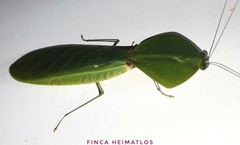
The European mantis (Mantis religiosa) is a large hemimetabolic insect in the family Mantidae, which is the largest family of the order Mantodea (mantises).
From Wikipedia: European mantis, CC BY-SA 4.0 (excerpt)

Care at a glance
Species-specific values
Values researched for this exact species. Air, surface and water temperatures are listed separately, and each source is kept as published rather than averaged.
| Minimum enclosure | 20 × 20 × 30 cm for one animal. Source: repticare.ch | |
| Humidity | 50–60 % Source: repticare.ch | |
| Uvb lighting | Bright lighting; no special equipment is needed. Source: repticare.ch | |
| Diet | Live food is essential. Source: repticare.ch | |
| Feeding frequency | One insect every two to three days. Source: repticare.ch | |
| Social housing | Kept singly. Source: repticare.ch | |
| Substrate | Coco humus or sand. Source: repticare.ch | |
| Seasonal cooling | The egg cases overwinter cool. Source: repticare.ch | |
| Warm side air temperature | 70–80 °F Source: bantam.earth | |
| Diet | Offer varied live insects, such as caterpillars, grasshoppers, roaches, fruit fly larvae, mealworms, and crickets. Source: bantam.earth | |
| Feeding frequency | Offer live food at least three times a week. Source: bantam.earth | |
| Social housing | Keep only one mantis per enclosure. Source: bantam.earth |
Understanding the animal
About this animal
About this animal
Their common name praying mantis is derived from the distinctive posture of the first pair of legs, which can be observed when the mantis is in repose, resembling a praying position. Both males and females have elongated bodies with two pairs of wings.
From Wikipedia: European mantis, CC BY-SA 4.0 (excerpt)
In the wild
In the wild
| Overview | The European mantis (Mantis religiosa) is a large hemimetabolic insect in the family Mantidae, which is the largest family of the order Mantodea (mantises). Their common name praying mantis is derived from the distinctive posture of the first pair of legs, which can be observed when the mantis is in repose, resembling a praying position. Both males and females have elongated bodies with two pairs of wings. — From Wikipedia: European mantis, CC BY-SA 4.0 (excerpt) |
| Where it lives | M. religiosa can be found throughout Europe, Asia, and Africa, as well as North America, where it is considered introduced. Two confirmed stable populations are in Germany: one in Rhineland-Palatinate and one in Baden-Württemberg. In the last years, more reports have been made of the distribution of the animals in Northern Europe (Latvia, Estonia), as well. — From Wikipedia: European mantis, CC BY-SA 4.0 (excerpt) |
| Reproduction | The sexual behavior of praying mantis in general is curious, so has received interest from scientists over the last century. The differences between the various species are well known. In M. religiosa, courtship and mating are separated into two steps: Preliminary courtship begins with the first visual contact between the animals and ends with the first physical contact. — From Wikipedia: European mantis, CC BY-SA 4.0 (excerpt) |
Native climate (measured)
Native climate (measured)
| Warm-season highs | about 81°F (up to 89°F in the hottest sampled areas) |
| Cool-season lows | about 36°F (down to 27°F in the coldest sampled areas) |
| Average temperature | 49–63°F across sampled records |
| Relative humidity | 69–75% on average (driest month about 64%) |
| Rainfall | about 646 mm a year, spread fairly evenly |
| Winters | Cool to cold winters (lows around 36°F) in much of its native range. Seasonal slowdown may be relevant, but species-specific biology determines whether brumation or hibernation occurs. |
Measured at 86 wild occurrence records sampled against WorldClim 2.1 climate data (1970–2000 averages). Air conditions in the range are ecological context, not enclosure settings: microhabitats such as burrows, leaf litter or basking rocks can be cooler, warmer or more humid.
Sources for this sheet
- GBIF Backbone Taxonomy (Global Biodiversity Information Facility) (CC BY 4.0) Peer-reviewed researchInternational scientific taxonomy used here for classification. GBIF Secretariat (2023). GBIF Backbone Taxonomy. Checklist dataset https://doi.org/10.15468/39omei, accessed via GBIF.org.
- Wikipedia (species article) (CC BY-SA 4.0) Community referenceFree encyclopedia; useful overviews with their own citations. Short excerpts are quoted under CC BY-SA 4.0, each credited with a link to its article.
- iNaturalist (captive observations) Community referenceCommunity observation platform run by the California Academy of Sciences and National Geographic; observations marked captive show animals living in homes, zoos and aquariums.