
Home / Reptiles / Snakes / Viperidae / Eyelash viper
No federal permit to keepEyelash viper
Bothriechis schlegelii
Reptiles › Snakes (Serpentes) › Viperidae (Vipers and pit vipers)
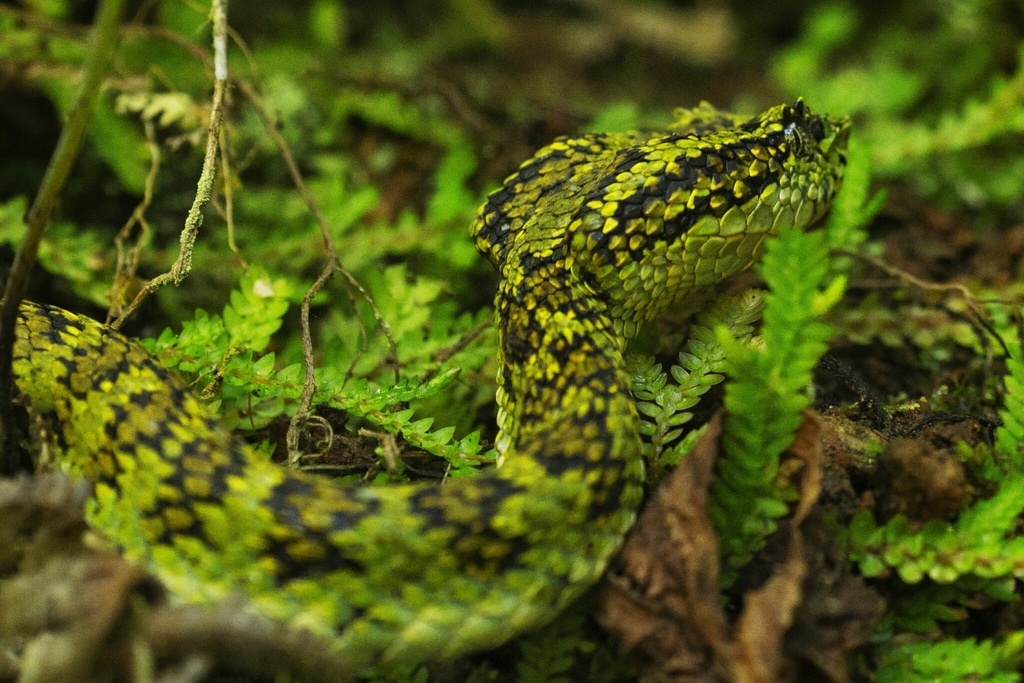
Bothriechis schlegelii, known commonly as the highland eyelash-pitviper, Schlegel's eyelash-pitviper, eyelash viper or eyelash palm viper, is a species of pit viper in the family Viperidae, native to Colombia.
From Wikipedia: Bothriechis schlegelii, CC BY-SA 4.0 (excerpt)
Care at a glance
Species-specific values
Values researched for this exact species. Air, surface and water temperatures are listed separately, and each source is kept as published rather than averaged.
| Minimum enclosure | Minimum space required is 75 x 60 x 100 cm per adult. Source: academy.herpeton.net | |
| Basking surface temperature | 81–84 °F (27–29 °C) Source: academy.herpeton.net | |
| Warm side air temperature | 72–79 °F (22–26 °C) Source: academy.herpeton.net | |
| Cool side air temperature | 68–73 °F (20–23 °C) Source: academy.herpeton.net | |
| Humidity | 70–85 % Source: academy.herpeton.net | |
| Uvb lighting | Low-output UVB may be offered as a measured Ferguson Zone 1 opportunity, with full shade available. Source: academy.herpeton.net | |
| Diet | Offer appropriately sized frozen-thawed mice; small quail or other whole prey may be given for variety. Source: academy.herpeton.net | |
| Feeding frequency | Juveniles may eat every 10-14 days. Source: academy.herpeton.net | |
| Feeding frequency | Adults may eat every 14-21 days. Source: academy.herpeton.net | |
| Social housing | House one animal per enclosure. Source: academy.herpeton.net | |
| Substrate | Use 6-10 cm of moisture-buffering soil and fine bark over drainage, with dry upper perches. Source: academy.herpeton.net |
Understanding the animal
About this animal
About this animal
Somewhat small, arboreal snakes, B. schlegelii is perhaps best known for the namesake superciliary ("eyelash") scales above its eyes, and for having distinctly keeled or "raised" scales covering the bulk of its body. The species is also known for producing a veritable rainbow of color forms (morphs).
From Wikipedia: Bothriechis schlegelii, CC BY-SA 4.0 (excerpt)
In the wild
In the wild
| Overview | Bothriechis schlegelii, known commonly as the highland eyelash-pitviper, Schlegel's eyelash-pitviper, eyelash viper or eyelash palm viper, is a species of pit viper in the family Viperidae, native to Colombia. Somewhat small, arboreal snakes, B. schlegelii is perhaps best known for the namesake superciliary ("eyelash") scales above its eyes, and for having distinctly keeled or "raised" scales covering the bulk of its body. The species is also known for producing a veritable rainbow of color forms (morphs). No subspecies are currently recognized as being valid. — From Wikipedia: Bothriechis schlegelii, CC BY-SA 4.0 (excerpt) |
| Behavior | Like other Bothriechis species, B. schlegelii is adapted to a nearly completely arboreal lifestyle, possessing a strong, prehensile tail with which it secures itself around tree limbs, often coiled into a tight bundle during the day, as the species is primarily nocturnal. — From Wikipedia: Bothriechis schlegelii, CC BY-SA 4.0 (excerpt) |
| Conservation | Eyelash vipers were evaluated for the IUCN Red List as being of least concern for extinction in 2013, having been removed from CITES Appendix III in 2002. While not listed as threatened, they are at risk of habitat loss from increased deforestation for timber, agriculture, and urbanization. However, the species is adaptable and can live in secondary forests as well as coffee and banana plantations. — From Wikipedia: Bothriechis schlegelii, CC BY-SA 4.0 (excerpt) |
Read about this species in the wild at Animal Diversity Web · The Reptile Database.
Native climate (measured)
Native climate (measured)
| Warm-season highs | about 75°F (up to 88°F in the hottest sampled areas) |
| Cool-season lows | about 57°F (down to 51°F in the coldest sampled areas) |
| Average temperature | 59–78°F across sampled records |
| Relative humidity | 81–86% on average (driest month about 80%) |
| Rainfall | about 2353 mm a year, spread fairly evenly |
Measured at 130 wild occurrence records sampled against WorldClim 2.1 climate data (1970–2000 averages). Air conditions in the range are ecological context, not enclosure settings: microhabitats such as burrows, leaf litter or basking rocks can be cooler, warmer or more humid.
Profile
Profile
Researched for this exact species. Sources are listed under In the wild above.
History
Named after Hermann Schlegel (1804-1884), German herpetologist.
Data and studies
The numbers
The numbers
Each bar is what one source reports. Where several sources weigh in, the dashed gold band marks their average.
Maximum recorded lifespan
Longest recorded lifespan reported by each database; typical lifespans are usually shorter. The AnAge record comes from an animal in human care.
Sources for this sheet
- AnAge: The Animal Ageing and Longevity Database (Human Ageing Genomic Resources) (CC BY 3.0) Peer-reviewed researchCurated, referenced longevity and life-history records for thousands of species; maximum lifespans are often from zoo animals.
- Myhrvold et al. (2015). An amniote life-history database. Ecology 96: 3109 Peer-reviewed researchPeer-reviewed compilation of life-history data for over 21,000 birds, mammals and reptiles.
- Clint's Reptiles (YouTube): Eyelash Pit Viper, The Best Pet Snake? Expert educator & keeperClint Laidlaw, PhD in Biology Education and MS in Evolutionary Ecology; owner of Clint's Reptile Room and a longtime keeper. His "Best Pet?" series reviews each species' care in depth.
- The Reptile Database Peer-reviewed researchScientist-curated catalog of every reptile species, with taxonomy and literature.
- GBIF Backbone Taxonomy (Global Biodiversity Information Facility) (CC BY 4.0) Peer-reviewed researchInternational scientific taxonomy used here for classification. GBIF Secretariat (2023). GBIF Backbone Taxonomy. Checklist dataset https://doi.org/10.15468/39omei, accessed via GBIF.org.
- Species+ (UNEP-WCMC and the CITES Secretariat) Zoo, university or veterinaryThe official database of species listed under CITES. UNEP (2026). The Species+ Website. Nairobi, Kenya. Compiled by UNEP-WCMC, Cambridge, UK. Available at: www.speciesplus.net. [Accessed 04/10/2026].
- Wikipedia (species article) (CC BY-SA 4.0) Community referenceFree encyclopedia; useful overviews with their own citations. Short excerpts are quoted under CC BY-SA 4.0, each credited with a link to its article.
- iNaturalist (captive observations) Community referenceCommunity observation platform run by the California Academy of Sciences and National Geographic; observations marked captive show animals living in homes, zoos and aquariums.
More vipers and pit vipers

African Saw-scaled Viper
Echis ocellatus
Pet trade

Arizona Black Rattlesnake
Crotalus cerberus
Pet trade

Armenian Steppe Viper
Vipera eriwanensis
Pet trade

Asp Viper
Vipera aspis
Pet trade

Berg adder
Bitis atropos
Pet trade

Black-speckled Palm Pit Viper
Bothriechis nigroviridis
Pet trade