Home / Mammals / Cats, dogs and other carnivores / Domestic ferret
No federal permit to keep In-depth sheetDomestic ferret
Mustela furo
Mammals › Cats, dogs and other carnivores (Carnivora) › Mustelidae (Ferrets, weasels and otters)
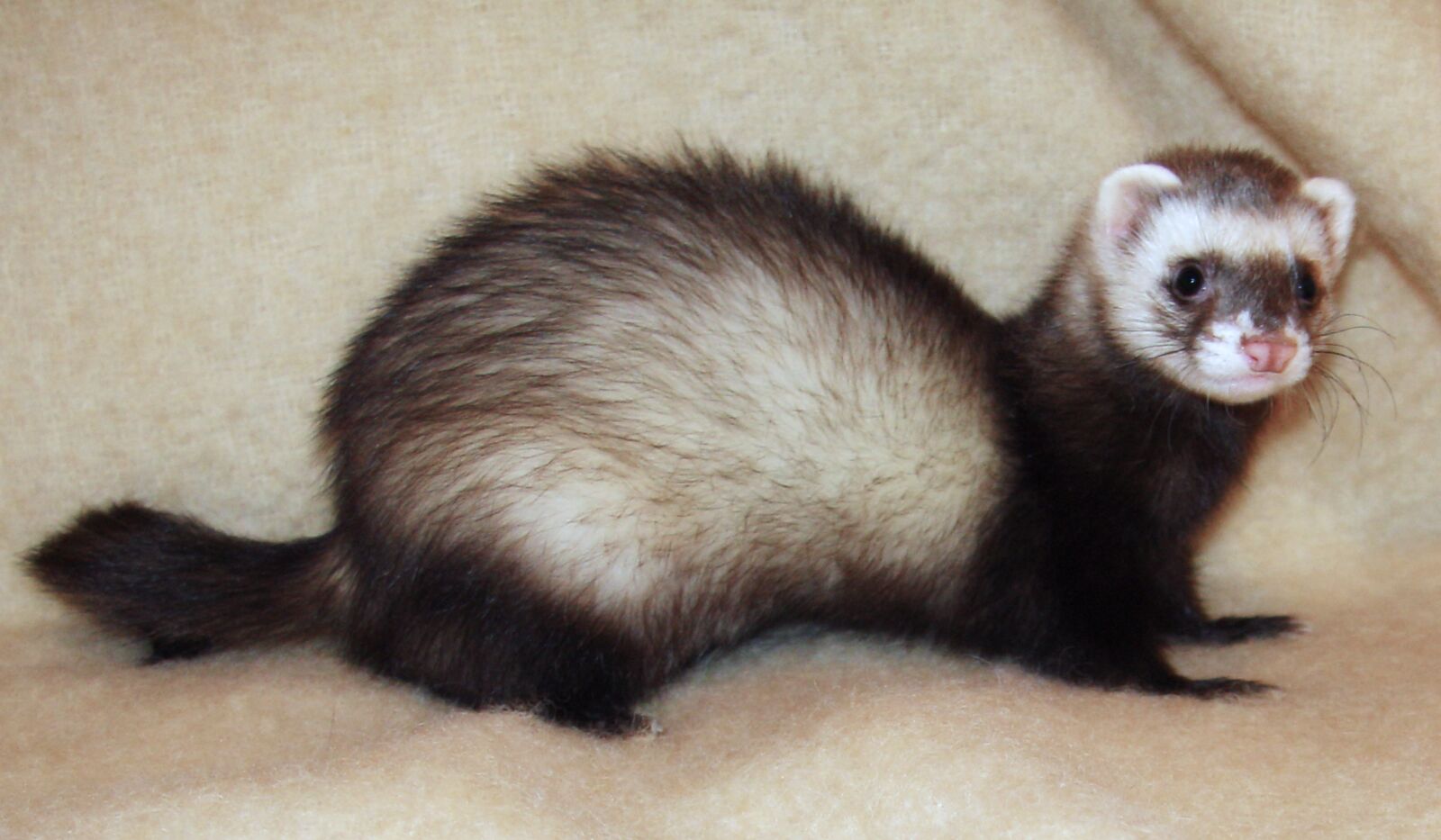
Ferrets are domesticated, highly active carnivores. They need a high-protein, high-fat diet, lots of supervised play and reproductive management.
Care at a glance
Species-specific values
Values researched for this exact species. Where they differ from the group guide below, follow these. Air, surface and water temperatures are listed separately, and each source is kept as published rather than averaged.
| Air temperature | 65–75 °F Comfortable housing range | 294 |
| Diet | Complete meat-based ferret food; low carbohydrate, high protein; food and water continuously available. | 294 |
Care guide
Diet
- True carnivores: 35–40% protein and over 20% fat, which most dog and cat foods don't provide.
Sources 40
Health
- Annual health checks. Females need reproductive control (neutering or hormone implants) to avoid dangerous prolonged seasons.
Sources 40
Show the group care guide for domestic ferrets
Domestic ferrets
Applies to most species in this group. Habitat: Homes. Individual species can differ, so compare with the species numbers above and the linked sources.
Housing & setup
- A large multi-level cage plus several hours of supervised play in a ferret-proofed room.
Diet
- Use complete meat-based ferret food, high in protein and low in carbohydrate; keep food and fresh water available.
Social life
- Social; many do best in pairs.
Health watch
- Adrenal disease, insulinoma, foreign-body blockages and distemper (vaccinate).
Understanding the animal
In the wild
In the wild
Researched for this exact species, not its family. Good care copies these conditions.123
| Where it lives | A domestic species without an indigenous wild habitat. Introduced feral populations in New Zealand occupy pasture, dry tussock grassland, scrub and river margins, using rabbit holes and other sheltered dens. |
| Ground it lives on | For feral populations: grassy soil and existing rabbit burrows, with dens in scrub or buildings. |
| Climate | New Zealand South Island feral-study sites had mean monthly temperatures of 37°F in July to 64°F in January, with occasional persistent snow. These describe introduced populations, not captive tolerances; humidity measurements were not supplied. |
| Active | Feral populations are largely nocturnal, resting in dens during the day. |
| Social life | A South Island study found mostly solitary daytime resting and overlapping home ranges with little evidence of territoriality; den sharing occurs elsewhere. |
| Wild diet | Feral animals chiefly eat rabbits where abundant; also rodents, birds, eggs, lizards, frogs, invertebrates and carrion. |
| Behavior to plan for | Feral animals range widely, switch between dens and can swim across waterways. They pursue prey into sheltered passages. |
What this means for care
- Provide several dark sleeping dens and tunnels plus substantial exercise space.
- Secure small escape openings and door access.
- Use animal-based feeding and prey-search enrichment.
- Use domestic-ferret social guidance; feral solitary resting does not by itself justify isolating pet ferrets.
Feral / introduced climate context
Feral / introduced climate context
| Warm-season highs | about 72°F (up to 74°F in the hottest sampled areas) |
| Cool-season lows | about 35°F (down to 27°F in the coldest sampled areas) |
| Average temperature | 47–57°F across sampled records |
| Relative humidity | 70–80% on average (driest month about 71%) |
| Rainfall | about 1305 mm a year, spread fairly evenly |
Context only — not a captive target. Domestic ferret has no indigenous native wild population. Feral records are ecological context, not a native-climate baseline. Values come from 95 outdoor occurrence records sampled against WorldClim 2.1 (1970–2000 averages). They show conditions where recorded animals occurred, not the temperatures or humidity they should be housed at.
Profile
Profile
Researched for this exact species. Sources are listed under In the wild above.
History
Ferrets may have been domesticated since ancient times, although surviving historical evidence is sparse and inconsistent. Contemporary scholarship agrees that they were bred for hunting rabbits in the practice known as rabbiting, and they later became prominent household pets in North America.
Behaviors reported
- Ferrets are known for hiding or carrying away small objects.
Unique adaptations
- A long, slender body characteristic of mustelids.
Remarkable facts
- The domestic ferret is a small domesticated mustelid and is most likely derived from the European polecat, Mustela putorius.
- Domestic ferrets can interbreed with European polecats and produce hybrid offspring.
- Average total length including the tail is about 20 in.
- They weigh approximately 1.5 to 4.4 lb.
- Males are considerably larger than females.
- Ferrets have been used as research animals in neuroscience and infectious-disease research, especially influenza.
From the sources
From the sources
Quoted from the matching sections of reputable sources for this exact species. Specialist databases are used first; Wikipedia (community-edited, CC BY-SA 4.0) only fills gaps. Other sources are short credited quotes.
| Overview | The ferret (Mustela furo) is a small, domesticated species belonging to the family Mustelidae. The ferret is most likely a domesticated form of the wild European polecat (Mustela putorius), as evidenced by the ferret's ability to interbreed with European polecats and produce hybrid offspring. Physically, ferrets resemble other mustelids because of their long, slender bodies. Including their tail, the average length of a ferret is about 50 cm; they weigh between 0.7 and 2.0 kg; and their fur can be black, brown, white, or a mixture of those colours. — Wikipedia (community-edited) |
| Wild diet | Ferrets are obligate carnivores. The natural diet of their wild ancestors consisted of whole small prey, including meat, organs, bones, skin, feathers and fur. Ferrets have short digestive systems and a quick metabolism, so they need to eat frequently. — Wikipedia (community-edited) |
| Behavior | Ferrets spend 14–18 hours a day asleep and are most active around the hours of dawn and dusk, meaning they are crepuscular. If they are caged, they should be taken out daily to exercise and satisfy their curiosity; they need at least an hour and a place to play. Unlike their polecat ancestors, which are solitary animals, most ferrets will live happily in social groups. — Wikipedia (community-edited) |
| History and naming | The name ferret is derived from the Late Latin furittus, a likely reference to the common ferret penchant for secreting away small items. In Old English (Anglo-Saxon), the animal was called mearþ. The word fyret seems to appear in Middle English in the 14th century from the Latin, with the modern spelling of ferret by the 16th century. — Wikipedia (community-edited) |
Data and studies
Researched care notes
Researched care notes
Findings checked against veterinary, zoo, welfare, keeper and peer-reviewed sources. Air, basking-surface and water temperatures are kept separate, and where sources disagree both are shown. “Study” notes report what a paper measured, not a universal rule.
Domestic Ferret (species)
- Ferrets are susceptible to overheating; housing requires heat protection.1
- Routine cage confinement is insufficient without supervised activity and enrichment outside the cage.1
- The management reference describes a carnivorous diet with appropriate animal-derived protein. No homemade recipe or fixed feeding quantity was validated by this dossier.1
- RSPCA recommends a suitable complete commercial diet and checking each animal’s intake and condition.2
- Provide safe food-search opportunities and introduce dietary changes gradually.2
The numbers
The numbers
Each bar is what one source reports. Where several sources weigh in, the dashed gold band marks their average.
Enclosure floor (two ferrets)
Minimum about 1.5×1×1 m, with multiple levels.
Maximum recorded lifespan
Longest recorded lifespan reported by each database; typical lifespans are usually shorter. The AnAge record comes from an animal in human care.
Typical adult weight
Average adult body mass in each database (FishBase gives the maximum recorded weight).
Litter size
Average per litter or clutch.
Veterinary & husbandry research
Veterinary & husbandry research
- Radiographic kidney measurements in North American pet ferrets (Mustela furo) Eshar D et al., The Journal of small animal practice 2013
- Systemic but not intra-intestinal vaccination with BCG reduces the severity of tuberculosis infection in ferrets (Mustela furo) Cross ML et al., The international journal of tuberculosis and lung disease: the official journal of the International Union against Tuberculosis and Lung Disease 2000
- Urine specific gravity values in clinically healthy young pet ferrets (Mustela furo) Eshar D et al., The Journal of small animal practice 2012
Peer-reviewed papers that mention this species alongside captivity, zoos, veterinary care or aquaculture. Some cover several species or mention it only in passing, so check the abstract. 170
Sources for this sheet
- Royal Veterinary College Exotics Service: Ferret care Zoo, university or veterinaryVet-school exotics hospital factsheet, reviewed 2021–2024.
- AnAge: The Animal Ageing and Longevity Database (Human Ageing Genomic Resources) Peer-reviewed researchCurated, referenced longevity and life-history records for thousands of species; maximum lifespans are often from zoo animals.
- Myhrvold et al. (2015). An amniote life-history database. Ecology 96: 3109 Peer-reviewed researchPeer-reviewed compilation of life-history data for over 21,000 birds, mammals and reptiles.
- 9 CFR 2.1: Animal Welfare Act licensing (USDA) Zoo, university or veterinaryWho needs a USDA license to breed, sell or exhibit animals.
- Merck Veterinary Manual: Management of ferrets Zoo, university or veterinaryThe Merck Veterinary Manual: a standard veterinary reference written and reviewed by veterinary specialists.
- MSD Veterinary Manual: Providing a Home for a Ferret Zoo, university or veterinaryAdded in the 2026 source-checked care-guide review.
- Clint's Reptiles (YouTube): Ferret, The Best Pet Mammal? Expert educator & keeperClint Laidlaw, PhD in Biology Education and MS in Evolutionary Ecology; owner of Clint's Reptile Room and a longtime keeper. His "Best Pet?" series reviews each species' care in depth.
- GBIF Backbone Taxonomy (Global Biodiversity Information Facility) Peer-reviewed researchInternational scientific taxonomy used here for classification.
- Wikipedia (species article) Community referenceFree encyclopedia; useful overviews with their own citations. Intro text is quoted under CC BY-SA 4.0.
- PubMed (U.S. National Library of Medicine) Peer-reviewed researchIndex of peer-reviewed veterinary, zoo and husbandry research.
- iNaturalist (captive observations) Community referenceCommunity observation platform run by the California Academy of Sciences and National Geographic; observations marked captive show animals living in homes, zoos and aquariums.
