Home / Invertebrates / Scorpions / Flat rock scorpion
No federal permit to keepFlat rock scorpion
Hadogenes troglodytes
Invertebrates › Scorpions (Scorpiones) › Hormuridae (Rock and wood scorpions)
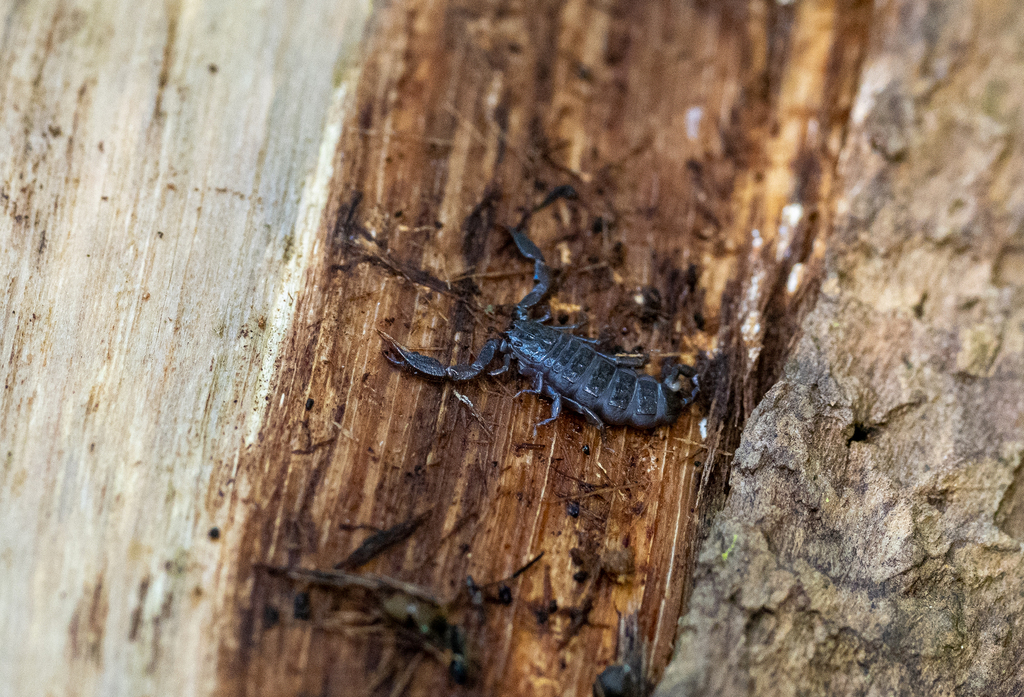
Hadogenes troglodytes is a species of scorpion from southern Africa.
From Wikipedia: Hadogenes troglodytes, CC BY-SA 4.0 (excerpt)

Care at a glance
Species-specific values
Values researched for this exact species. Air, surface and water temperatures are listed separately, and each source is kept as published rather than averaged.
| Minimum enclosure | A 10 gallon tank suits one adult; a 20 gallon long is better. Source: invertkeeping.com | |
| Enclosure temperature | 75–85 °F Source: invertkeeping.com | |
| Humidity | 40–50 % Source: invertkeeping.com | |
| Diet | Offer appropriately sized crickets, dubia roach nymphs, red runners, or occasional mealworms; prey should be no longer than the pincers. Source: invertkeeping.com | |
| Feeding frequency | Adults get two or three prey items every one to two weeks; juveniles may eat weekly. Source: invertkeeping.com | |
| Substrate | Use 1 to 2 inches of dry sand and coco fibre or topsoil, roughly 60:40, packed firm. Source: invertkeeping.com |
Understanding the animal
About this animal
About this animal
It is commonly known as the flat rock scorpion and commonly sold on the exotic pet market. It was once regarded as having the longest recorded body length of any scorpion, reaching up to 20 cm; however Heterometrus swammerdami currently holds the record for being the world's largest scorpion at 9 inches (23 cm) in length.
From Wikipedia: Hadogenes troglodytes, CC BY-SA 4.0 (excerpt)
In the wild
In the wild
| Overview | Hadogenes troglodytes is a species of scorpion from southern Africa. It is commonly known as the flat rock scorpion and commonly sold on the exotic pet market. It was once regarded as having the longest recorded body length of any scorpion, reaching up to 20 cm; however Heterometrus swammerdami currently holds the record for being the world's largest scorpion at 9 inches (23 cm) in length. May be confused with Hadogenes bicolor. — From Wikipedia: Hadogenes troglodytes, CC BY-SA 4.0 (excerpt) |
| Where it lives | Troglodytes thrives in a slightly humid rocky environment. The ideal troglodytes habitat has plenty of cracks and crevices available. This species remains highly localized tending to moving up and down one rocky outcrop for their entire lives. — From Wikipedia: Hadogenes troglodytes, CC BY-SA 4.0 (excerpt) |
| Behavior | Troglodytes is very reclusive and is likely to remain unseen unless their hiding place is disturbed. This species of scorpion will generally sting as a last defense and will try to flee before fighting. Nocturnal hunter, preferring to leave its hiding spots when it is cooler, predates on insects up to its own body size. — From Wikipedia: Hadogenes troglodytes, CC BY-SA 4.0 (excerpt) |
| Appearance and size | The overall body appearance is consistent with other members of Hadogenes. The carapace, pedipalps, chela, sternites, and metasoma are all flattened allowing them to maneuver in and out of the small cracks and crevices that are abundant in the rocky outcrops they are endemic to. — From Wikipedia: Hadogenes troglodytes, CC BY-SA 4.0 (excerpt) |
Native climate (measured)
Native climate (measured)
| Warm-season highs | about 89°F (up to 92°F in the hottest sampled areas) |
| Cool-season lows | about 44°F (down to 38°F in the coldest sampled areas) |
| Average temperature | 66–73°F across sampled records |
| Relative humidity | 57–63% on average (driest month about 51%) |
| Rainfall | about 535 mm a year, with strong wet and dry seasons |
Measured at 120 wild occurrence records sampled against WorldClim 2.1 climate data (1970–2000 averages). Air conditions in the range are ecological context, not enclosure settings: microhabitats such as burrows, leaf litter or basking rocks can be cooler, warmer or more humid.
Sources for this sheet
- GBIF Backbone Taxonomy (Global Biodiversity Information Facility) (CC BY 4.0) Peer-reviewed researchInternational scientific taxonomy used here for classification. GBIF Secretariat (2023). GBIF Backbone Taxonomy. Checklist dataset https://doi.org/10.15468/39omei, accessed via GBIF.org.
- Wikipedia (species article) (CC BY-SA 4.0) Community referenceFree encyclopedia; useful overviews with their own citations. Short excerpts are quoted under CC BY-SA 4.0, each credited with a link to its article.
- iNaturalist (captive observations) Community referenceCommunity observation platform run by the California Academy of Sciences and National Geographic; observations marked captive show animals living in homes, zoos and aquariums.