
Home / Reptiles / Lizards / Agamidae / Frilled lizard
No federal permit to keepFrilled lizard
Chlamydosaurus kingii
Reptiles › Lizards (Lacertilia) › Agamidae (Agamas and dragons)
The frilled lizard (Chlamydosaurus kingii), also known commonly as the frilled agama, frillneck lizard, frill-necked lizard or frilled dragon, is a species of lizard in the family Agamidae.

Care at a glance
Species-specific values
Values researched for this exact species. Air, surface and water temperatures are listed separately, and each source is kept as published rather than averaged.
| Minimum enclosure | Adults: 4–6 feet tall, at least 2½ feet deep, and 5 feet long; smaller may suit a single adult. Source: reptilesmagazine.com | |
| Basking surface temperature | 115 °F Source: reptilesmagazine.com | |
| Warm side air temperature | 85–90 °F Source: reptilesmagazine.com | |
| Uvb lighting | Provide a good UVB source, mercury vapor or fluorescent, and basking bulbs for heat. Source: reptilesmagazine.com | |
| Substrate | Coco fiber, play sand, and organic potting soil at about 2-inch depth; cypress mulch or forest bedding are alternatives. Source: reptilesmagazine.com | |
| Diet | Mainly insects dusted with calcium and vitamin D3; an occasional pinky or fuzzy mouse may be offered, and produce can be tried. Source: reptilesmagazine.com | |
| Feeding frequency | Juveniles: up to three times daily. Adults: once daily or every two days; gravid females more often. Source: reptilesmagazine.com | |
| Humidity | 70 % Source: reptilesmagazine.com |
Understanding the animal
About this animal
About this animal
The species is native to northern Australia and southern New Guinea and is the only member of the genus Chlamydosaurus. Its common names refer to the large frill around its neck, which usually stays folded against the lizard's body.
From Wikipedia: Frilled lizard, CC BY-SA 4.0 (excerpt)
In the wild
In the wild
Researched for this exact species, not its family. Wild conditions are context, not enclosure settings.123
| Where it lives | Northern Australian and southern New Guinean grassy woodland and dry sclerophyll forest. Mostly occupies trunks and limbs, descending chiefly to forage. |
| Ground it lives on | Primarily arboreal; grass and leaf litter during ground foraging. |
| Climate | Subhumid to semi-arid wet/dry tropical climate; activity decreases during the dry season. Numerical wild temperature and humidity ranges were not established. |
| Active | Diurnal; reduced dry-season activity. |
| Social life | Breeding males are territorial; broader group structure was not established. |
| Wild diet | Mainly insects and other small invertebrates; occasional small mammals reported. |
| Behavior to plan for | Runs on hind legs toward trees when disturbed. Raised frill, open mouth and hissing are defensive displays. |
Native climate (measured)
Native climate (measured)
| Warm-season highs | about 93°F (up to 99°F in the hottest sampled areas) |
| Cool-season lows | about 59°F (down to 50°F in the coldest sampled areas) |
| Average temperature | 69–82°F across sampled records |
| Relative humidity | 61–73% on average (driest month about 59%) |
| Rainfall | about 1387 mm a year, with strong wet and dry seasons |
Measured at 129 wild occurrence records sampled against WorldClim 2.1 climate data (1970–2000 averages). Air conditions in the range are ecological context, not enclosure settings: microhabitats such as burrows, leaf litter or basking rocks can be cooler, warmer or more humid.
Profile
Profile
Researched for this exact species. Sources are listed under In the wild above.
History
British zoologist John Edward Gray described the species in 1825 from a specimen collected by botanist Allan Cunningham at Careening Bay during Captain Phillip Parker King's HMS Mermaid expedition. The care author reported seeing Indonesian imports around 1994 and successfully breeding some by 1998 as increasing numbers of young animals entered captivity.
Data and studies
The numbers
The numbers
Each bar is what one source reports. Where several sources weigh in, the dashed gold band marks their average.
Maximum recorded lifespan
Longest recorded lifespan reported by each database; typical lifespans are usually shorter. The AnAge record comes from an animal in human care.
Typical adult weight
Average adult body mass in each database (FishBase gives the maximum recorded weight).
Adult snout-to-vent length
Body length without the tail.
Incubation
Basking spot
Species-specific values from keeper care sheets. Basking figures are often surface readings taken with an infrared thermometer, which run hotter than air.
Care articles for this species
Care articles for this species
- Frilled Lizard Care Sheet (Reptiles Magazine)
Written by keepers, breeders and vets Reptiles MagazineReptiFiles
Sources for this sheet
- AnAge: The Animal Ageing and Longevity Database (Human Ageing Genomic Resources) (CC BY 3.0) Peer-reviewed researchCurated, referenced longevity and life-history records for thousands of species; maximum lifespans are often from zoo animals.
- Myhrvold et al. (2015). An amniote life-history database. Ecology 96: 3109 Peer-reviewed researchPeer-reviewed compilation of life-history data for over 21,000 birds, mammals and reptiles.
- Reptiles Magazine (care articles) Experienced keeper or breederEstablished reptile and amphibian hobby magazine; care articles are written by breeders, keepers and veterinarians.
- Clint's Reptiles (YouTube): Frilled Dragon, The Best Pet Lizard? Expert educator & keeperClint Laidlaw, PhD in Biology Education and MS in Evolutionary Ecology; owner of Clint's Reptile Room and a longtime keeper. His "Best Pet?" series reviews each species' care in depth.
- The Reptile Database Peer-reviewed researchScientist-curated catalog of every reptile species, with taxonomy and literature.
- GBIF Backbone Taxonomy (Global Biodiversity Information Facility) (CC BY 4.0) Peer-reviewed researchInternational scientific taxonomy used here for classification. GBIF Secretariat (2023). GBIF Backbone Taxonomy. Checklist dataset https://doi.org/10.15468/39omei, accessed via GBIF.org.
- Wikipedia (species article) (CC BY-SA 4.0) Community referenceFree encyclopedia; useful overviews with their own citations. Short excerpts are quoted under CC BY-SA 4.0, each credited with a link to its article.
- iNaturalist (captive observations) Community referenceCommunity observation platform run by the California Academy of Sciences and National Geographic; observations marked captive show animals living in homes, zoos and aquariums.
More agamas and dragons
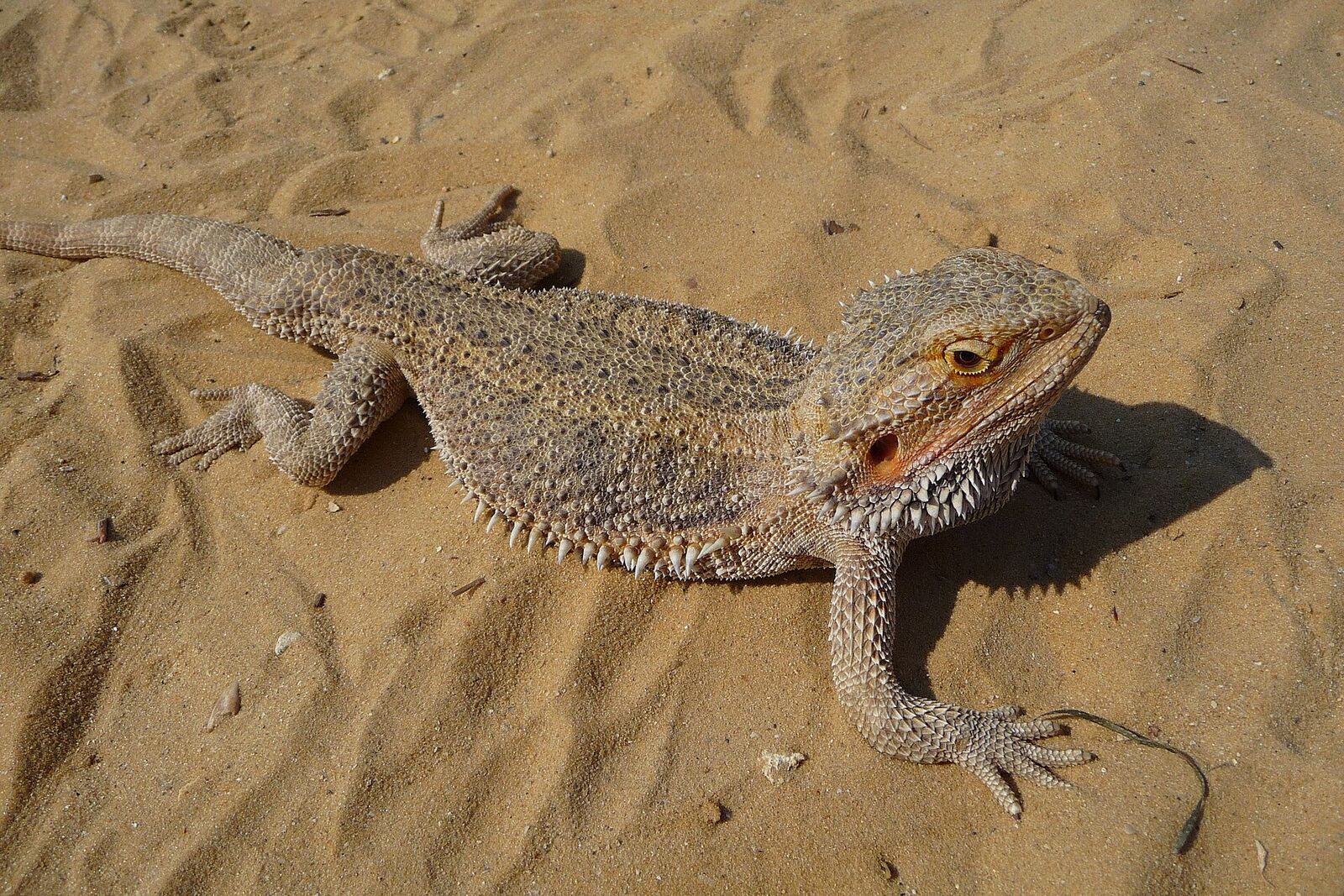
Bearded dragon
Pogona vitticeps
Sun-loving, friendly and endlessly popular.
Pet trade

(Sulawesi) Sailfin Lizard
Hydrosaurus celebensis
Pet trade

(Sulawesi) Sailfin Lizard (Hydrosaurus microlophus)
Hydrosaurus microlophus
Pet trade

Australian water dragon
Intellagama lesueurii
Pet trade

Bent's Mastigure
Uromastyx benti
Pet trade

Black-necked agama
Acanthocercus atricollis
Zoos & aquariums