
Home / Invertebrates / Stony corals / Frogspawn coral
Some federal rules applyFrogspawn coral
Fimbriaphyllia divisa
Invertebrates › Stony corals (Scleractinia) › Euphylliidae (Hammer, frogspawn, torch corals)
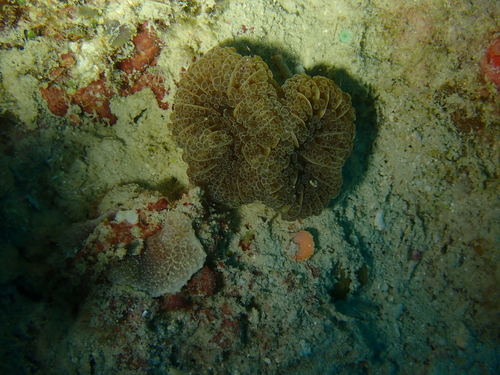
Fimbriaphyllia divisa, commonly known as frogspawn coral, is a large-polyped stony coral native to the Indo-Pacific islands.
From Wikipedia: Fimbriaphyllia divisa, CC BY-SA 4.0 (excerpt)
Care at a glance
Species-specific values
Values researched for this exact species. Air, surface and water temperatures are listed separately, and each source is kept as published rather than averaged.
| Water temperature | 75–78 °F Source: topshelfaquatics.com | |
| Diet | Accepts small meaty foods and fine coral foods; also photosynthetic. Source: topshelfaquatics.com | |
| Feeding frequency | Target feed once or twice weekly. Source: topshelfaquatics.com | |
| Social housing | Keep 6–8 inches from neighboring corals because its sweepers can sting. Source: topshelfaquatics.com |
Understanding the animal
About this animal
About this animal
It is a commonly kept species in the marine aquarium hobby. The related coral Fimbriaphyllia paradivisa is frequently misidentified as frogspawn leading to some confusion.
From Wikipedia: Fimbriaphyllia divisa, CC BY-SA 4.0 (excerpt)
In the wild
In the wild
| Overview | Fimbriaphyllia divisa, commonly known as frogspawn coral, is a large-polyped stony coral native to the Indo-Pacific islands. It is a commonly kept species in the marine aquarium hobby. The related coral Fimbriaphyllia paradivisa is frequently misidentified as frogspawn leading to some confusion. Fimbriaphyllia divisa has a corallite skeleton with a flabello-meandroid "wall" structure whereas Fimbriaphyllia paradivisa has a tree-like branching structure with separate corallites. — From Wikipedia: Fimbriaphyllia divisa, CC BY-SA 4.0 (excerpt) |
Read about this species in the wild at SeaLifeBase.
Sources for this sheet
- Species+ (UNEP-WCMC and the CITES Secretariat) Zoo, university or veterinaryThe official database of species listed under CITES. UNEP (2026). The Species+ Website. Nairobi, Kenya. Compiled by UNEP-WCMC, Cambridge, UK. Available at: www.speciesplus.net. [Accessed 04/10/2026].
- USFWS International Affairs: CITES Zoo, university or veterinaryFederal agency that issues CITES permits.
- SeaLifeBase (Palomares & Pauly, eds.), version 24.07 (CC BY-NC 4.0) Peer-reviewed researchFishBase's sister database for non-fish marine and freshwater life; values are referenced.
- GBIF Backbone Taxonomy (Global Biodiversity Information Facility) (CC BY 4.0) Peer-reviewed researchInternational scientific taxonomy used here for classification. GBIF Secretariat (2023). GBIF Backbone Taxonomy. Checklist dataset https://doi.org/10.15468/39omei, accessed via GBIF.org.
- Wikipedia (species article) (CC BY-SA 4.0) Community referenceFree encyclopedia; useful overviews with their own citations. Short excerpts are quoted under CC BY-SA 4.0, each credited with a link to its article.
- iNaturalist (captive observations) Community referenceCommunity observation platform run by the California Academy of Sciences and National Geographic; observations marked captive show animals living in homes, zoos and aquariums.