Home / Fishes / Killifish and livebearers / Scheeli Killifish
No federal permit to keepScheeli Killifish
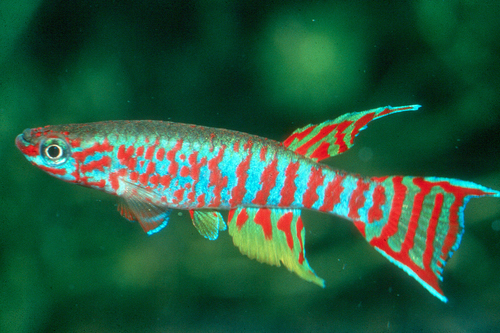
Fundulopanchax scheeli
Fishes › Killifish and livebearers (Cyprinodontiformes) › Nothobranchiidae (African killifish)
Fundulopanchax scheeli, the emerald aphyosemion, is a species of killifish, endemic to the lower Cross River basin in Nigeria.

Care at a glance
Species-specific aquarium care
- Tank: At least 24 in long and 12 in front to back for one adult (adults commonly reach about 2.4 in / 6 cm).
- Water: Freshwater.
- Temperature: 72–79°F (range recorded for this species).
- Layout: Uses both the bottom and open water: give open swimming space plus cover near the substrate.
Calculated from this species' own FishBase record: tank size from its typical adult length and swimming zone, water values from its recorded ranges. The group guide below fills in general care.
Care guide
Species care notes
- Tank: a base of at least 18 × 10 in (roughly 7 US gallons); space needed is rated “modest tank”.
- Water: a fairly wide range, from slightly acidic to slightly alkaline, 73–79 °F, pH 6–7.5, 3–15 dGH.
- Behaviour: temperament peaceful.
- Difficulty: Easy (Seriously Fish rating).
Short excerpts from the species profile:
- Setup: “A dark substrate should be used, ideally peat moss or the like and the tank should have dense areas of planting and pieces of wood to serve as cover.”
- Diet: “Small live or frozen foods such as daphnia or bloodworm are preferred, although the fish will also accept good quality flake in most cases.”
From the Seriously Fish profile for this species, which has the full habitat, maintenance, diet, behaviour and breeding write-up 167
African killifish
Applies to most species in this group. Habitat: African killifish occupy permanent small streams and swamps as well as seasonal floodplain pools that dry out, where annual Nothobranchius survive as eggs. Individual species can differ, so compare with the species numbers above and the linked sources.
Housing & setup
- For an Aphyosemion australe pair or trio, provide at least a 45 × 25 cm (18 × 10 in) footprint; a Nothobranchius rachovii pair needs at least 45 × 30 cm (18 × 12 in).
- Fit a tightly sealed cover: lyretails are accomplished jumpers.
- Provide floating vegetation to shade the water and plants or spawning mops; Epiplatys use surface vegetation for egg laying.
- Use gentle aeration or filtration; maintain clean water and separate breeding species and locality strains.
- Collect annual N. rachovii eggs in spawning medium for separate incubation; its profile specifies 5–7 months of storage before wetting.
Climate & lighting
| Water | 70–75°F |
Diet
- Live or frozen Daphnia and Artemia.
- Chopped bloodworms and appropriately sized worms.
- Small insects for surface-feeding Epiplatys; tiny live foods for small fry.
Social life
- A. australe can be kept as a pair or trio with carefully selected peaceful companions; breeding tanks should hold one species and locality strain.
Health watch
- Velvet susceptibility in A. australe fry.
- Fungal loss of incubating eggs.
- Nutritional deficiencies from an unsuitable diet.
Understanding the animal
About this animal
About this animal
It is a coastal rainforest fish which lives in small streams and ponds. It prefers a temperature of around 75 °F (24 °C), and a slightly acidic pH around 6–7.
Quoted from the Wikipedia article “Fundulopanchax scheeli” (CC BY-SA 4.0) 174
In the wild
In the wild
From this species’ own FishBase record (habitat, bottom type, water and breeding data), not its family. Good care copies these conditions.1
| Where it lives | Lives in freshwater. Uses both the bottom and open water. Occurs in brooks and small streams in the coastal rainforest and forested savanna, mainly in waters on tertiary sedimentary soil. |
| Water it lives in | Freshwater, 72–79 °F (22–26 °C). |
| Climate | Tropical climate. |
What this means for care
- Keep water within its wild range, 72–79 °F.
From the sources
From the sources
Quoted from the matching sections of reputable sources for this exact species. Specialist databases are used first; Wikipedia (community-edited, CC BY-SA 4.0) only fills gaps. Other sources are short credited quotes.
| Overview | Fundulopanchax scheeli, the emerald aphyosemion, is a species of killifish, endemic to the lower Cross River basin in Nigeria. It is a coastal rainforest fish which lives in small streams and ponds. It prefers a temperature of around 75 °F, and a slightly acidic pH around 6–7. The specific name honours the Danish count, army colonel, explorer and ichthyologist Jørgen J. Scheel (1916–1989). — Wikipedia (community-edited) |
| Where it lives | Home ranges Population dynamics Growth parameters Max. ages / sizes Length-weight rel. Length-frequencies Mass conversion Recruitment Abundance Life cycle Reproduction Maturity Maturity/Gills rel. — FishBase |
| Biology | Occurs in brooks and small streams in the coastal rainforest and forested savanna, mainly in waters on tertiary sedimentary soil. Not a seasonal killifish. Is easy to maintain in the aquarium. — FishBase |
Data and studies
The numbers
The numbers
Each bar is what one source reports. Where several sources weigh in, the dashed gold band marks their average.
Adult length
Maximum recorded length. Measured as total length. Fish in home aquariums often stay smaller than wild records.
Water temperature
Range the species tolerates in nature; aim for the middle.
pH
Water hardness
Minimum tank footprint
Seriously Fish recommends a tank base of at least 18 × 10 in (about 7 US gallons).
Sources for this sheet
- FishBase (Froese & Pauly, eds.), version 24.07 Peer-reviewed researchThe global scientific database on fishes, maintained by a consortium of research institutions; every value is referenced.
- Seriously Fish species profiles Experienced keeper or breederLong-running aquarium reference written and peer-checked by experienced fishkeepers and ichthyologists; each profile covers habitat, tank size, water, diet, behaviour and breeding.
- Seriously Fish — aphyosemion australe Experienced keeper or breederAdded in the 2026 source-checked care-guide review.
- Seriously Fish — nothobranchius rachovii Experienced keeper or breederAdded in the 2026 source-checked care-guide review.
- American Killifish Association — The AKA Beginners Guide Experienced keeper or breederAdded in the 2026 source-checked care-guide review.
- Merck Veterinary Manual — Disorders and Diseases of Fish Zoo, university or veterinaryAdded in the 2026 source-checked care-guide review.
- Wikipedia (species article) Community referenceFree encyclopedia; useful overviews with their own citations. Intro text is quoted under CC BY-SA 4.0.
More african killifish
Aphyosemion bualanum
Aphyosemion bualanum
Aquarium hobby

Aphyosemion ogoense
Aphyosemion ogoense
Aquarium hobby

Blue lyretail
Fundulopanchax gardneri
Aquarium hobby

Bluefin notho
Nothobranchius rachovii
Aquarium hobby

Clown killi
Epiplatys annulatus
Aquarium hobby

Egger's killifish
Nothobranchius eggersi
Aquarium hobby