
Home / Reptiles / Lizards / Gekkonidae / Lined gecko
No federal permit to keepLined gecko
Gekko vittatus
Reptiles › Lizards (Lacertilia) › Gekkonidae (Geckos)
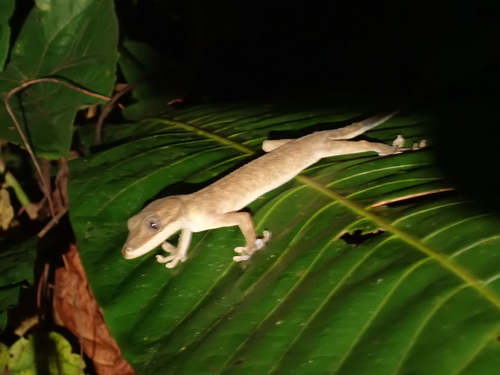
The lined gecko (Gekko vittatus), also known as the skunk gecko due to the notable stripe down its back, is a species of gecko. It can be found in Indonesia, New Guinea, Palau, and the Solomon Islands. White lined geckos usually live between 3-5…
From Wikipedia: Lined gecko, CC BY-SA 4.0 (excerpt)
Care at a glance
Species-specific values
Values researched for this exact species. Air, surface and water temperatures are listed separately, and each source is kept as published rather than averaged.
| Minimum enclosure | A single gecko can live comfortably in an 18" x 18" x 24" habitat. Source: thebiodude.com | |
| Minimum enclosure | For more than one gecko, the article recommends at least a 24" x 24" x 24" habitat. Source: thebiodude.com | |
| Basking surface temperature | 88–92 °F Source: thebiodude.com | |
| Warm side air temperature | The article gives an ambient cool-side temperature, but no warm-side air temperature. Source: thebiodude.com | |
| Cool side air temperature | 78–85 °F Source: thebiodude.com | |
| Night temperature | 70–75 °F Source: thebiodude.com | |
| Humidity | 50 % Source: thebiodude.com | |
| Uvb lighting | Mid-Ferguson zone UVB, such as Arcadia 6%, is strongly recommended. Source: thebiodude.com | |
| Uvb lighting | Use a 10–12 hour photoperiod, shifting seasonally from 10 hours in winter up to 14 hours in summer. Source: thebiodude.com | |
| Diet | Offer varied prey, such as small crickets, dubia roaches, black soldier fly larvae, and silkworms. Source: thebiodude.com | |
| Diet | Do not feed superworms; waxworms or butterworms may be offered sparingly as occasional treats. Source: thebiodude.com | |
| Feeding frequency | Juveniles should be fed daily. Source: thebiodude.com | |
| Feeding frequency | Adults should be fed every other day or 3–4 times per week. Source: thebiodude.com | |
| Social housing | The article recommends at least a 24" x 24" x 24" habitat for more than one gecko. Source: thebiodude.com | |
| Substrate | The article recommends at least a 2-inch drainage layer. Source: thebiodude.com | |
| Substrate | The article recommends 3 inches of proper bioactive substrate. Source: thebiodude.com | |
| Seasonal cooling | The article gives night lows but does not state seasonal cooling guidance. Source: thebiodude.com | |
| Minimum enclosure | One adult: approximately 18 × 18 × 24 inches is a practical minimum starting point. Source: bigappleherp.com | |
| Warm side air temperature | 82–85 °F Source: bigappleherp.com | |
| Warm side air temperature | 75–82 °F Source: bigappleherp.com | |
| Night temperature | 70–75 °F Source: bigappleherp.com | |
| Humidity | 60–80 % Source: bigappleherp.com | |
| Uvb lighting | Provide low to moderate linear UVB, with shade and exposure available. Source: bigappleherp.com | |
| Diet | Feed a varied rotation of suitable captive invertebrate prey; live invertebrates should remain central. Source: bigappleherp.com | |
| Feeding frequency | Juveniles need smaller prey and more frequent feeding; adults can follow a regular schedule adjusted to condition and appetite. Source: bigappleherp.com | |
| Social housing | Individual housing is the safest general recommendation; do not house two males together. Source: bigappleherp.com | |
| Substrate | Use tropical substrate that retains moderate moisture; soil or coconut mixes, bark, and leaf litter are options. Source: bigappleherp.com |
Understanding the animal
In the wild
In the wild
| Overview | The lined gecko (Gekko vittatus), also known as the skunk gecko due to the notable stripe down its back, is a species of gecko. It can be found in Indonesia, New Guinea, Palau, and the Solomon Islands. White lined geckos usually live between 3-5 years in the wild; however, in captivity with proper care their lifespans drastically increase, including those wild caught. In captivity, they can live twice their wild lifespan at the minimum, with some individuals living 15-20 years with proper care. — From Wikipedia: Lined gecko, CC BY-SA 4.0 (excerpt) |
| Wild diet | Lined geckos are insectivores, feeding primarily on invertebrates. In captivity, they are fed crickets, roaches, and mealworms. — From Wikipedia: Lined gecko, CC BY-SA 4.0 (excerpt) |
| Behavior | Lined geckos are a nocturnal species, active at night. They hide and sleep during the day. This is an arboreal species of gecko, with "sticky" toe pads that allow them to climb a variety of surfaces. — From Wikipedia: Lined gecko, CC BY-SA 4.0 (excerpt) |
| Reproduction | Lined geckos breed in the spring and lay clutches of two eggs every month or so, totaling an average of 6-12 eggs. Eggs incubate for 80-120 days and females will guard their eggs, and babies, from threats. Once the babies are nearly adult size, they venture away from the mom to pursue their own lives. — From Wikipedia: Lined gecko, CC BY-SA 4.0 (excerpt) |
Read about this species in the wild at The Reptile Database.
Native climate (measured)
Native climate (measured)
| Warm-season highs | about 87°F (up to 89°F in the hottest sampled areas) |
| Cool-season lows | about 71°F (down to 64°F in the coldest sampled areas) |
| Average temperature | 73–81°F across sampled records |
| Relative humidity | 83–87% on average (driest month about 82%) |
| Rainfall | about 3006 mm a year, spread fairly evenly |
Measured at 137 wild occurrence records sampled against WorldClim 2.1 climate data (1970–2000 averages). Air conditions in the range are ecological context, not enclosure settings: microhabitats such as burrows, leaf litter or basking rocks can be cooler, warmer or more humid.
Profile
Profile
Researched for this exact species. Sources are listed under In the wild above.
Data and studies
The numbers
The numbers
Each bar is what one source reports. Where several sources weigh in, the dashed gold band marks their average.
Adult snout-to-vent length
Body length without the tail.
Incubation
Sources for this sheet
- Myhrvold et al. (2015). An amniote life-history database. Ecology 96: 3109 Peer-reviewed researchPeer-reviewed compilation of life-history data for over 21,000 birds, mammals and reptiles.
- The Reptile Database Peer-reviewed researchScientist-curated catalog of every reptile species, with taxonomy and literature.
- GBIF Backbone Taxonomy (Global Biodiversity Information Facility) (CC BY 4.0) Peer-reviewed researchInternational scientific taxonomy used here for classification. GBIF Secretariat (2023). GBIF Backbone Taxonomy. Checklist dataset https://doi.org/10.15468/39omei, accessed via GBIF.org.
- Wikipedia (species article) (CC BY-SA 4.0) Community referenceFree encyclopedia; useful overviews with their own citations. Short excerpts are quoted under CC BY-SA 4.0, each credited with a link to its article.
- iNaturalist (captive observations) Community referenceCommunity observation platform run by the California Academy of Sciences and National Geographic; observations marked captive show animals living in homes, zoos and aquariums.
More geckos

Bibron's gecko
Chondrodactylus bibronii
Pet trade

Blue-tailed day gecko
Phelsuma cepediana
Zoos & aquariums

Common house gecko
Hemidactylus frenatus
Pet trade

Electric blue gecko
Lygodactylus williamsi
Pet trade

Flat-tailed day gecko
Phelsuma serraticauda
Pet trade

Giant leaf-tailed gecko
Uroplatus fimbriatus
Pet trade