Home / Amphibians / Frogs and toads / Giant (white-lipped) tree frog
No federal permit to keepGiant (white-lipped) tree frog
Nyctimystes infrafrenatus
Amphibians › Frogs and toads (Anura) › Pelodryadidae (Australian tree frogs)
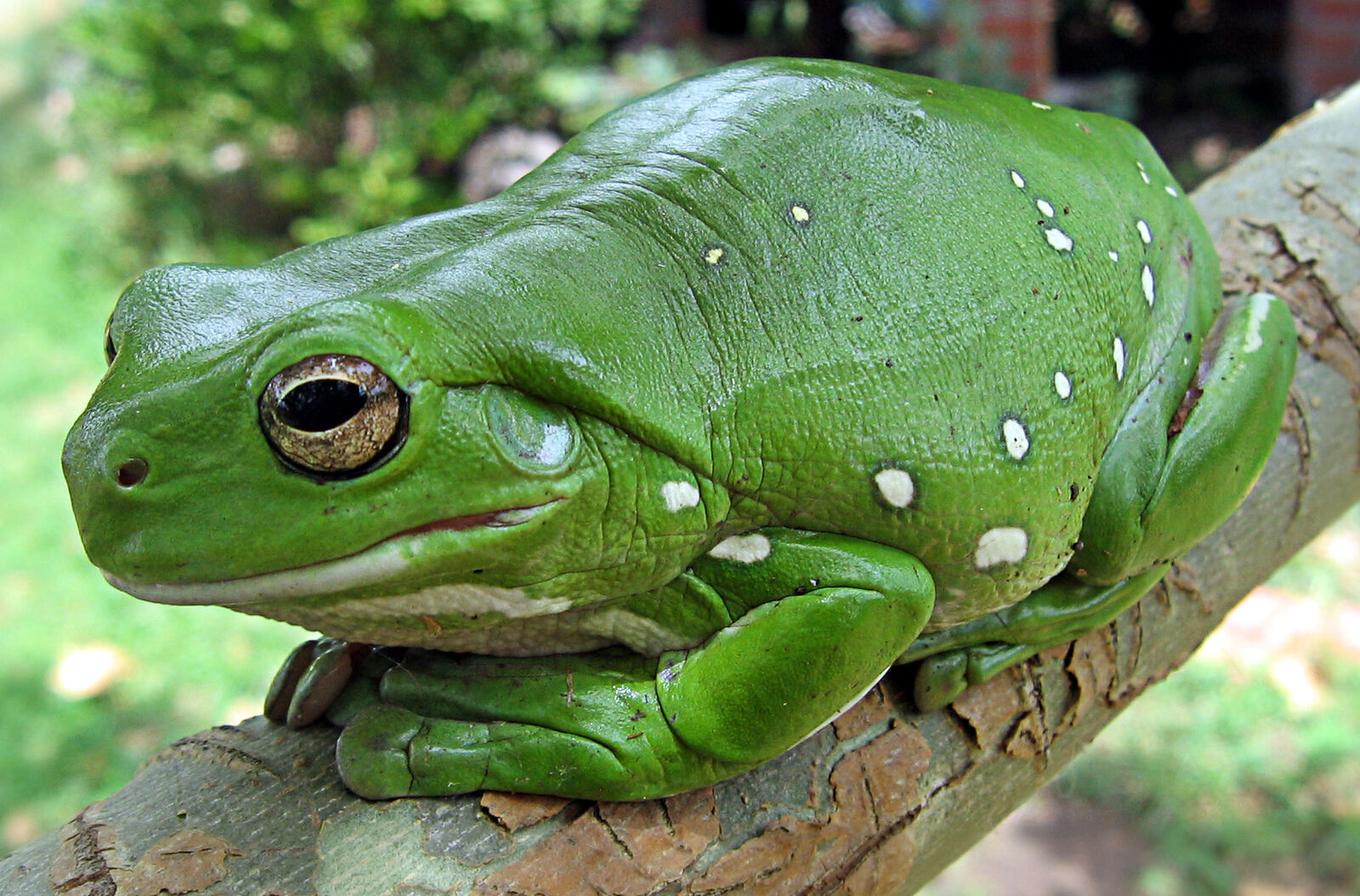
The white-lipped tree frog (Sandyrana infrafrenata) is a species of frog in the family Pelodryadidae.
From Wikipedia: White-lipped tree frog, CC BY-SA 4.0 (excerpt)

Care at a glance
Species-specific values
Values researched for this exact species. Air, surface and water temperatures are listed separately, and each source is kept as published rather than averaged.
| Minimum enclosure | At least 450 mm long and 600 mm high. Source: reptilecentre.com | |
| Warm side air temperature | 75 °F Source: reptilecentre.com | |
| Basking surface temperature | 75–80 °F Source: reptilecentre.com | |
| Uvb lighting | Use a 5–6% UV tube or an equivalent compact light. Source: reptilecentre.com | |
| Substrate | Use slightly moist substrate; coarse orchid bark is recommended, with a little moss if needed to raise humidity. Source: reptilecentre.com | |
| Diet | Mainly live foods, especially brown crickets; black crickets, locusts, mealworms, waxworms, and calciworms can also be offered. Source: reptilecentre.com | |
| Feeding frequency | Gut-load live food before feeding it to the frog. Source: reptilecentre.com |
Understanding the animal
About this animal
About this animal
It is the world's largest tree frog (the Cuban tree frog reaches a similar maximum size) and is found in Australia, Indonesia, Papua New Guinea, the Solomon Islands and Timor-Leste. Other common names include the New Guinea treefrog, giant tree frog, and Australian giant treefrog.
From Wikipedia: White-lipped tree frog, CC BY-SA 4.0 (excerpt)
In the wild
In the wild
| Overview | The white-lipped tree frog (Sandyrana infrafrenata) is a species of frog in the family Pelodryadidae. It is the world's largest tree frog (the Cuban tree frog reaches a similar maximum size) and is found in Australia, Indonesia, Papua New Guinea, the Solomon Islands and Timor-Leste. Other common names include the New Guinea treefrog, giant tree frog, and Australian giant treefrog. — From Wikipedia: White-lipped tree frog, CC BY-SA 4.0 (excerpt) |
| Where it lives | The white-lipped tree frog is found along the coastal areas of Cape York Peninsula and the wet tropics of north-eastern Queensland, Australia. It is the most widely distributed tree frog in the New Guinea region, spanning from eastern Indonesia, through the New Guinea mainland, to the Bismarck and the Admiralty Islands in the north. — From Wikipedia: White-lipped tree frog, CC BY-SA 4.0 (excerpt) |
| Appearance and size | The white-lipped tree frog reaches 11–14 cm in length. Its weight is typically 30–60 g. Females are larger than males, and have thicker skin in correlation with the difference in body size. — From Wikipedia: White-lipped tree frog, CC BY-SA 4.0 (excerpt) |
Native climate (measured)
Native climate (measured)
| Warm-season highs | about 87°F (up to 89°F in the hottest sampled areas) |
| Cool-season lows | about 61°F (down to 56°F in the coldest sampled areas) |
| Average temperature | 72–80°F across sampled records |
| Relative humidity | 77–82% on average (driest month about 72%) |
| Rainfall | about 2146 mm a year, with strong wet and dry seasons |
Measured at 268 wild occurrence records sampled against WorldClim 2.1 climate data (1970–2000 averages). Air conditions in the range are ecological context, not enclosure settings: microhabitats such as burrows, leaf litter or basking rocks can be cooler, warmer or more humid.
Sources for this sheet
- AmphibiaWeb (University of California, Berkeley) (CC BY-NC) Peer-reviewed researchUniversity-hosted database of amphibian biology and conservation.
- GBIF Backbone Taxonomy (Global Biodiversity Information Facility) (CC BY 4.0) Peer-reviewed researchInternational scientific taxonomy used here for classification. GBIF Secretariat (2023). GBIF Backbone Taxonomy. Checklist dataset https://doi.org/10.15468/39omei, accessed via GBIF.org.
- Wikipedia (species article) (CC BY-SA 4.0) Community referenceFree encyclopedia; useful overviews with their own citations. Short excerpts are quoted under CC BY-SA 4.0, each credited with a link to its article.