
Home / Fishes / Carp, barbs, minnows, loaches / Cyprinidae / Goldfish
No federal permit to keepGoldfish
Carassius auratus
Fishes › Carp, barbs, minnows, loaches (Cypriniformes) › Cyprinidae (Carps and barbs)
The goldfish (Carassius auratus) is a freshwater fish in the family Cyprinidae of the order Cypriniformes.

Care at a glance
Species-specific values
Values researched for this exact species. Air, surface and water temperatures are listed separately, and each source is kept as published rather than averaged.
| Minimum tank volume | 50 L RSPCA minimum must ALSO meet adult-body-length dimensions and grow with fish number; slim active varieties need more space. | kb.rspca.org.au |
| Minimum tank dimensions body length | length: 4 adult body lengths; width: 2 adult body lengths; height: 3 adult body lengths Dimensions must be based on eventual adult size; volume alone is insufficient. | kb.rspca.org.au |
| Water temperature | 68–75 °F (20–24 °C) RSPCA ideal aquarium range; do not confuse with the full outdoor seasonal tolerance range. | kb.rspca.org.au |
| Water pH | 6.5–7.5 | kb.rspca.org.au |
| Typical lifespan | 10–15 years | kb.rspca.org.au |
| Reported lifespan upper | 30 years Some varieties with appropriate care; not an average or guarantee. | kb.rspca.org.au |
| Social | Social; increase space and filtration with fish number. | kb.rspca.org.au |
Species-specific aquarium care
- Tank: At least 24 in long and 12 in front to back for one adult (adults commonly reach about 3.9 in / 10 cm; the largest recorded was 18.9 in).
- Water: Freshwater (tolerates brackish).
- pH: 6–8.
- Hardness: 5–19 dGH.
- Layout: Uses both the bottom and open water: give open swimming space plus cover near the substrate.
- Diet: An omnivore: feed a quality goldfish pellet or flake as the staple, with vegetables (peas, leafy greens) and occasional brine shrimp or daphnia; feed sparingly once a day. (PetMD; OATA)
Calculated from this species' own FishBase record: tank size from its typical adult length and swimming zone, water values from its recorded ranges. The group guide below fills in general care.
Understanding the animal
About this animal
About this animal
It is commonly kept as a pet in indoor aquariums, and is one of the most popular aquarium fish. Goldfish released into the wild have become an invasive pest in parts of North America and Australia.
From Wikipedia: Goldfish, CC BY-SA 4.0 (excerpt)
In the wild
In the wild
From this species’ own FishBase record (habitat, bottom type, water and breeding data), not its family. Wild conditions are context, not enclosure settings.1
| Where it lives | Lives in freshwater and brackish water, in rivers and streams, lakes, rice paddies. Uses both the bottom and open water. |
| Ground it lives on | Over mud, vegetation. |
| Climate | Subtropical climate. |
| Wild diet | Grazing on aquatic plants. |
| Behavior to plan for | Breeding: open water/substratum egg scatterers. |
Data and studies
Researched care notes
Researched care notes
Findings checked against veterinary, zoo, welfare, keeper and peer-reviewed sources. Air, basking-surface and water temperatures are kept separate, and where sources disagree both are shown. “Study” notes report what a paper measured, not a universal rule.
Fancy Goldfish (domesticated forms)
- OATA describes 15–23°C water as optimal within a broader tolerance range. Single-source published guidance.1
- OATA recommends 100 L for an adult, with 50 L additional water per further adult, filtration, and gentle flow. Treat this as a starting stocking recommendation, not a complete bioload formula.1
- Fancy and faster common-type fish can differ in food access. Assess compatibility rather than grouping solely by species name.2
- OATA targets no measurable ammonia or nitrite. Its nitrate advice is relative to source-water nitrate, not an automatically interchangeable absolute concentration. Preserve chemical form and units.1
The numbers
The numbers
Each bar is what one source reports. Where several sources weigh in, the dashed gold band marks their average.
Maximum recorded lifespan
Longest recorded lifespan reported by each database; typical lifespans are usually shorter.
Typical adult weight
Average adult body mass in each database (FishBase gives the maximum recorded weight).
Adult length
Common length to maximum recorded length. Measured as total length. Fish in home aquariums often stay smaller than wild records.
Sources for this sheet
- AnAge: The Animal Ageing and Longevity Database (Human Ageing Genomic Resources) (CC BY 3.0) Peer-reviewed researchCurated, referenced longevity and life-history records for thousands of species; maximum lifespans are often from zoo animals.
- FishBase (Froese & Pauly, eds.), version 24.07 (CC BY-NC 4.0) Peer-reviewed researchThe global scientific database on fishes, maintained by a consortium of research institutions; every value is referenced.
- Wikipedia (species article) (CC BY-SA 4.0) Community referenceFree encyclopedia; useful overviews with their own citations. Short excerpts are quoted under CC BY-SA 4.0, each credited with a link to its article.
- iNaturalist (captive observations) Community referenceCommunity observation platform run by the California Academy of Sciences and National Geographic; observations marked captive show animals living in homes, zoos and aquariums.
More carps and barbs
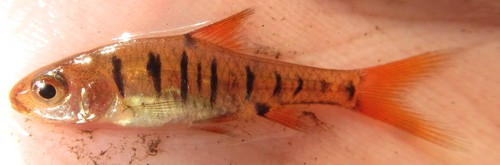
Acrossocheilus parallens
Acrossocheilus parallens
Aquarium hobby
African banded barb
Enteromius fasciolatus
Aquarium hobby
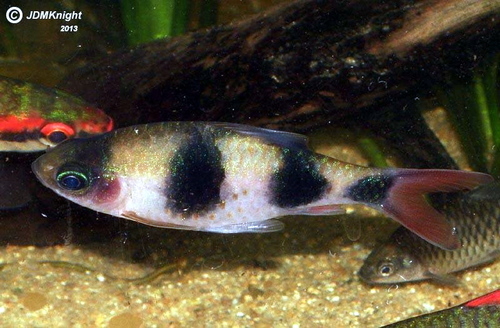
Arulius barb
Dawkinsia arulius
Aquarium hobby

Bala shark
Balantiocheilos melanopterus
Aquarium hobby

Beardless barb
Cyclocheilichthys apogon
Aquarium hobby

Bigspot barb
Barbodes dunckeri
Aquarium hobby