
Home / Fishes / Bichirs and ropefish / Gray bichir
No federal permit to keepGray bichir
Polypterus senegalus
Fishes › Bichirs and ropefish (Polypteriformes) › Polypteridae (Bichirs and ropefish)
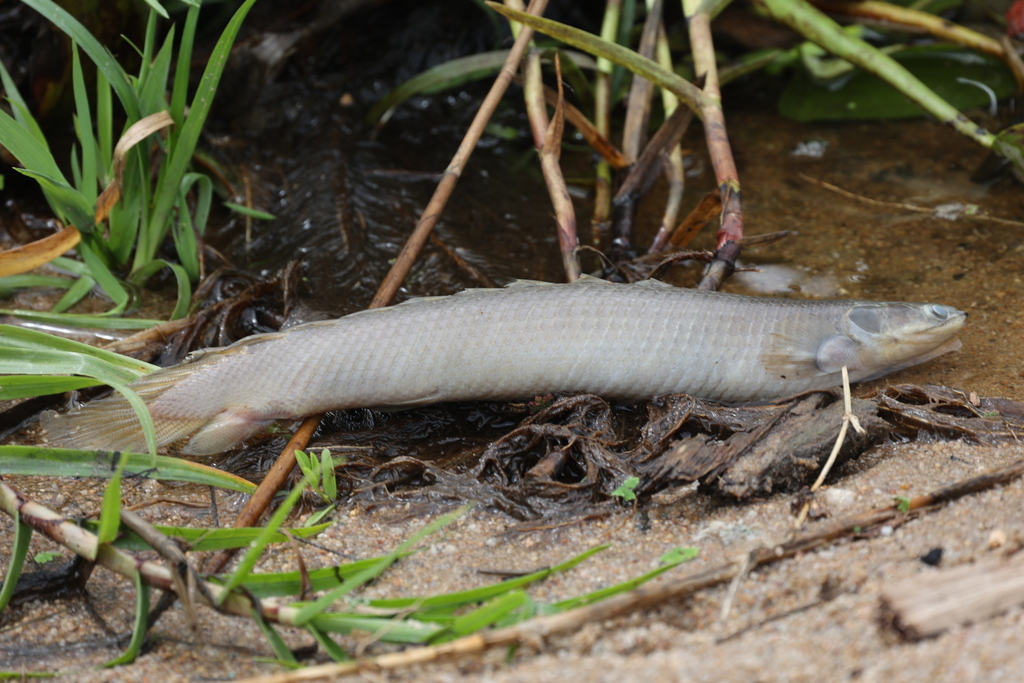
Polypterus senegalus, commonly known as the Senegal bichir, gray bichir or Cuvier's bichir, is an African species of ray-finned fish in the bichir family, Polypteridae.
Care at a glance
Species-specific values
Values researched for this exact species. Air, surface and water temperatures are listed separately, and each source is kept as published rather than averaged.
| Minimum enclosure | Minimum 90-gallon tank. Source: aquariadise.com | |
| Water temperature | 75–82 °F Source: aquariadise.com | |
| Substrate | Sand is the recommended substrate; fine sand supports natural movement and easier cleanup. Source: aquariadise.com | |
| Diet | Carnivorous diet with live or frozen meaty foods; pellets may supplement but should not be primary. Source: aquariadise.com | |
| Minimum enclosure | At least 55 gallons for one adult. Source: fishkeepingworld.com | |
| Water temperature | 77–84 °F Source: fishkeepingworld.com | |
| Diet | Carnivorous; aquarium foods include worms, shrimp, mussels, fish pieces, and sinking carnivore pellets. Source: fishkeepingworld.com | |
| Feeding frequency | Feed juveniles daily and adults a few times a week. Source: fishkeepingworld.com | |
| Social housing | House with fish too large to swallow; avoid small fish, shrimp, and snails. Source: fishkeepingworld.com | |
| Substrate | Use soft sand. Source: fishkeepingworld.com |
Species-specific aquarium care
- Tank: At least 108 in long and 54 in front to back for one adult (adults commonly reach about 27.6 in / 70 cm).
- Water: Freshwater.
- Temperature: 77–82°F (range recorded for this species).
- pH: 6–8.
- Hardness: 5–19 dGH.
- Layout: Lives on or near the bottom: floor space and hiding places matter more than height.
- Diet: Eats a varied diet: mix quality prepared foods with frozen and live foods. FishBase classes it as a carnivore.
- Availability: Rarely or never seen in the aquarium trade; expect to source it from specialists or not at all.
Calculated from this species' own FishBase record: tank size from its typical adult length and swimming zone, water values from its recorded ranges. The group guide below fills in general care.
Understanding the animal
About this animal
About this animal
It is a typical example of polypterid fishes, as most of its defining physical features are common across the genus, such as its ancient, lungfish- or arowana-like appearance, the ability to breathe atmospheric oxygen, and its armor-like scales. These factors have influenced the species' popularity in captivity, and it is commonly kept by aquarists and other hobbyists.
From Wikipedia: Polypterus senegalus, CC BY-SA 4.0 (excerpt)
In the wild
In the wild
From this species’ own FishBase record (habitat, bottom type, water and breeding data), not its family. Wild conditions are context, not enclosure settings.1
| Where it lives | Lives in freshwater, in rivers and streams. Stays near the bottom. |
| Climate | Tropical climate. |
| Behavior to plan for | Breeding: open water/substratum egg scatterers. |
Data and studies
The numbers
The numbers
Each bar is what one source reports. Where several sources weigh in, the dashed gold band marks their average.
Maximum recorded lifespan
Longest recorded lifespan reported by each database; typical lifespans are usually shorter. The AnAge record comes from an animal in human care.
Typical adult weight
Average adult body mass in each database (FishBase gives the maximum recorded weight).
Adult length
Maximum recorded length. Measured as standard length (snout to the base of the tail, not counting the tail fin). Fish in home aquariums often stay smaller than wild records.
Sources for this sheet
- AnAge: The Animal Ageing and Longevity Database (Human Ageing Genomic Resources) (CC BY 3.0) Peer-reviewed researchCurated, referenced longevity and life-history records for thousands of species; maximum lifespans are often from zoo animals.
- FishBase (Froese & Pauly, eds.), version 24.07 (CC BY-NC 4.0) Peer-reviewed researchThe global scientific database on fishes, maintained by a consortium of research institutions; every value is referenced.
- Wikipedia (species article) (CC BY-SA 4.0) Community referenceFree encyclopedia; useful overviews with their own citations. Short excerpts are quoted under CC BY-SA 4.0, each credited with a link to its article.
- iNaturalist (captive observations) Community referenceCommunity observation platform run by the California Academy of Sciences and National Geographic; observations marked captive show animals living in homes, zoos and aquariums.
More bichirs and ropefish

Barred bichir
Polypterus delhezi
Aquarium hobby

Cross River Bichir
Polypterus teugelsi
Aquarium hobby

Mottled bichir
Polypterus weeksii
Aquarium hobby

Ornate bichir
Polypterus ornatipinnis
Aquarium hobby
Poll's bichir
Polypterus polli
Aquarium hobby

Reedfish
Erpetoichthys calabaricus
Aquarium hobby