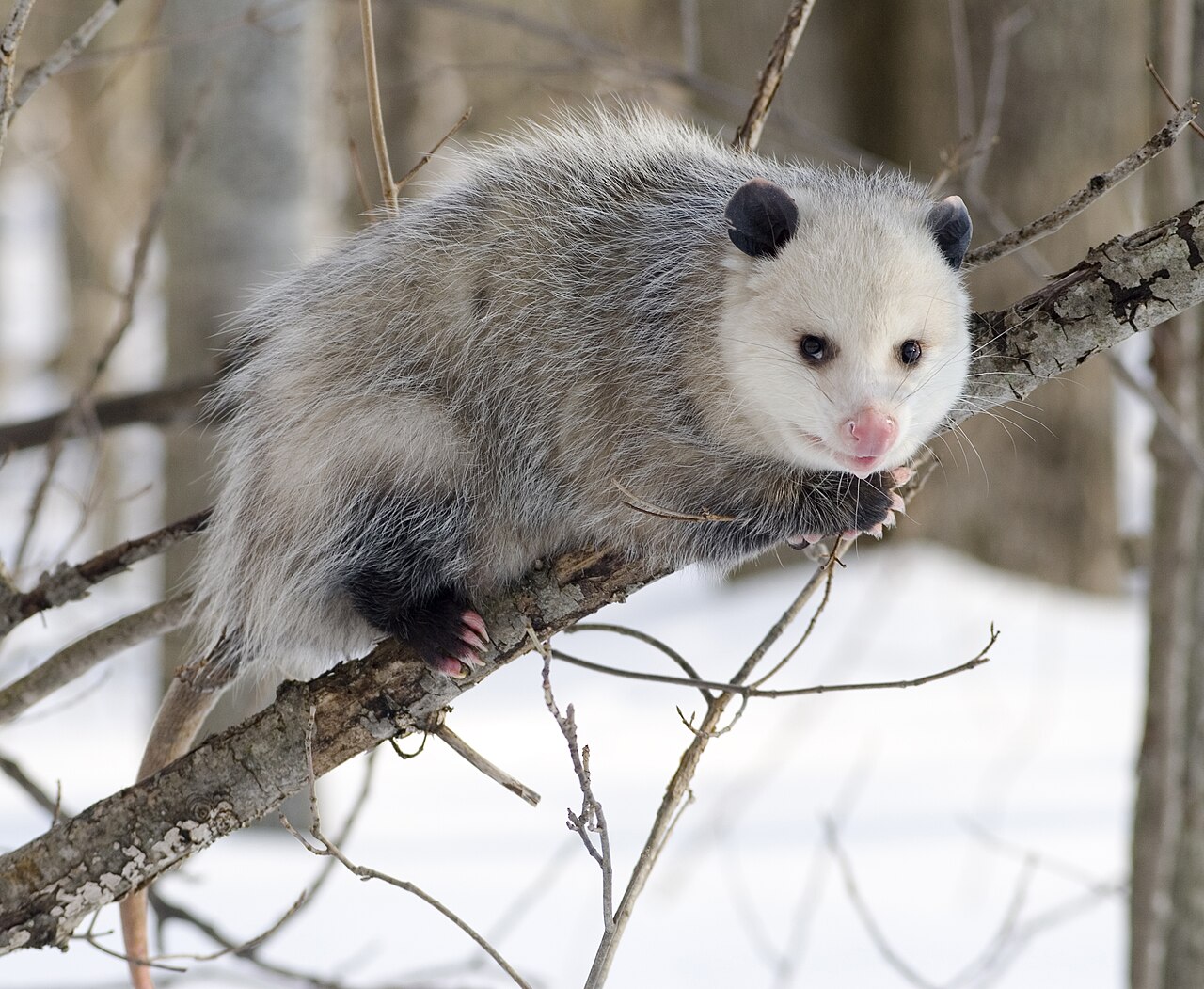
Home / Mammals / Opossums / Gray short-tailed opossum
No federal permit to keepGray short-tailed opossum
Monodelphis domestica
Mammals › Opossums (Didelphimorphia) › Didelphidae (Opossums)
The gray short-tailed opossum (Monodelphis domestica) is a small South American member of the family Didelphidae.
From Wikipedia: Gray short-tailed opossum, CC BY-SA 4.0 (excerpt)

Care at a glance
Species-specific values
Values researched for this exact species. Air, surface and water temperatures are listed separately, and each source is kept as published rather than averaged.
| Minimum enclosure | Minimum space 60 x 45 x 45 cm; larger is preferred. Source: royalveterinarycenter.com | |
| Warm side air temperature | 70–81 °F (21–27 °C) Source: royalveterinarycenter.com | |
| Basking surface temperature | 81–84 °F (27–29 °C) Source: royalveterinarycenter.com | |
| Humidity | 40–60 % Source: royalveterinarycenter.com | |
| Uvb lighting | UVB lighting is not required; a normal day/night light cycle is enough. Source: royalveterinarycenter.com | |
| Diet | Base diet on insectivore or exotic-omnivore pellet, rotated with gut-loaded live insects; include small amounts of lean meat or egg, pinkie mice, and produce. Source: royalveterinarycenter.com | |
| Social housing | House adults singly; cohousing can cause fighting, stress, and injury. Source: royalveterinarycenter.com | |
| Substrate | Use 5 to 8 cm of aspen or paper bedding for digging. Source: royalveterinarycenter.com |
Understanding the animal
About this animal
About this animal
Unlike most other marsupials, the gray short-tailed opossum does not have a true pouch. The scientific name Monodelphis is derived from Greek and means "single womb" (referring to the lack of a pouch) and the Latin word domestica which means "domestic" (chosen because of the species' habit of entering human dwellings).
From Wikipedia: Gray short-tailed opossum, CC BY-SA 4.0 (excerpt)
In the wild
In the wild
| Overview | The gray short-tailed opossum (Monodelphis domestica) is a small South American member of the family Didelphidae. Unlike most other marsupials, the gray short-tailed opossum does not have a true pouch. The scientific name Monodelphis is derived from Greek and means "single womb" (referring to the lack of a pouch) and the Latin word domestica which means "domestic" (chosen because of the species' habit of entering human dwellings). It was the first marsupial to have its genome sequenced. — From Wikipedia: Gray short-tailed opossum, CC BY-SA 4.0 (excerpt) |
Read about this species in the wild at Animal Diversity Web.
Native climate (measured)
Native climate (measured)
| Warm-season highs | about 88°F (up to 93°F in the hottest sampled areas) |
| Cool-season lows | about 66°F (down to 55°F in the coldest sampled areas) |
| Average temperature | 73–81°F across sampled records |
| Relative humidity | 69–79% on average (driest month about 65%) |
| Rainfall | about 1012 mm a year, with strong wet and dry seasons |
Measured at 72 wild occurrence records sampled against WorldClim 2.1 climate data (1970–2000 averages). Air conditions in the range are ecological context, not enclosure settings: microhabitats such as burrows, leaf litter or basking rocks can be cooler, warmer or more humid.
Data and studies
The numbers
The numbers
Each bar is what one source reports. Where several sources weigh in, the dashed gold band marks their average.
Maximum recorded lifespan
Longest recorded lifespan reported by each database; typical lifespans are usually shorter. The AnAge record comes from an animal in human care.
Typical adult weight
Average adult body mass in each database (FishBase gives the maximum recorded weight).
Litter size
Average per litter or clutch.
Gestation
Female maturity
Veterinary & husbandry research
Veterinary & husbandry research
- Reproduction, development and physiology of the gray short-tailed opossum (Monodelphis domestica) Kraus DB et al., Laboratory animal science 1987
Peer-reviewed papers that mention this species alongside captivity, zoos, veterinary care or aquaculture. Some cover several species or mention it only in passing, so check the abstract. See all 15 on PubMed → PubMed
Sources for this sheet
- AnAge: The Animal Ageing and Longevity Database (Human Ageing Genomic Resources) (CC BY 3.0) Peer-reviewed researchCurated, referenced longevity and life-history records for thousands of species; maximum lifespans are often from zoo animals.
- Myhrvold et al. (2015). An amniote life-history database. Ecology 96: 3109 Peer-reviewed researchPeer-reviewed compilation of life-history data for over 21,000 birds, mammals and reptiles.
- 9 CFR 2.1: Animal Welfare Act licensing (USDA) Zoo, university or veterinaryWho needs a USDA license to breed, sell or exhibit animals.
- GBIF Backbone Taxonomy (Global Biodiversity Information Facility) (CC BY 4.0) Peer-reviewed researchInternational scientific taxonomy used here for classification. GBIF Secretariat (2023). GBIF Backbone Taxonomy. Checklist dataset https://doi.org/10.15468/39omei, accessed via GBIF.org.
- Wikipedia (species article) (CC BY-SA 4.0) Community referenceFree encyclopedia; useful overviews with their own citations. Short excerpts are quoted under CC BY-SA 4.0, each credited with a link to its article.
- PubMed (U.S. National Library of Medicine) Peer-reviewed researchIndex of peer-reviewed veterinary, zoo and husbandry research.
- iNaturalist (captive observations) Community referenceCommunity observation platform run by the California Academy of Sciences and National Geographic; observations marked captive show animals living in homes, zoos and aquariums.