
Home / Fishes / Cichlids and convict blennies / Cichlidae / Guapote
No federal permit to keepGuapote
Parachromis dovii
Fishes › Cichlids and convict blennies (Cichliformes) › Cichlidae (Cichlids)
Parachromis dovii, the wolf cichlid, rainbow bass, or guapote, is a species of cichlid native to Central America, where it occurs in lakes, rivers and streams in Honduras, Nicaragua and Costa Rica.

Care at a glance
Species-specific values
Values researched for this exact species. Air, surface and water temperatures are listed separately, and each source is kept as published rather than averaged.
| Minimum enclosure | A realistic minimum of 125–150 US gallons for one fish. Source: aquaristatlas.com | |
| Water temperature | 75–86 °F Source: aquaristatlas.com | |
| Diet | Offer massivore or carnivore pellets plus occasional whole fish, earthworms, mussel, and prawn. Source: aquaristatlas.com | |
| Social housing | Many keepers house a large male alone; attempted tankmates should be large and robust in a roomy tank with supervision. Source: aquaristatlas.com |
Species-specific aquarium care
- Tank: At least 114 in long and 57 in front to back for one adult (adults commonly reach about 28.3 in / 72 cm).
- Water: Freshwater.
- Temperature: 70–99°F (range recorded for this species).
- Hardness: 0–20 dGH.
- Layout: Lives on or near the bottom: floor space and hiding places matter more than height.
- Availability: Rarely or never seen in the aquarium trade; expect to source it from specialists or not at all.
Calculated from this species' own FishBase record: tank size from its typical adult length and swimming zone, water values from its recorded ranges. The group guide below fills in general care.
Understanding the animal
About this animal
About this animal
It is one of the largest cichlids, reaching up to 14 kg (31 lb) in weight and 80 cm (2.6 ft) long. A highly predatory species, it mostly feeds on other fish.
From Wikipedia: Parachromis dovii, CC BY-SA 4.0 (excerpt)
In the wild
In the wild
From this species’ own FishBase record (habitat, bottom type, water and breeding data), not its family. Wild conditions are context, not enclosure settings.1
| Where it lives | Lives in freshwater. Stays near the bottom. |
| Climate | Tropical climate. |
| Behavior to plan for | Breeding: clutch tenders. |
Data and studies
The numbers
The numbers
Each bar is what one source reports. Where several sources weigh in, the dashed gold band marks their average.
Typical adult weight
Average adult body mass in each database (FishBase gives the maximum recorded weight).
Adult length
Maximum recorded length. Measured as total length. Fish in home aquariums often stay smaller than wild records.
Sources for this sheet
- FishBase (Froese & Pauly, eds.), version 24.07 (CC BY-NC 4.0) Peer-reviewed researchThe global scientific database on fishes, maintained by a consortium of research institutions; every value is referenced.
- Wikipedia (species article) (CC BY-SA 4.0) Community referenceFree encyclopedia; useful overviews with their own citations. Short excerpts are quoted under CC BY-SA 4.0, each credited with a link to its article.
- iNaturalist (captive observations) Community referenceCommunity observation platform run by the California Academy of Sciences and National Geographic; observations marked captive show animals living in homes, zoos and aquariums.
More cichlids
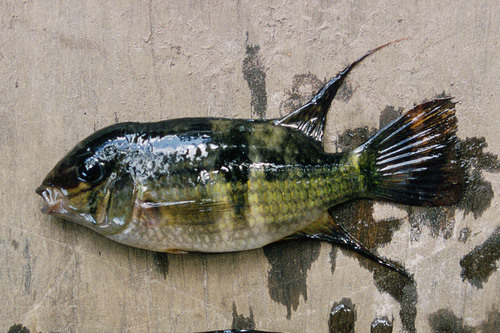
Aequidens potaroensis
Aequidens potaroensis
Aquarium hobby

Agassiz's dwarf cichlid
Apistogramma agassizii
Aquarium hobby

Altolamprologus calvus
Altolamprologus calvus
Aquarium hobby

Altum Angel
Pterophyllum altum
Aquarium hobby

Amatitlania myrnae
Amatitlania myrnae
Aquarium hobby
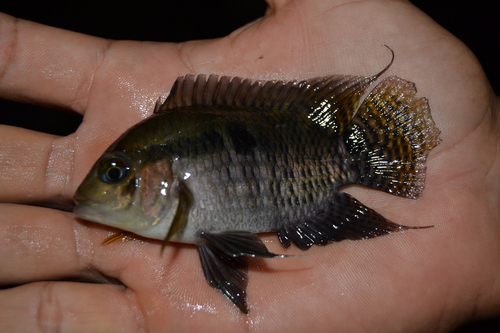
Amazon Cichlid
Cichlasoma amazonarum
Aquarium hobby