
Home / Fishes / Killifish and livebearers / Gulf killifish
No federal permit to keepGulf killifish
Fundulus grandis
Fishes › Killifish and livebearers (Cyprinodontiformes) › Fundulidae (Topminnows and killifish)
The Gulf killifish (Fundulus grandis) is one of the largest members of the genus Fundulus; it is capable of growing up to 7 inches (18 cm) in length, whereas the majority of other Fundulus reach a maximum length of 4 inches (10 cm).
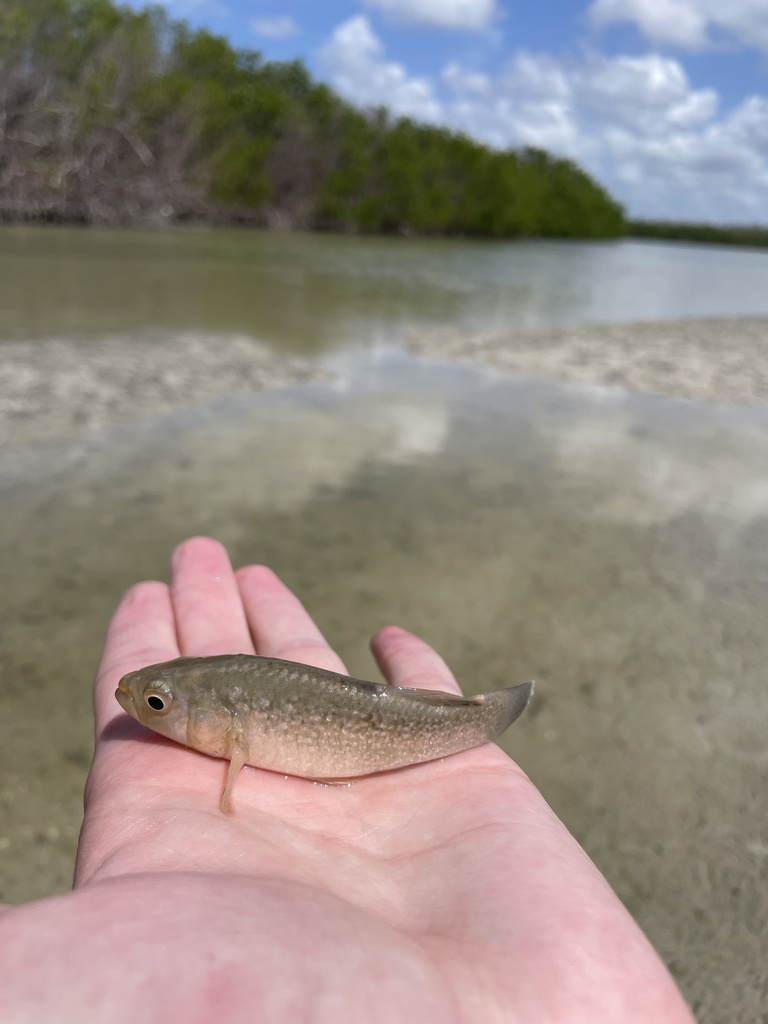
Care at a glance
Species-specific values
Values researched for this exact species. Air, surface and water temperatures are listed separately, and each source is kept as published rather than averaged.
| Minimum enclosure | Keep Gulf killifish broodstock in ponds or outdoor pools; indoor tanks may be used for hatching and larval rearing. Source: ask.ifas.ufl.edu | |
| Spawning starts at | 68 °F Source: ask.ifas.ufl.edu | |
| Egg incubation temperature | 79 °F Source: ask.ifas.ufl.edu | |
| Diet | Larvae may be fed Artemia nauplii, prepared larval diets, or a combination; grow-out ponds can use floating pellets under 1 mm with under 35% protein and under 5% fat. Source: ask.ifas.ufl.edu | |
| Substrate | Air-incubate cleaned eggs between two pieces of non-toxic foam in a plastic container. Source: ask.ifas.ufl.edu |
Species-specific aquarium care
- Tank: At least 24 in long and 12 in front to back for one adult (adults commonly reach about 4.1 in / 10.4 cm; the largest recorded was 7.1 in).
- Water: Freshwater (tolerates brackish).
- Temperature: 72–79°F (range recorded for this species).
- Layout: Uses both the bottom and open water: give open swimming space plus cover near the substrate.
- Diet: FishBase classes it as a carnivore.
Calculated from this species' own FishBase record: tank size from its typical adult length and swimming zone, water values from its recorded ranges. The group guide below fills in general care.
Understanding the animal
About this animal
About this animal
Therefore, F. grandis is among the largest minnows preyed upon by many sport fish, such as flounder, speckled trout (Cynoscion nebulosus), and red drum (Sciaenops ocellatus). Fundulus derives from the Latin meaning "bottom," and grandis means "large".
From Wikipedia: Gulf killifish, CC BY-SA 4.0 (excerpt)
In the wild
In the wild
From this species’ own FishBase record (habitat, bottom type, water and breeding data), not its family. Wild conditions are context, not enclosure settings.1
| Where it lives | Lives in freshwater and brackish water, in open ocean. Uses both the bottom and open water. |
| Climate | Tropical climate. |
| Behavior to plan for | Breeding: open water/substratum egg scatterers. |
Data and studies
The numbers
The numbers
Each bar is what one source reports. Where several sources weigh in, the dashed gold band marks their average.
Adult length
Common length to maximum recorded length. Measured as total length. Fish in home aquariums often stay smaller than wild records.
Veterinary & husbandry research
Veterinary & husbandry research
- Apoptosis, PCNA, and p53 in Fundulus grandis fish liver after in vivo exposure to N-methyl-N'-nitro-N-nitrosoguanidine and 2-aminofluorene Blas-Machado U et al., Toxicologic pathology 2000
Peer-reviewed papers that mention this species alongside captivity, zoos, veterinary care or aquaculture. Some cover several species or mention it only in passing, so check the abstract. PubMed
Sources for this sheet
- FishBase (Froese & Pauly, eds.), version 24.07 (CC BY-NC 4.0) Peer-reviewed researchThe global scientific database on fishes, maintained by a consortium of research institutions; every value is referenced.
- Wikipedia (species article) (CC BY-SA 4.0) Community referenceFree encyclopedia; useful overviews with their own citations. Short excerpts are quoted under CC BY-SA 4.0, each credited with a link to its article.
- PubMed (U.S. National Library of Medicine) Peer-reviewed researchIndex of peer-reviewed veterinary, zoo and husbandry research.
- iNaturalist (captive observations) Community referenceCommunity observation platform run by the California Academy of Sciences and National Geographic; observations marked captive show animals living in homes, zoos and aquariums.
More topminnows and killifish
Banded killifish
Fundulus diaphanus
Aquarium hobby

Bayou killifish
Fundulus pulvereus
Aquarium hobby
Blackspotted topminnow
Fundulus olivaceus
Aquarium hobby

Bluefin killifish
Lucania goodei
Aquarium hobby

California killifish
Fundulus parvipinnis
Aquarium hobby

Diamond killifish
Fundulus xenicus
Aquarium hobby