
Home / Invertebrates / Abalones / Ass's ear abalone
No federal permit to keepAss's ear abalone
Haliotis asinina
Invertebrates › Abalones (Lepetellida) › Haliotidae (Abalones)
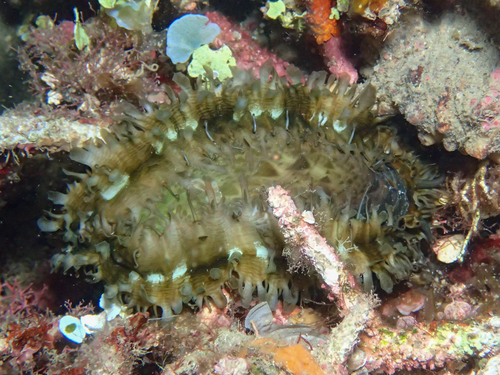
Haliotis asinina, common name the ass's-ear abalone, is a fairly large species of sea snail, a tropical gastropod mollusk in the family Haliotidae, the abalone, also known as ormers or pāua.
From Wikipedia: Haliotis asinina, CC BY-SA 4.0 (excerpt)
Care at a glance
Species-specific values
Values researched for this exact species. Air, surface and water temperatures are listed separately, and each source is kept as published rather than averaged.
| Minimum enclosure | Recommended minimum aquarium volume is approximately 110–120 litres. Source: akvaariokeidas.fi | |
| Water temperature | 72–79 °F (22–26 °C) Source: akvaariokeidas.fi | |
| Diet | Algae and supplemental marine algae foods; listed supplements include dried nori, algae sheets, spirulina tablets, algae-based foods, and herbivore pellets. Source: akvaariokeidas.fi | |
| Diet | When natural algae is limited, offer supplemental algae foods such as seaweed, algae sheets, spirulina tablets, or herbivore pellets. Source: akvaariokeidas.fi |
Understanding the animal
About this animal
About this animal
Both the common name and the scientific name are based on the shape of the shell, which is long, narrow and curved, resembling the shape of a donkey's ear.
From Wikipedia: Haliotis asinina, CC BY-SA 4.0 (excerpt)
In the wild
In the wild
| Overview | Haliotis asinina, common name the ass's-ear abalone, is a fairly large species of sea snail, a tropical gastropod mollusk in the family Haliotidae, the abalone, also known as ormers or pāua. Both the common name and the scientific name are based on the shape of the shell, which is long, narrow and curved, resembling the shape of a donkey's ear. — From Wikipedia: Haliotis asinina, CC BY-SA 4.0 (excerpt) |
| Wild diet | These large animals are nocturnal. They graze amongst turf algae and inhabit the undersides of boulders and coral bommies. — From Wikipedia: Haliotis asinina, CC BY-SA 4.0 (excerpt) |
Read about this species in the wild at SeaLifeBase.
Data and studies
The numbers
The numbers
Each bar is what one source reports. Where several sources weigh in, the dashed gold band marks their average.
Sources for this sheet
- SeaLifeBase (Palomares & Pauly, eds.), version 24.07 (CC BY-NC 4.0) Peer-reviewed researchFishBase's sister database for non-fish marine and freshwater life; values are referenced.
- GBIF Backbone Taxonomy (Global Biodiversity Information Facility) (CC BY 4.0) Peer-reviewed researchInternational scientific taxonomy used here for classification. GBIF Secretariat (2023). GBIF Backbone Taxonomy. Checklist dataset https://doi.org/10.15468/39omei, accessed via GBIF.org.
- Wikipedia (species article) (CC BY-SA 4.0) Community referenceFree encyclopedia; useful overviews with their own citations. Short excerpts are quoted under CC BY-SA 4.0, each credited with a link to its article.
- iNaturalist (captive observations) Community referenceCommunity observation platform run by the California Academy of Sciences and National Geographic; observations marked captive show animals living in homes, zoos and aquariums.
