Home / Fishes / Cichlids / Cichlidae / Gold Severum Cichlid
No federal permit to keepGold Severum Cichlid
Heros efasciatus
Fishes › Cichlids (Cichliformes) › Cichlidae (Cichlids)
Heros efasciatus is a species of tropical freshwater cichlid native to the Amazon basin in South America.

Care at a glance
Species-specific aquarium care
- Tank: At least 36 in long and 12 in front to back for one adult (adults commonly reach about 6.7 in / 17 cm).
- Water: Freshwater.
- Temperature: 75–90°F (range recorded for this species).
- Layout: Uses both the bottom and open water: give open swimming space plus cover near the substrate.
- Diet: A grazer on plants and algae: base the diet on vegetable foods (algae wafers, blanched vegetables, spirulina). FishBase classes it as a herbivore.
Calculated from this species' own FishBase record: tank size from its typical adult length and swimming zone, water values from its recorded ranges. The group guide below fills in general care.
Care guide
Species care notes
- Tank: a base of at least 47 × 18 in (roughly 64 US gallons); space needed is rated “large tank”.
- Water: soft, acidic water, 72–84 °F, pH 5.5–7, 1–8 dGH.
- Difficulty: Easy (Seriously Fish rating).
Short excerpts from the species profile:
- Setup: “A biotope setup would be very simple to arrange.”
- Tankmates: “Except when spawning, it's fairly mild-mannered for a cichlid of this size.”
- Breeding: “If you aim to breed severums, it is a good idea to buy a group of young fish and grow them on.”
From the Seriously Fish profile for this species, which has the full habitat, maintenance, diet, behaviour and breeding write-up 167
Central and South American cichlids
Applies to most species in this group. Habitat: Rivers and lakes of the Americas. Individual species can differ, so compare with the species numbers above and the linked sources.
Housing & setup
- Size ranges widely, from convicts at 5 in to Parachromis over 20 in; plan tank size for the adult fish.
- Most tolerate neutral, moderately hard water; strong filtration and rock or wood caves.
Climate & lighting
| Water | 75–82°F |
Diet
- Omnivorous cichlid pellets plus vegetables for herbivores (Vieja, Uaru) and meaty foods for predators (Parachromis).
Social life
- Territorial; breeding pairs can clear a whole tank.
Health watch
- Aggression and territorial injuries, especially when breeding; hole-in-the-head in poor water.
Understanding the animal
About this animal
About this animal
It is commonly found in the aquarium trade, often in its gold colored variation rather than the wild-type olive green one.
Quoted from the Wikipedia article “Heros efasciatus” (CC BY-SA 4.0) 174
In the wild
In the wild
From this species’ own FishBase record (habitat, bottom type, water and breeding data), not its family. Good care copies these conditions.1
| Where it lives | Lives in freshwater, in estuaries. Uses both the bottom and open water. Has been caught, sporadically, in lentic environment such as zones of flooded grounds, as well as estuaries where the tidal current is notable, along the banks with thick riverine vegetation. Omnivorous but mainly frugivorous. |
| Water it lives in | Freshwater, 75–90 °F (24–32 °C), pH 7, hardness 20 dH. |
| Climate | Tropical climate. |
| Wild diet | Grazing on aquatic plants. |
| Behavior to plan for | Breeding: clutch tenders. |
What this means for care
- Keep water within its wild range, 75–90 °F.
Native climate (measured)
Native climate (measured)
| Warm-season highs | about 89°F (up to 92°F in the hottest sampled areas) |
| Cool-season lows | about 70°F (down to 67°F in the coldest sampled areas) |
| Average temperature | 78–80°F across sampled records |
| Relative humidity | 82–85% on average (driest month about 79%) |
| Rainfall | about 2382 mm a year |
Measured at 144 wild occurrence records sampled against WorldClim 2.1 climate data (1970–2000 averages). Air conditions in the range are ecological context, not enclosure settings: microhabitats such as burrows, leaf litter or basking rocks can be cooler, warmer or more humid.
From the sources
From the sources
Quoted from the matching sections of reputable sources for this exact species. Specialist databases are used first; Wikipedia (community-edited, CC BY-SA 4.0) only fills gaps. Other sources are short credited quotes.
| Overview | Heros efasciatus is a species of tropical freshwater cichlid native to the Amazon basin in South America. It is commonly found in the aquarium trade, often in its gold colored variation rather than the wild-type olive green one. — Wikipedia (community-edited) |
| Where it lives | Home ranges Population dynamics Growth parameters Max. ages / sizes Length-weight rel. Length-frequencies Mass conversion Recruitment Abundance Life cycle Reproduction Maturity Maturity/Gills rel. — FishBase |
| Wild diet | Heros efasciatus is one of the few cichlid species that act as a regular frugivore, quite notably during the wet season when riparian zones become inundated with water. — Wikipedia (community-edited) |
| Reproduction | Up to 1000 eggs are depoited on flat stones or on roots; both parents participate in caring for eggs and larvae. — FishBase |
| Biology | Has been caught, sporadically, in lentic environment such as zones of flooded grounds, as well as estuaries where the tidal current is notable, along the banks with thick riverine vegetation. Omnivorous but mainly frugivorous. — FishBase |
Data and studies
The numbers
The numbers
Each bar is what one source reports. Where several sources weigh in, the dashed gold band marks their average.
Typical adult weight
Average adult body mass in each database (FishBase gives the maximum recorded weight).
Adult length
Maximum recorded length. Measured as standard length (snout to the base of the tail, not counting the tail fin). Fish in home aquariums often stay smaller than wild records.
Water temperature
Range the species tolerates in nature; aim for the middle.
pH
Water hardness
Minimum tank footprint
Seriously Fish recommends a tank base of at least 47 × 18 in (about 64 US gallons).
Veterinary & husbandry research
Veterinary & husbandry research
- Comparative cytogenetics of ten species of cichlid fishes (Teleostei, Cichlidae) from the Araguaia River system, Brazil, by conventional cytogenetic methods Valente GT et al., Comparative cytogenetics 2012
Peer-reviewed papers that mention this species alongside captivity, zoos, veterinary care or aquaculture. Some cover several species or mention it only in passing, so check the abstract. 170
Sources for this sheet
- FishBase (Froese & Pauly, eds.), version 24.07 Peer-reviewed researchThe global scientific database on fishes, maintained by a consortium of research institutions; every value is referenced.
- Seriously Fish species profiles Experienced keeper or breederLong-running aquarium reference written and peer-checked by experienced fishkeepers and ichthyologists; each profile covers habitat, tank size, water, diet, behaviour and breeding.
- Merck Veterinary Manual: Management of aquarium fish Zoo, university or veterinaryThe Merck Veterinary Manual: a standard veterinary reference written and reviewed by veterinary specialists.
- Merck Veterinary Manual: Types and features of aquatic systems Zoo, university or veterinaryThe Merck Veterinary Manual: a standard veterinary reference written and reviewed by veterinary specialists.
- Wikipedia (species article) Community referenceFree encyclopedia; useful overviews with their own citations. Intro text is quoted under CC BY-SA 4.0.
- PubMed (U.S. National Library of Medicine) Peer-reviewed researchIndex of peer-reviewed veterinary, zoo and husbandry research.
- iNaturalist (captive observations) Community referenceCommunity observation platform run by the California Academy of Sciences and National Geographic; observations marked captive show animals living in homes, zoos and aquariums.
More cichlids

Agassiz's dwarf cichlid
Apistogramma agassizii
Aquarium hobby

Altolamprologus calvus
Altolamprologus calvus
Aquarium hobby

Altum Angel
Pterophyllum altum
Aquarium hobby
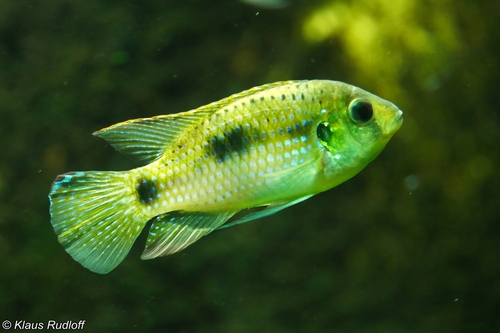
Anomalochromis thomasi
Anomalochromis thomasi
Aquarium hobby

Apistogramma eremnopyge
Apistogramma eremnopyge
Aquarium hobby
Argentine humphead
Gymnogeophagus balzanii
Aquarium hobby