Home / Fishes / Tetras, piranhas and pacus / Iguanodectes spilurus
No federal permit to keepIguanodectes spilurus
Iguanodectes spilurus
Fishes › Tetras, piranhas and pacus (Characiformes) › Iguanodectidae (Slender tetras)
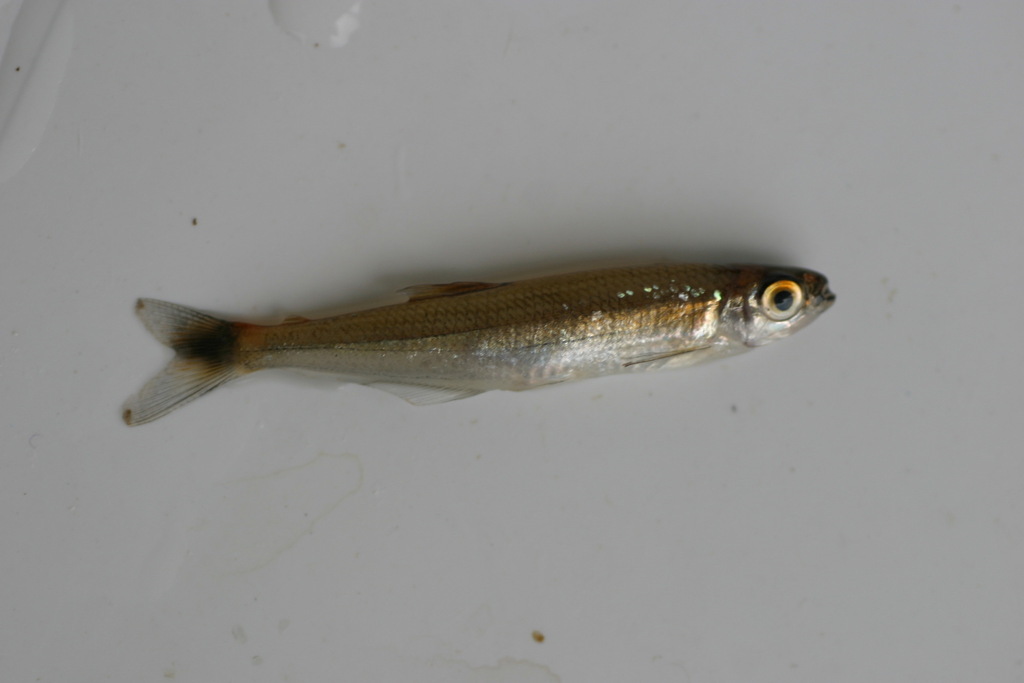
Iguanodectes spilurus, the green-line lizard tetra, sometimes referred to in retail stores as the slender tetra, is a small characiform fish from the rivers of South America.
Care at a glance
Species-specific aquarium care
- Tank: At least 24 in long and 12 in front to back for one adult (adults commonly reach about 4.0 in / 10.15 cm).
- Water: Freshwater.
- Temperature: 73–81°F (range recorded for this species).
- pH: 5–7.5.
- Hardness: 0–18 dGH.
- Layout: Uses both the bottom and open water: give open swimming space plus cover near the substrate.
Calculated from this species' own FishBase record: tank size from its typical adult length and swimming zone, water values from its recorded ranges. The group guide below fills in general care.
Care guide
Species care notes
- Tank: a base of at least 47 × 18 in (roughly 64 US gallons); space needed is rated “large tank”.
- Water: a fairly wide range, from slightly acidic to slightly alkaline, 68–82 °F, pH 5–7.5, 1–12 dGH.
- Behaviour: temperament peaceful; a shoaling fish best kept in a group of six or more; not a community fish.
- Difficulty: Moderate (Seriously Fish rating).
Short excerpts from the species profile:
- Setup: “Probably most-suited to an arrangement comprising a sandy substrate plus some driftwood roots and branches, although it should also thrive in a planted set-up.”
- Diet: “Likely to be omnivorous feeding on small invertebrates, crustacea, filamentous algae, fallen fruit and suchlike in nature.”
- Tankmates: “Generally peaceful making it an ideal resident of the well-researched community aquarium.”
From the Seriously Fish profile for this species, which has the full habitat, maintenance, diet, behaviour and breeding write-up 167
Slender tetras
Applies to most species in this group. Habitat: Iguanodectes spilurus occupies South American tributaries, clear vegetated morichals, blackwaters and floodplain lakes, while Bryconops affinis is particularly associated with swift Guiana Shield creeks. [fg302-spilurus_sf, fg302-affinis_fb]. Individual species can differ, so compare with the species numbers above and the linked sources.
Housing & setup
- For I. spilurus, provide at least a 120 × 45 cm (47 × 18 inch) aquarium footprint.
- Use sand, driftwood roots and branches, or a planted arrangement for I. spilurus.
- Introduce I. spilurus only to a biologically mature aquarium with consistently clean water.
- For B. affinis, allow extensive open swimming lanes and flowing water: a habitat-based design inference from its incessant swimming and swift-creek ecology, not a published tank minimum.
Climate & lighting
| Water | 71.6–82.4°F |
Diet
- I. spilurus: quality dry foods supplemented with varied prey.
- I. spilurus: live/frozen bloodworms or mosquito larvae.
- I. spilurus: Daphnia or Moina.
- B. affinis: plant material and small invertebrates, matching its natural diet.
Social life
- Keep I. spilurus in groups of at least 8–10, with more females than males and peaceful similar-sized companions; B. affinis spawns in schools.
Health watch
- Water-quality stress in I. spilurus, which is specifically sensitive to poor conditions.
- Freshwater white spot and parasitic skin/gill disease: general freshwater-fish risks, not a family-specific prevalence estimate.
Understanding the animal
About this animal
About this animal
It is not a well-studied species, but research is available, including data from hobbyists who keep it as an ornamental fish. It has a distinct lateral stripe of reflective-green scales, and lacks any red markings therein; red is common in congeners' lateral stripes (and is thus a differentiating feature).
Quoted from the Wikipedia article “Iguanodectes spilurus” (CC BY-SA 4.0) 174
In the wild
In the wild
From this species’ own FishBase record (habitat, bottom type, water and breeding data), not its family. Good care copies these conditions.1
| Where it lives | Lives in freshwater. Uses both the bottom and open water. |
| Water it lives in | Freshwater, 73–81 °F (23–27 °C), pH 5–7.5, hardness 18 dH. |
| Climate | Tropical climate. |
| Behavior to plan for | Breeding: open water/substratum egg scatterers. |
What this means for care
- Keep water within its wild range, 73–81 °F.
Native climate (measured)
Native climate (measured)
| Warm-season highs | about 91°F (up to 95°F in the hottest sampled areas) |
| Cool-season lows | about 70°F (down to 65°F in the coldest sampled areas) |
| Average temperature | 78–81°F across sampled records |
| Relative humidity | 78–84% on average (driest month about 76%) |
| Rainfall | about 2274 mm a year |
Measured at 300 wild occurrence records sampled against WorldClim 2.1 climate data (1970–2000 averages). Air conditions in the range are ecological context, not enclosure settings: microhabitats such as burrows, leaf litter or basking rocks can be cooler, warmer or more humid.
From the sources
From the sources
Quoted from the matching sections of reputable sources for this exact species. Specialist databases are used first; Wikipedia (community-edited, CC BY-SA 4.0) only fills gaps. Other sources are short credited quotes.
| Overview | Iguanodectes spilurus, the green-line lizard tetra, sometimes referred to in retail stores as the slender tetra, is a small characiform fish from the rivers of South America. It is not a well-studied species, but research is available, including data from hobbyists who keep it as an ornamental fish. It has a distinct lateral stripe of reflective-green scales, and lacks any red markings therein; red is common in congeners' lateral stripes (and is thus a differentiating feature). For a time, researchers had uncertainties regarding the taxonomic status of I. spilurus. — Wikipedia (community-edited) |
| Where it lives | Home ranges Population dynamics Growth parameters Max. ages / sizes Length-weight rel. Length-frequencies Mass conversion Recruitment Abundance Life cycle Reproduction Maturity Maturity/Gills rel. — FishBase |
| Wild diet | Iguanodectes spilurus is omnivorous, and is a visual animal, using sight to pursue prey (as opposed to a mechanism like sensory barbels). Along with invertebrates, it also eats algae, leaf litter, and detritus. It seems to be easygoing by nature, living in sympatry with various other fish species within its native range (including congeners I. geisleri and I. polylepis). — Wikipedia (community-edited) |
| Behavior | Aquarists report that I. spilurus is a peaceful species that adapts well to a tank environment. It prefers to be kept in schools of at least 5 congeners, and an optimal aquarium setup for I. spilurus reportedly includes ample swimming room near the surface of the water. — Wikipedia (community-edited) |
| Appearance and size | Iguanodectes spilurus is a small fish, reaching a maximum of 10.2 cm (4.0 in) in standard length (SL). Based on hobbyist reports, captive specimens, or specimens for sale in the trade, more often reach a maximum of roughly 5 cm (2 in). Its body is silvery in color, its fins are largely translucent, and it lacks a red lateral stripe (which is seen in multiple other members of the genus). — Wikipedia (community-edited) |
| Biology | Found in fast-flowing creeks. — FishBase |
| History and naming | Iguanodectes spilurus was originally described as Piabuca spilurus by German-British zoologist Albert Günther in 1864. American ichthyologist Edward Drinker Cope later described it as Iguanodectes tenuis in 1872, under the impression that he was studying a separate species entirely; this was possibly due to the varying coloration of I. spilurus. — Wikipedia (community-edited) |
| Conservation | Iguanodectes spilurus has not been evaluated by the IUCN. However, its range spans several river basins and countries therein, which provides a stable basis for its population. Its wide range also indicates an ability to adapt to changes in its environment (at least to an extent). — Wikipedia (community-edited) |
Data and studies
The numbers
The numbers
Each bar is what one source reports. Where several sources weigh in, the dashed gold band marks their average.
Adult length
Maximum recorded length. Measured as standard length (snout to the base of the tail, not counting the tail fin). Fish in home aquariums often stay smaller than wild records.
Water temperature
Range the species tolerates in nature; aim for the middle.
Water hardness
Minimum tank footprint
Seriously Fish recommends a tank base of at least 47 × 18 in (about 64 US gallons).
Sources for this sheet
- FishBase (Froese & Pauly, eds.), version 24.07 Peer-reviewed researchThe global scientific database on fishes, maintained by a consortium of research institutions; every value is referenced.
- Seriously Fish species profiles Experienced keeper or breederLong-running aquarium reference written and peer-checked by experienced fishkeepers and ichthyologists; each profile covers habitat, tank size, water, diet, behaviour and breeding.
- Seriously Fish: Iguanodectes spilurus Experienced keeper or breederAdded in the 2026 source-checked care-guide review.
- FishBase: Bryconops affinis Peer-reviewed researchAdded in the 2026 source-checked care-guide review.
- Frank Schäfer, Aquarium Glaser: Bryconops cf. caudomaculatus Experienced keeper or breederAdded in the 2026 source-checked care-guide review.
- Merck Veterinary Manual: Parasitic Diseases of Fish Zoo, university or veterinaryAdded in the 2026 source-checked care-guide review.
- Wikipedia (species article) Community referenceFree encyclopedia; useful overviews with their own citations. Intro text is quoted under CC BY-SA 4.0.