
Home / Fishes / Tangs, angelfish, butterflyfish / Japanese angelfish
No federal permit to keepJapanese angelfish
Centropyge interrupta
Fishes › Tangs, angelfish, butterflyfish (Acanthuriformes) › Pomacanthidae (Marine angelfish)
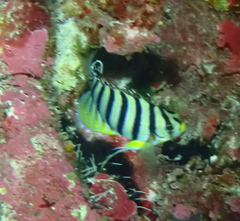
The Japanese angelfish (Centropyge interrupta) or Japanese pygmy angelfish, is a species of marine ray-finned fish, a marine angelfish belonging to the family Pomacanthidae.

Care at a glance
Species-specific values
Values researched for this exact species. Air, surface and water temperatures are listed separately, and each source is kept as published rather than averaged.
| Minimum enclosure | 90 gallons Source: fancyreef.com | |
| Water temperature | 74–78 °F Source: fancyreef.com | |
| Diet | Offer varied foods daily, including angelfish preparations, frozen foods, chopped seafood, and marine algae sheets. Source: fancyreef.com | |
| Social housing | Can be housed with active community fish in larger systems; avoid similarly shaped dwarf angelfish in small tanks. Source: fancyreef.com | |
| Minimum enclosure | Recommended minimum aquarium volume is 300 liter (79 gallons). Source: reeflings.com | |
| Water temperature | 75–81 °F (24–27 °C) Source: reeflings.com | |
| Diet | Offer marine algae, spirulina, angelfish preparations, and supplemental mysis shrimp or other protein-rich foods. Source: reeflings.com | |
| Feeding frequency | Feed several times daily in small amounts. Source: reeflings.com | |
| Social housing | Best kept in pairs. Source: reeflings.com |
Species-specific aquarium care
- Tank: At least 24 in long and 12 in front to back for one adult (adults commonly reach about 5.9 in / 15 cm).
- Water: Marine.
- Layout: Lives around reefs and rockwork: give caves, overhangs and swimming room along the rock.
- Habitat: Associated with coral reefs: needs stable marine water quality; check reef safety before mixing with corals and invertebrates.
- Diet: A grazer on plants and algae: base the diet on vegetable foods (algae wafers, blanched vegetables, spirulina). FishBase classes it as a herbivore.
Calculated from this species' own FishBase record: tank size from its typical adult length and swimming zone, water values from its recorded ranges. The group guide below fills in general care.
Understanding the animal
About this animal
About this animal
It is found in the western Pacific Ocean.
From Wikipedia: Japanese angelfish, CC BY-SA 4.0 (excerpt)
In the wild
In the wild
From this species’ own FishBase record (habitat, bottom type, water and breeding data), not its family. Wild conditions are context, not enclosure settings.1
| Where it lives | Lives in the sea, in coral reefs, open ocean. Lives around reefs. |
| Climate | Temperate climate. |
| Wild diet | Grazing on aquatic plants. |
| Behavior to plan for | Breeding: open water/substratum egg scatterers. |
Data and studies
The numbers
The numbers
Each bar is what one source reports. Where several sources weigh in, the dashed gold band marks their average.
Adult length
Maximum recorded length. Measured as total length. Fish in home aquariums often stay smaller than wild records.
Sources for this sheet
- FishBase (Froese & Pauly, eds.), version 24.07 (CC BY-NC 4.0) Peer-reviewed researchThe global scientific database on fishes, maintained by a consortium of research institutions; every value is referenced.
- Wikipedia (species article) (CC BY-SA 4.0) Community referenceFree encyclopedia; useful overviews with their own citations. Short excerpts are quoted under CC BY-SA 4.0, each credited with a link to its article.
More marine angelfish

Angelfish
Holacanthus bermudensis
Aquarium hobby

Arabian angelfish
Pomacanthus asfur
Aquarium hobby

Banded angelfish
Apolemichthys arcuatus
Aquarium hobby
Barred angelfish
Paracentropyge multifasciata
Aquarium hobby

Bicolor angelfish
Centropyge bicolor
Aquarium hobby

Black-velvet angelfish
Chaetodontoplus melanosoma
Aquarium hobby