Home / Amphibians / Salamanders and newts / Japanese giant salamander
Federal restrictions applyJapanese giant salamander
Andrias japonicus
Amphibians › Salamanders and newts (Caudata) › Cryptobranchidae (Giant salamanders)
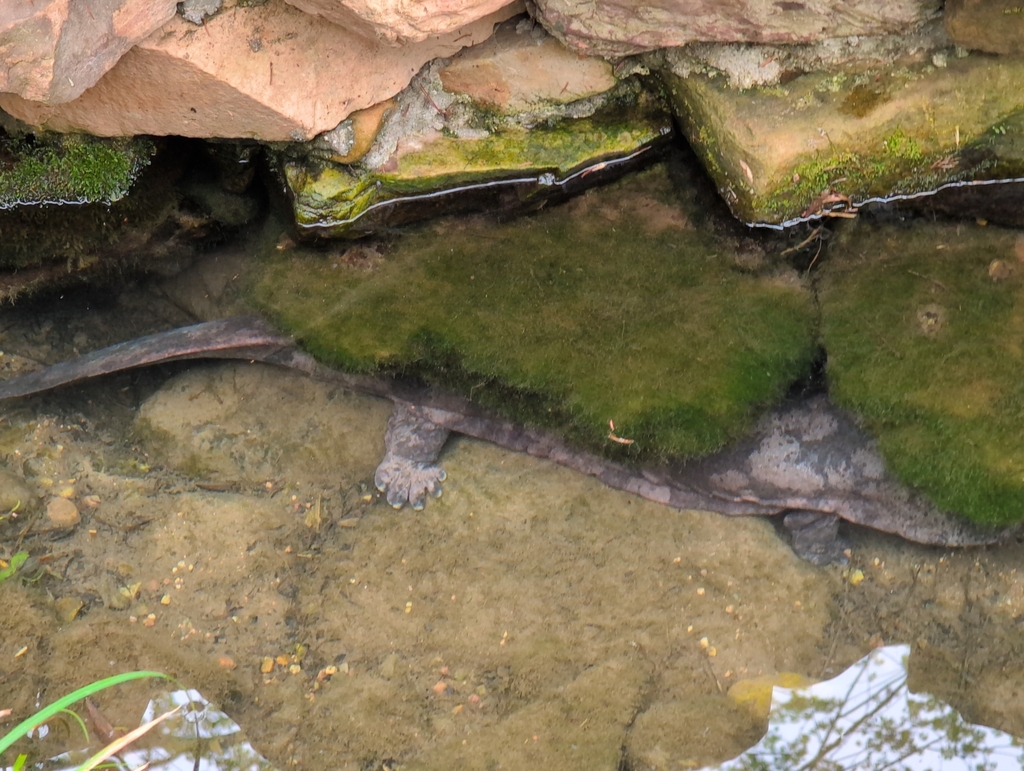
The Japanese giant salamander (Andrias japonicus) is a species of fully aquatic giant salamander endemic to Japan, occurring across the western portion of the main island of Honshu, with smaller populations present on Shikoku and in northern Kyushu.
From Wikipedia: Japanese giant salamander, CC BY-SA 4.0 (excerpt)

Care at a glance
Species-specific values
Values researched for this exact species. Air, surface and water temperatures are listed separately, and each source is kept as published rather than averaged.
| Water temperature | 45–62 °F (6.97–16.85 °C) Source: link.springer.com | |
| Water temperature | 49–56 °F (9.18–13.11 °C) Source: link.springer.com | |
| Diet | Tong-fed frozen and thawed trout or mice. Source: link.springer.com | |
| Feeding frequency | Diet was provided on average twice per week. Source: link.springer.com |
Warnings
Understanding the animal
About this animal
About this animal
With a length of up to 5 feet (1.5 m), it is the third-largest salamander in the world, being surpassed only by the very similar and closely related Chinese giant salamander and the South China giant salamander. It is known in Japanese as ōsanshōuo (オオサンショウウオ/大山椒魚), literally meaning "giant salamander".
From Wikipedia: Japanese giant salamander, CC BY-SA 4.0 (excerpt)
In the wild
In the wild
| Overview | The Japanese giant salamander (Andrias japonicus) is a species of fully aquatic giant salamander endemic to Japan, occurring across the western portion of the main island of Honshu, with smaller populations present on Shikoku and in northern Kyushu. With a length of up to 5 ft, it is the third-largest salamander in the world, being surpassed only by the very similar and closely related Chinese giant salamander and the South China giant salamander. It is known in Japanese as, literally meaning "giant salamander". Other local names include hanzaki, hanzake, and ankou. — From Wikipedia: Japanese giant salamander, CC BY-SA 4.0 (excerpt) |
| Conservation | The Japanese giant salamander is threatened by pollution, habitat loss (among other changes, by the silting up of the rivers where it lives), dams and concrete banks, and invasive species. The construction of concrete streambanks and agricultural dams throughout the distribution range has imposed a significant negative impact on giant salamanders. — From Wikipedia: Japanese giant salamander, CC BY-SA 4.0 (excerpt) |
Read about this species in the wild at Animal Diversity Web.
Data and studies
The numbers
The numbers
Each bar is what one source reports. Where several sources weigh in, the dashed gold band marks their average.
Maximum recorded lifespan
Longest recorded lifespan reported by each database; typical lifespans are usually shorter. The AnAge record comes from an animal in human care.
Incubation
Female maturity
Sources for this sheet
- AnAge: The Animal Ageing and Longevity Database (Human Ageing Genomic Resources) (CC BY 3.0) Peer-reviewed researchCurated, referenced longevity and life-history records for thousands of species; maximum lifespans are often from zoo animals.
- 50 CFR Part 16: Injurious wildlife (Lacey Act) Zoo, university or veterinaryCurrent federal regulation, read from eCFR.
- U.S. Association of Reptile Keepers v. Zinke (D.C. Cir. 2017) Zoo, university or veterinaryAppeals ruling that the Lacey Act's shipping ban does not cover moves between the continental states.
- 50 CFR 17.11: Endangered and threatened wildlife Zoo, university or veterinaryCurrent federal Endangered Species Act list.
- Species+ (UNEP-WCMC and the CITES Secretariat) Zoo, university or veterinaryThe official database of species listed under CITES. UNEP (2026). The Species+ Website. Nairobi, Kenya. Compiled by UNEP-WCMC, Cambridge, UK. Available at: www.speciesplus.net. [Accessed 04/10/2026].
- USFWS International Affairs: CITES Zoo, university or veterinaryFederal agency that issues CITES permits.
- AmphibiaWeb (University of California, Berkeley) (CC BY-NC) Peer-reviewed researchUniversity-hosted database of amphibian biology and conservation.
- GBIF Backbone Taxonomy (Global Biodiversity Information Facility) (CC BY 4.0) Peer-reviewed researchInternational scientific taxonomy used here for classification. GBIF Secretariat (2023). GBIF Backbone Taxonomy. Checklist dataset https://doi.org/10.15468/39omei, accessed via GBIF.org.
- Wikipedia (species article) (CC BY-SA 4.0) Community referenceFree encyclopedia; useful overviews with their own citations. Short excerpts are quoted under CC BY-SA 4.0, each credited with a link to its article.
- iNaturalist (captive observations) Community referenceCommunity observation platform run by the California Academy of Sciences and National Geographic; observations marked captive show animals living in homes, zoos and aquariums.