
Home / Mammals / Cats, dogs and other carnivores / Leopard cat
Some federal rules applyLeopard cat
Prionailurus bengalensis
Mammals › Cats, dogs and other carnivores (Carnivora) › Felidae (Cats)
The leopard cat (Prionailurus bengalensis) is a small wild cat with dark spots on the tawny-coloured body and limbs.
From Wikipedia: Leopard cat, CC BY-SA 4.0 (excerpt)

Care at a glance
Species-specific values
Values researched for this exact species. Air, surface and water temperatures are listed separately, and each source is kept as published rather than averaged.
| Minimum enclosure | A single Asian leopard cat needs an enclosure at least 2m long, 2m wide, and 2.5m high. Source: gov.scot | |
| Social housing | Do not keep ocelots and Asian leopard cats in large groups; provide separation if needed. Source: gov.scot | |
| Substrate | Outdoor enclosure floors are recommended to be covered with mulch such as bark or wood chippings. Source: gov.scot | |
| Diet | Provide high-quality complete cat food or varied meat, including whole prey; live vertebrate prey is prohibited. Source: gov.scot | |
| Feeding frequency | Moist cat food should not be the exclusive diet because it leads to dental problems. Source: gov.scot |
Understanding the animal
About this animal
About this animal
It has two dark stripes running from the eyes to the ears and smaller white streaks running from the eyes to the nose, and two to four rows of elongated spots along its back. Its tail is about half the size of its head-to-body length.
From Wikipedia: Leopard cat, CC BY-SA 4.0 (excerpt)
In the wild
In the wild
| Overview | The leopard cat (Prionailurus bengalensis) is a small wild cat with dark spots on the tawny-coloured body and limbs. It has two dark stripes running from the eyes to the ears and smaller white streaks running from the eyes to the nose, and two to four rows of elongated spots along its back. Its tail is about half the size of its head-to-body length. The leopard cat is native to continental South, Southeast and East Asia. — From Wikipedia: Leopard cat, CC BY-SA 4.0 (excerpt) |
| History and naming | Felis bengalensis was the scientific name proposed by Robert Kerr in 1792 for a leopard cat from Bengal. — From Wikipedia: Leopard cat, CC BY-SA 4.0 (excerpt) |
Read about this species in the wild at Animal Diversity Web.
Native climate (measured)
Native climate (measured)
| Warm-season highs | about 84°F (up to 90°F in the hottest sampled areas) |
| Cool-season lows | about 38°F (down to 18°F in the coldest sampled areas) |
| Average temperature | 46–79°F across sampled records |
| Relative humidity | 71–81% on average (driest month about 69%) |
| Rainfall | about 1506 mm a year |
| Winters | Cool to cold winters (lows around 38°F) in much of its native range. Seasonal slowdown may be relevant, but species-specific biology determines whether brumation or hibernation occurs. |
Measured at 34 wild occurrence records sampled against WorldClim 2.1 climate data (1970–2000 averages). Air conditions in the range are ecological context, not enclosure settings: microhabitats such as burrows, leaf litter or basking rocks can be cooler, warmer or more humid.
Profile
Profile
Researched for this exact species. Sources are listed under In the wild above.
History
Felis bengalensis was the scientific name proposed by Robert Kerr in 1792 for a leopard cat from Bengal.
From Wikipedia: Leopard cat, CC BY-SA 4.0 (excerpt)
Data and studies
The numbers
The numbers
Each bar is what one source reports. Where several sources weigh in, the dashed gold band marks their average.
Maximum recorded lifespan
Longest recorded lifespan reported by each database; typical lifespans are usually shorter. The AnAge record comes from an animal in human care.
Typical adult weight
Average adult body mass in each database (FishBase gives the maximum recorded weight).
Litter size
Average per litter or clutch.
Gestation
Female maturity
Veterinary & husbandry research
Veterinary & husbandry research
- Sperm cryopreservation in the Far-Eastern wildcat (Prionailurus bengalensis euptilurus) Amstislavsky S et al., Reproduction in domestic animals = Zuchthygiene 2018
- Characterization and cryopreservation of Amur leopard cats (Prionailurus bengalensis euptilurus) semen collected by urethral catheterization Jeong DH et al., Theriogenology 2018
- Neoplasia in captive Tsushima leopard cats (Prionailurus bengalensis euptilurus) Nakamura SI et al., Journal of comparative pathology 2023
Peer-reviewed papers that mention this species alongside captivity, zoos, veterinary care or aquaculture. Some cover several species or mention it only in passing, so check the abstract. See all 22 on PubMed → PubMed
Sources for this sheet
- AnAge: The Animal Ageing and Longevity Database (Human Ageing Genomic Resources) (CC BY 3.0) Peer-reviewed researchCurated, referenced longevity and life-history records for thousands of species; maximum lifespans are often from zoo animals.
- Myhrvold et al. (2015). An amniote life-history database. Ecology 96: 3109 Peer-reviewed researchPeer-reviewed compilation of life-history data for over 21,000 birds, mammals and reptiles.
- 50 CFR 17.11: Endangered and threatened wildlife Zoo, university or veterinaryCurrent federal Endangered Species Act list.
- Species+ (UNEP-WCMC and the CITES Secretariat) Zoo, university or veterinaryThe official database of species listed under CITES. UNEP (2026). The Species+ Website. Nairobi, Kenya. Compiled by UNEP-WCMC, Cambridge, UK. Available at: www.speciesplus.net. [Accessed 04/10/2026].
- USFWS International Affairs: CITES Zoo, university or veterinaryFederal agency that issues CITES permits.
- 9 CFR 2.1: Animal Welfare Act licensing (USDA) Zoo, university or veterinaryWho needs a USDA license to breed, sell or exhibit animals.
- GBIF Backbone Taxonomy (Global Biodiversity Information Facility) (CC BY 4.0) Peer-reviewed researchInternational scientific taxonomy used here for classification. GBIF Secretariat (2023). GBIF Backbone Taxonomy. Checklist dataset https://doi.org/10.15468/39omei, accessed via GBIF.org.
- Wikipedia (species article) (CC BY-SA 4.0) Community referenceFree encyclopedia; useful overviews with their own citations. Short excerpts are quoted under CC BY-SA 4.0, each credited with a link to its article.
- PubMed (U.S. National Library of Medicine) Peer-reviewed researchIndex of peer-reviewed veterinary, zoo and husbandry research.
- iNaturalist (captive observations) Community referenceCommunity observation platform run by the California Academy of Sciences and National Geographic; observations marked captive show animals living in homes, zoos and aquariums.
More cats
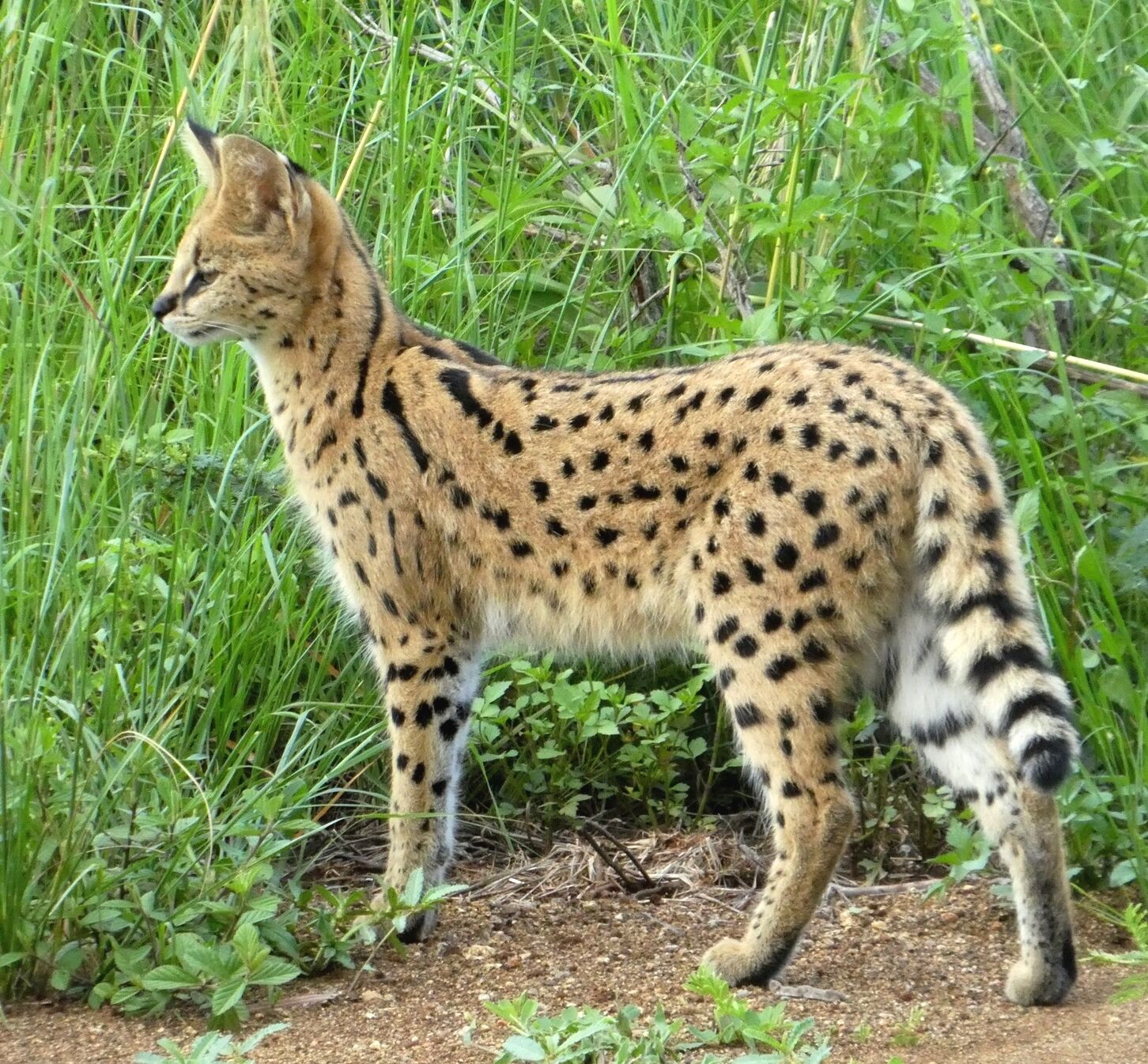
Serval
Leptailurus serval
A long-legged African cat that can leap 5 feet.
Pet trade

Asian golden cat
Catopuma temminckii
Pet trade

Black-footed cat
Felis nigripes
Pet trade

Bobcat
Lynx rufus
Zoos & aquariums

Canada lynx
Lynx canadensis
Zoos & aquariums

Caracal
Caracal caracal
Pet trade