
Home / Fishes / Tangs, angelfish, butterflyfish / Lord Howe Island butterflyfish
No federal permit to keepLord Howe Island butterflyfish
Amphichaetodon howensis
Fishes › Tangs, angelfish, butterflyfish (Acanthuriformes) › Chaetodontidae (Butterflyfish)
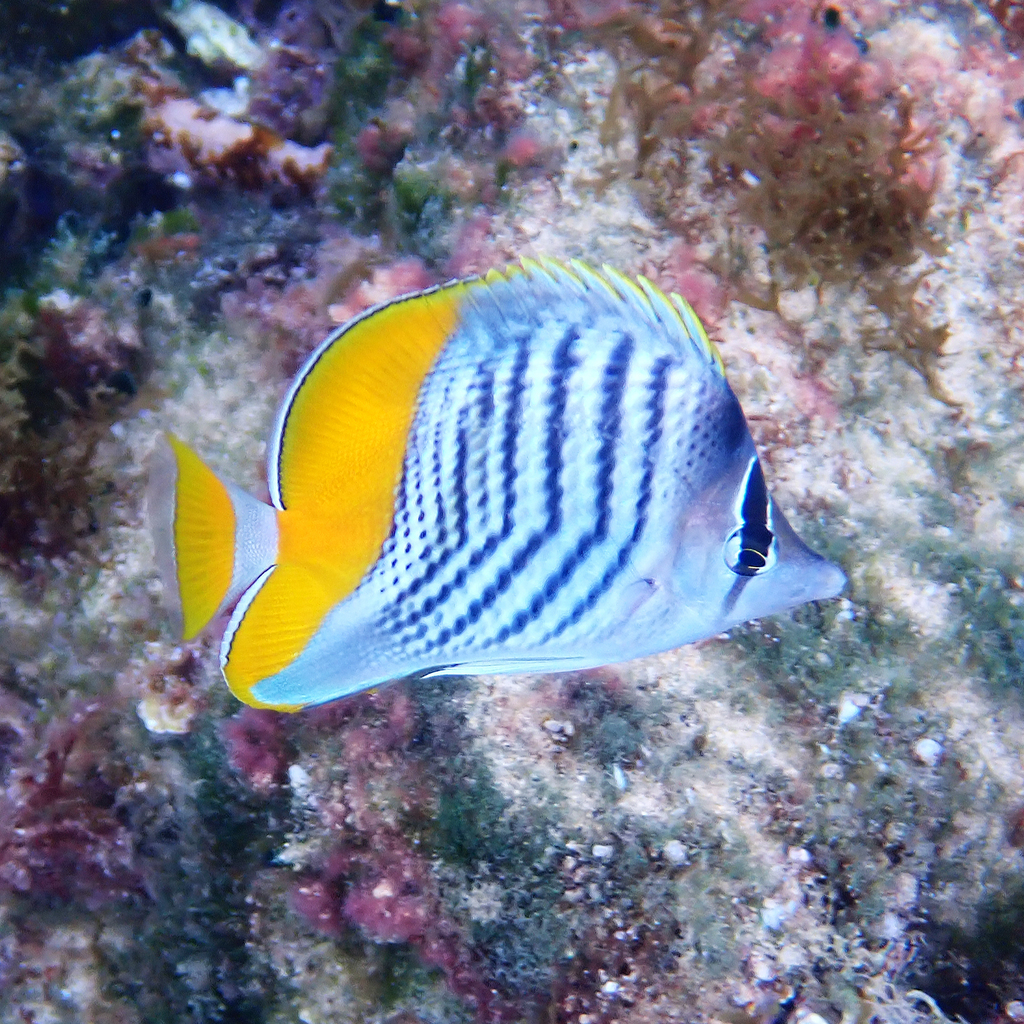
The Lord Howe Island butterflyfish (Amphichaetodon howensis) is a butterflyfish of the family Chaetodontidae, found along the east coast of Australia, around Lord Howe Island, and down the east coast of Northland in New Zealand, at depths of between…
From Wikipedia: Lord Howe Island butterflyfish, CC BY-SA 4.0 (excerpt)

Care at a glance
Species-specific values
Values researched for this exact species. Air, surface and water temperatures are listed separately, and each source is kept as published rather than averaged.
| Minimum enclosure | Recommended minimum volume is 200 liters (53 gallons). Source: reeflings.com | |
| Social housing | Best kept alone. Source: reeflings.com | |
| Diet | Provide meaty foods, algae, and high-quality marine flake or pellet food. Source: reeflings.com |
Species-specific aquarium care
- Tank: At least 30 in long and 15 in front to back for one adult (adults commonly reach about 7.1 in / 18 cm).
- Water: Marine.
- Layout: Lives around reefs and rockwork: give caves, overhangs and swimming room along the rock.
- Diet: A predator: feed meaty foods sized to its mouth (frozen fish, shrimp, worms); it will eat tankmates that fit in its mouth. FishBase classes it as a carnivore.
Calculated from this species' own FishBase record: tank size from its typical adult length and swimming zone, water values from its recorded ranges. The group guide below fills in general care.
Understanding the animal
In the wild
In the wild
From this species’ own FishBase record (habitat, bottom type, water and breeding data), not its family. Wild conditions are context, not enclosure settings.1
| Where it lives | Lives in the sea, in open ocean. Lives around reefs. |
| Water it lives in | Marine, depth 10–150 m. |
| Climate | Temperate climate. |
| Wild diet | Hunting macrofauna (predator). |
Data and studies
The numbers
The numbers
Each bar is what one source reports. Where several sources weigh in, the dashed gold band marks their average.
Adult length
Maximum recorded length. Measured as standard length (snout to the base of the tail, not counting the tail fin). Fish in home aquariums often stay smaller than wild records.
Sources for this sheet
- FishBase (Froese & Pauly, eds.), version 24.07 (CC BY-NC 4.0) Peer-reviewed researchThe global scientific database on fishes, maintained by a consortium of research institutions; every value is referenced.
- Wikipedia (species article) (CC BY-SA 4.0) Community referenceFree encyclopedia; useful overviews with their own citations. Short excerpts are quoted under CC BY-SA 4.0, each credited with a link to its article.
More butterflyfish

African butterflyfish
Chaetodon dolosus
Aquarium hobby

Asian butterflyfish
Chaetodon argentatus
Aquarium hobby
Atoll butterflyfish
Chaetodon mertensii
Aquarium hobby

Banded butterflyfish
Chaetodon striatus
Aquarium hobby

Bank butterflyfish
Prognathodes aya
Aquarium hobby

Black-spotted butterflyfish
Chaetodon nigropunctatus
Aquarium hobby